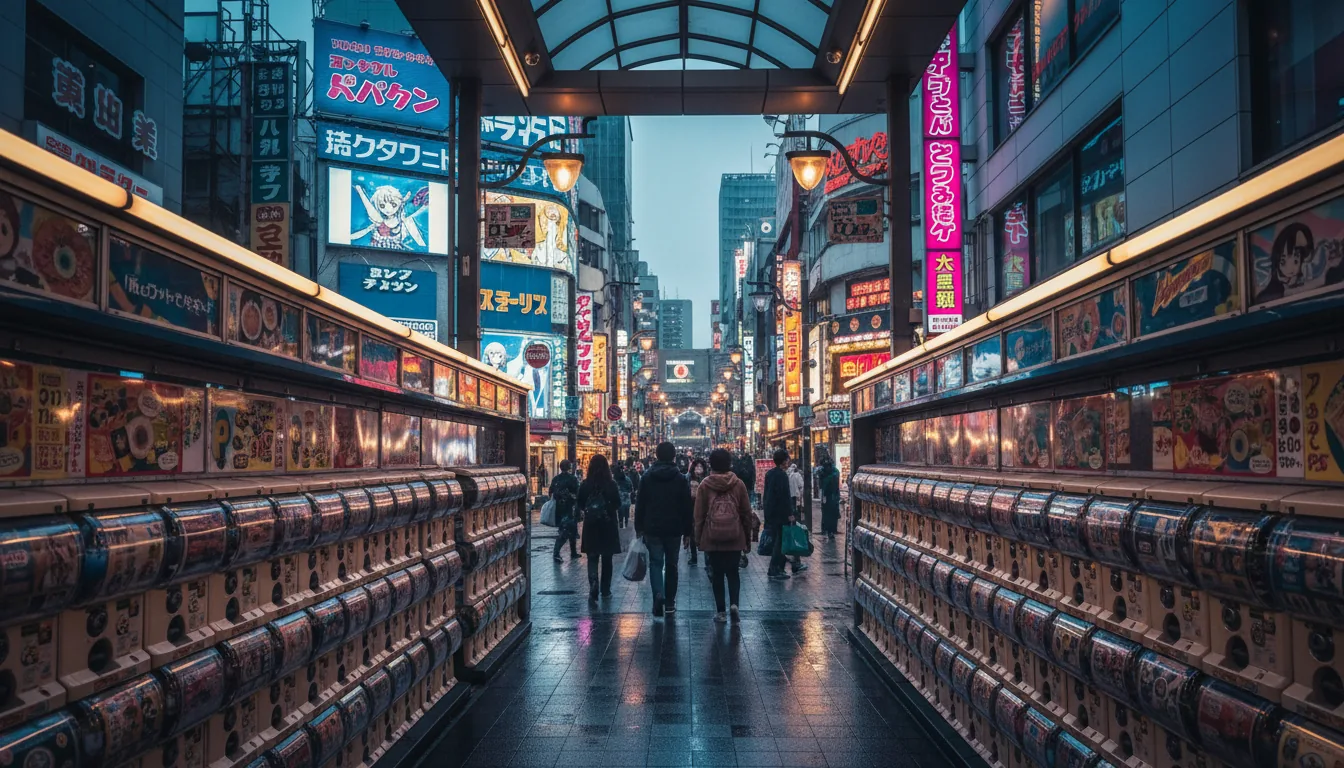
- Gashapon is a collectible figure in a capsule, sold from Japanese coin machines (¥100–600).
- The main brands are Bandai, Takara Tomy A.R.T.S. and Kitan Club. For sculpting quality, Kaiyodo.
- Outside Japan you can buy from anime shops, department stores and specialist online retailers that ship from Japan.
- Start with a themed series you actually love, not the rarest or most expensive one.
- For storage: acrylic boxes, LED-lit cabinets and per-series dividers are the collector standard.
What gashapon is: history and origins in Japan
The word gashapon (ガシャポン) is a double onomatopoeia: "gasha" mimics the metallic sound of the crank turning, and "pon" is the dull thud of the capsule dropping into the tray. It is, quite literally, the sound of an entire billion-yen industry.
The story starts in Japan in 1965, when Ryuzo Shimazaki, president of Penny Corporation, imported the first American capsule machines. US gumball machines had been dispensing low-quality toys in capsules for decades, but Japan would transform the concept completely.
The real leap came in 1977, when Bandai launched its own machine design — the iconic red and yellow unit still recognisable today — and started the first figure series under anime and tokusatsu licences. That was the birth of modern gashapon as we know it.
"Gashapon" is Bandai's registered trademark. "Gachapon" is the phonetic variant most common in everyday Japanese use. Both are used interchangeably in the West. "Gacha" on its own spread through mobile games, which borrowed the same chance mechanic. All of them point back to the same idea.
For the full history — from the 1960s to today's global expansion — see our gashapon history and origins guide, which covers each era with dates, brands and numbers.
Why Japan and nowhere else
Gashapon culture is rooted in things that are specific to Japanese society: a national obsession with miniatures and craft precision, a distribution network of konbini and train stations that makes impulse buying effortless, and an otaku culture that turns anime, manga and game licences into merchandise almost immediately. No other market brought those ingredients together at the same time, even though the model has exported successfully in recent years.
How a gashapon machine works
Understanding the mechanism matters, especially if you are planning a trip to Japan or you come across machines closer to home.
Step by step
- Identify the series: every machine displays an image of all the characters or figures in that series and the price per pull. Read it before you put money in.
- Insert the coins: in Japan the standard is ¥300–600 (older machines still run at ¥100–200). Put in the exact amount or the coins will not take.
- Turn the crank: always clockwise. Some modern units use a button instead.
- Collect the capsule: it drops into the opening at the bottom. Each capsule is random within that series' assortment.
- Open the capsule: most open by pressing the side seams or twisting the halves in opposite directions. Inside you will find the figure, possibly in pieces, with assembly instructions.
The random factor: the mechanic that makes it addictive
You do not choose which figure you get. The capsule is random within the set loaded into that machine. This creates the same psychological pull as blind boxes: variable ratio reinforcement, the same technique used in slot machines and mobile gacha apps. You do not know whether the next one is the figure you want — and that uncertainty is a large part of the appeal.
Gashapon series usually contain between 5 and 8 different figures. Completing one takes 10–20 pulls statistically, assuming figures are evenly distributed. In practice, some are rarer than others.
The main brands: Bandai, Takara Tomy and Kitan Club
Bandai Gashapon — the benchmark
Bandai is the founding and dominant name in gashapon. With 60 years in the sector, its catalogue is the broadest: Dragon Ball, One Piece, Naruto, Gundam, Kamen Rider, Super Sentai, Sailor Moon — practically every iconic anime and tokusatsu franchise has passed through Bandai's machines.
In 2019 Bandai opened its first Gashapon Official Shops outside Japan (Singapore, Hong Kong, the United States), physical stores dedicated entirely to gashapon with hundreds of machines. For a collector, they are a theme park. If you go to Japan, the gashapon floor at the Gashapon Bandai Official Shop in Akihabara is essential — we cover it in detail in our Akihabara guide for collectors.
Bandai's average quality is solid and consistent. For main series from big IP, the level of detail is excellent for the price.
Takara Tomy A.R.T.S — animals and nature with scientific precision
Takara Tomy A.R.T.S. (the Takara Tomy division for capsule toys) specialises in animal and nature series with a level of detail that rivals museum pieces. Its insect, marine mammal, dinosaur and wildlife series are considered the best of the genre by collectors and educators alike.
They also produce the most popular Pokémon gashapon series (licensed from Nintendo / The Pokémon Company), which are by far the most sought after by younger and nostalgic collectors worldwide.
Kitan Club — conceptual and virally strange
Kitan Club makes the strangest, most unexpected gashapon: cats dangling from your fingers (the "Cat Cafe" series that went viral in 2016), Japanese mythological creatures (yokai), and series built on absurd humour. Their editorial strategy leans on original concepts rather than licences — and it has worked exceptionally well in the share-on-social era.
If you want gashapon that will surprise someone who knows nothing about collecting, Kitan Club is your brand.
Kaiyodo — museum-grade sculpting
For collectors who put quality above everything, Kaiyodo is the reference. Its Capsule Q Museum line combines 3D scanning with top-tier sculptors to produce 5–8 cm figures with detail that would embarrass many 30 cm figures from other brands. The price reflects that (¥500–800 per figure), but these are pieces that hold up over time.
| Brand | Speciality | Price per figure (JP) | Difficulty to find in Europe |
|---|---|---|---|
| Bandai | Anime, tokusatsu, licences | ¥300–600 | Medium |
| Takara Tomy A.R.T.S. | Animals, nature, Pokémon | ¥300–500 | High |
| Kitan Club | Conceptual, viral, humour | ¥300–500 | High |
| Kaiyodo | Premium sculpting quality | ¥500–800 | Very high |
Where to buy gashapon outside Japan
Access to gashapon in Europe has improved a lot over the past five years, though it remains largely an import product.
Physical shops
Your best bet in person is a shop specialising in anime, manga and Japanese culture. In most European capitals you will find stores importing series directly from Japan or through European distributors. Stock varies a lot, but recent Bandai series are usually there.
Department stores such as Fnac and El Corte Inglés carry Japanese figure sections in their larger branches, though the range is more limited and skews mainstream: mostly Dragon Ball, One Piece and Pokémon from Bandai.
Actual gashapon machines are also starting to appear in shopping centres in larger cities — a trend that imports the Japanese distribution model directly. If you find one, expect €2–5 per pull.
Online shops that ship internationally
- HobbyLink Japan (HLJ): the reference online store for Japanese figures. Ships worldwide, with a broad gashapon catalogue across all brands, and pre-orders before release.
- AmiAmi: popular with advanced collectors. Its used section is where you find discontinued series at reasonable prices.
- BigBadToyStore (BBTS): US store with deep stock and shipping to Europe. Useful for series that are hard to find in Japanese shops.
- Mercari Japan: the Japanese second-hand marketplace. With a proxy service (Buyee, ZenMarket) you can buy directly from Japanese sellers. Very competitive on retired series.
- Local marketplaces: Wallapop, Vinted and their equivalents have active collector communities selling single figures or complete series. Useful for filling gaps without buying whole boxes.
If you travel to Japan, gashapon spending is a genuine budget line for any collector. Read our complete guide to gashapon in Japan and the Akihabara guide to know exactly which shops to visit, in what order, and how to stretch your budget.
How to organise and store your collection
A gashapon collection grows fast. Without a system from the start, you end up with figures in unlabelled boxes and duplicates you forgot you owned. Here is what serious collectors actually do.
Pick a categorisation system
Before you think about where to keep them, decide how to categorise. The main options:
- By brand: all the Bandai together, all the Takara Tomy together. Practical for general collections.
- By IP / franchise: all the Dragon Ball together regardless of brand, all the Pokémon together. Better if you follow specific franchises.
- By complete series: each full series in its own space. The favourite of precision collectors — and visually striking once a series is complete.
- By release year: useful for historical collections or tracking your progress over time.
Storage and display options
Gashapon has one advantage over other collectibles: the small size allows very high display density. The most used options:
- Stackable acrylic boxes: the standard for clean display. A 10×10×5 cm box holds 3–6 figures with room to read the detail. They stack, they are easy to clean, and they look professional.
- LED-lit cabinets: for higher-value collections or centrepiece displays. Lighting makes the colours pop. The Ikea DETOLF is the go-to on a tight budget; dedicated cabinets from brands like Display King offer better light control.
- Floating shelves with dividers: for large collections. Clear acrylic dividers stop figures toppling into each other.
- Storage boxes with dividers (no display): for stock or series you are still completing. Wooden boxes with adjustable dividers are the most practical.
For more on presentation and lighting, see our definitive display guide for gashapon collectors.
The digital inventory: do not skip it
Keeping a digital inventory is a habit most collectors pick up too late. A simple spreadsheet (Google Sheets, Notion) with columns for series, figure, acquisition date, condition and price paid saves you from surprises: it stops you buying duplicates, lets you value your collection, and becomes essential if you ever want to sell or insure the better pieces.
High-value gashapon and limited editions
The gashapon value market does not hit the speculative peaks of POP MART blind boxes, but some pieces appreciate significantly. Knowing what to look for is the difference between a collection with value and a collection of souvenirs.
What makes a gashapon valuable
- Retired series: once Bandai or Takara Tomy retire a series, the only source is the secondary market. The popular ones appreciate 30–150% in the first two years after retirement.
- Rare figures within a series: some series include special variants with lower distribution. These are the most hunted and the first to sell out second hand.
- Special collaborations: series tied to events (World Cup, Olympics, film releases) are more limited and harder to find outside Japan.
- Retailer-exclusive editions: some series are only sold in specific Japanese shops (Lawson, 7-Eleven, anime events). These are rarities even within Japan.
Series with the most upside
Kaiyodo Capsule Q Museum — the dinosaur and marine life series are museum pieces at machine prices. Discontinued series reach €20–80 per figure in good condition.
Takara Tomy Animatales / Yell — hyper-realistic animal series that went viral on social media. The rabbit, cat and dog series reach €15–40 per discontinued piece.
Retired Bandai licence series — when an IP loses its Bandai licence (distributor change, end of franchise), the series produced become permanently unrepeatable. Dragon Ball GT, some 1990s Sailor Moon formats and certain historic Kamen Rider series are the clearest examples.
Viral Kitan Club series — the ones that went viral (Cat Cafe, Shakashaka Animal) had short production runs and are now hard to find complete. If you locate an original full box, expect 3–5x the original price second hand.
Community and events
Gashapon is not a solitary hobby. There is a growing community with active channels and events where you can meet other collectors.
Online communities
- Reddit r/gashapon: the most active international community. Ideal for identifying series, asking for recommendations and sharing pulls.
- Japanese collecting Discord servers: search for "Japanese toys", "collectible figures" or otaku culture servers — most have channels dedicated to gashapon and capsule toys.
- Instagram and TikTok: #gashapon, #capsuletoy and #gachapon have active communities. Useful for discovering new series, stock alerts and display inspiration.
- Facebook groups: Japanese figure collector groups have very active trading and selling communities.
Events
The biggest meeting points for gashapon collectors are Japanese and pop culture conventions:
- Japan Weekend (Madrid and Barcelona): the largest Japanese culture event in Spain. Always has a figure trading area, gashapon machines and importers with event-exclusive stock.
- Salón del Manga, Barcelona: decades of history and a large specialist retail area. One of the best places to find rare pieces from European distribution.
- Regional conventions: new Japanese culture events appear every year in mid-sized cities. Many run collector swap meets, ideal for completing series.
A trip to Japan: the full experience
For serious collectors, a gashapon-focused trip to Japan is a different level entirely. Akihabara in Tokyo has the highest density of gashapon on earth — hundreds of machines in the Gashapon Bandai Official Shop, plus second-hand figure specialists. Read our complete Akihabara guide and the Japan guide for collectors to plan the trip.
Frequently asked questions
What is gashapon?
Gashapon is a collectible figure sold inside a plastic capsule from coin-operated vending machines, originally from Japan. The name comes from "gasha" (the sound of the crank) and "pon" (the capsule dropping). Figures are usually 3–8 cm and come in themed series of 5–8 pieces.
Where can I buy gashapon outside Japan?
Anime and manga shops carry them in most European cities, and department stores such as El Corte Inglés and Fnac have Japanese figure sections. Online, HobbyLink Japan, AmiAmi and BigBadToyStore all ship internationally. Physical gashapon machines are also appearing in shopping centres in larger cities.
How much does a gashapon cost?
In Japan the standard price is ¥300–600 (roughly €2–4). Buying through importers in Europe, expect €4–8 per figure. Premium series from brands like Kaiyodo or Revoltech can reach €8–15 per piece.
Which are the best gashapon brands?
The main brands are Bandai (the largest, with Dragon Ball, One Piece and Gundam licences), Takara Tomy A.R.T.S (realistic animal series and Pokémon collaborations) and Kitan Club (more artistic, conceptual figures). For advanced collectors, Kaiyodo stands out for exceptional sculpting quality.
How do you use a gashapon machine?
Insert the amount shown (usually ¥100–600 in Japan, or the euro equivalent in European machines), turn the crank clockwise, and the capsule drops into the tray at the bottom. Open the capsule at the side seams and you will find the figure, often in parts with assembly instructions.
Are Bandai gashapon genuine, or are there fakes?
Bandai and the other major Japanese brands produce genuine gashapon to high quality standards. Counterfeits exist mainly on platforms like AliExpress at very low prices. Genuine gashapon carry clear copyright marks, precise paint work and capsule packaging with the manufacturer logo.
How much does it cost to start collecting gashapon?
The entry point is one of the lowest in figure collecting. With €15–20 you can buy 3–5 pulls from a basic series online. A complete six-figure series works out at €30–50 allowing for duplicates. The challenge is availability outside Japan, not price.
How many figures are in a typical gashapon series?
Most gashapon series have between 5 and 8 different figures. Bandai series for major franchises sometimes reach 10–12 pieces. Some include a secret variant or clear version with a lower appearance rate.
How do you clean gashapon figures?
For routine dust, use a soft paint brush or low-pressure compressed air. For surface dirt, a microfibre cloth lightly dampened with water. Avoid alcohol and solvents on painted figures, as they can damage the finish. Unpainted figures in resin or solid vinyl tolerate more direct cleaning.
Is it better to buy complete series or do individual pulls?
It depends on your goal. If you want the machine experience, individual pulls are the point. If you want to complete a collection without duplicates, buying a full series on the secondary market (Mercari JP, AmiAmi used) is usually more cost-effective, if less exciting.