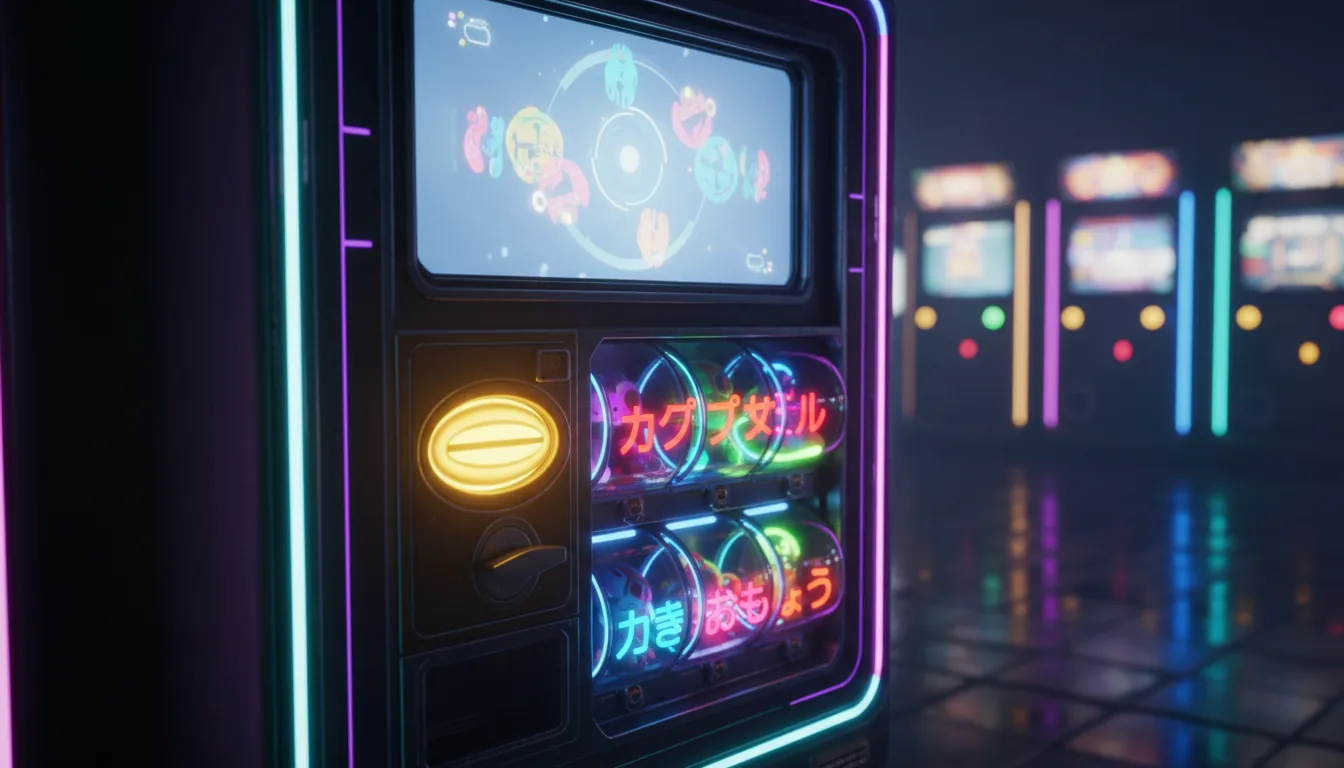
Picture yourself standing in a corridor of a Japanese train station. On one side, rows of gashapon machines glow under fluorescent light — hundreds of them, packed tightly together, each one a small transparent globe filled with brightly colored capsules. You insert a coin, turn the handle, and hear the satisfying "gasha-gasha" clank as the mechanism turns. Then — "pon!" — a capsule drops into the tray. Inside could be anything: a tiny Dragon Ball figure, a miniature recreation of a ramen bowl, a perfectly articulated crab, or a thumb-sized replica of a Renaissance painting. This is the gashapon experience. And once you've had it, you're hooked for life.
This guide covers everything you need to know about gashapon capsule toys — from the history of the format to how the machines work mechanically, from understanding rarity systems to finding where to buy the best series as a collector outside Japan. Whether you've never seen a gashapon machine in your life or you've already got a small collection and want to take it seriously, you're in the right place.
What Does "Gashapon" Actually Mean?
The word gashapon (ガシャポン) is a Japanese portmanteau — specifically, an onomatopoeia — built from two sounds. "Gasha" (ガシャ) represents the mechanical noise the machine makes when you turn the crank: a metallic, clanking rotation. "Pon" (ポン) is the lighter, satisfying sound of the capsule falling into the collection tray at the bottom. Put them together and you have a word that literally sounds like what it describes.
Technically, "Gashapon" is a registered trademark of Bandai, one of Japan's largest toy manufacturers and the company that pioneered the format in the early 1960s. Competing manufacturers use the more generic term gachapon (ガチャポン) or simply gacha (ガチャ). In everyday conversation, especially outside Japan, the terms are used interchangeably. Collectors tend to use "gashapon" as a catch-all, just as people say "Kleenex" for any facial tissue.
In Western markets, you'll also encounter the terms capsule toys, capsule vending, or simply gachas. All of these point to the same core product: a toy in a plastic capsule, distributed randomly through a coin-operated vending machine.
Gashapon — Bandai's registered trademark; the gold standard.
Gachapon / Gacha — Generic term; used by all other manufacturers.
Capsule toy — The product itself; the figure inside the capsule.
Gacha mechanics — The randomized pull system, also used in mobile games.
The History of Gashapon: From 1960s America to a Global Phenomenon
The gashapon format did not originate in Japan. Its ancestor was the American gumball machine, which began dispensing small toys and trinkets in the 1950s. The concept was imported to Japan in the 1960s by Ryuzo Shirakawa, who founded a company called Popy (later absorbed by Bandai). He saw American capsule vending machines and recognized their potential in a country with a deep culture of miniature craftsmanship — the same culture that produced netsuke, intricate ivory carvings, and okimono decorative figurines.
Bandai officially launched the Gashapon brand in 1977, installing machines in Japanese department stores and train stations. The early machines were simple and the figures were crude by today's standards — rubber animals, mini cars, simple character figures. But the format caught on immediately, driven by two forces: the element of surprise (you never know exactly what you'll get) and the price point (a few hundred yen, accessible to children and adults alike).
The 1980s marked the first golden age of gashapon in Japan. The rise of manga and anime — Dragon Ball, Saint Seiya, Mobile Suit Gundam — created a hunger for licensed character merchandise that gashapon could fulfill at scale. Bandai signed licensing deals with Toei Animation and other studios, and the machines became a fixture of Japanese commercial spaces. By 1985, there were tens of thousands of gashapon machines across Japan.
The 1990s brought two major evolutions. First, the quality revolution: manufacturers invested in better sculpts, more detailed paint applications, and more articulation. Gashapon figures were no longer cheap toys — they were increasingly becoming collectible miniatures. Second, the adult collector market emerged. Series like Kaiyodo's "Revoltech Mini" and Bandai's HG (High Grade) Gashapon lines targeted adult collectors willing to pay more for premium quality.
Today, the gashapon industry in Japan generates over ¥40 billion (approximately $270 million USD) annually. Bandai alone operates more than 70,000 machines across Japan. The number of active series at any given time runs into the hundreds. Major gashapon hubs — the Bandai Namco Asobi Store in Akihabara, the Gashapon Department Store in Ikebukuro — attract international tourists specifically for the capsule toy experience. And the format has gone global, with machines appearing in shopping malls in the United States, Europe, Southeast Asia, and Latin America.
How a Gashapon Machine Works: The Mechanics Explained
A gashapon machine is a marvel of elegant mechanical engineering. Despite looking simple from the outside, the internal mechanism is precisely calibrated to ensure randomized distribution, prevent jamming, and handle coins from multiple denominations. Here's what happens when you insert your coin and turn the handle:
1. The Coin Mechanism
You insert a coin (or coins — most modern machines accept ¥100 coins, sometimes requiring two or three for higher-priced series). The coin slides down a track and is validated by a simple weight or magnetic sensor. If the coin passes validation, it triggers the release mechanism. Fake coins or foreign coins that don't match the expected weight fall through to the return slot.
2. The Crank and Rotor
Once a valid coin is registered, the crank becomes movable. Turning it clockwise rotates an internal rotor — a disc with a single capsule-sized pocket cut into it. As the rotor turns, one capsule falls from the central reservoir into the pocket, is carried forward by the rotation, and then drops through a chute to the delivery tray. The mechanism is self-limiting: one full turn of the crank dispenses exactly one capsule.
3. The Capsule Reservoir
Inside the clear globe of the machine, capsules are stored in a loose pile. Gravity feeds them downward into the rotor. This is where true randomization happens — there's no sorting system. Capsules mix together through vibration and gravity, so which capsule lands in the rotor pocket at any given moment is genuinely random. Manufacturers achieve their stated distribution rates (e.g., "1 in 12 chance of getting the secret rare") by controlling how many of each type they load into each machine's initial stock.
4. The Capsule Itself
Standard gashapon capsules are spherical, made of two interlocking halves of polypropylene plastic. They come in several sizes: 45mm (most common for small figures), 65mm (standard for medium figures), and 75mm or larger for premium series. The capsule halves snap together securely enough to survive the drop into the tray but open easily by hand. Inside, you'll find the figure components (sometimes pre-assembled, sometimes requiring assembly), a small instruction sheet, and occasionally a collector checklist showing all figures in the series.
5. Is It Truly Random?
Yes — and no. The distribution is random within a loaded machine, but the machine is loaded with a specific ratio of figures. If a series has 8 figures and claims a 1:12 rarity for the secret rare, the machine was initially loaded with roughly 1 secret-rare capsule for every 12 capsules total. As the machine depletes, the odds shift. Near the end of a machine's stock, if the secret rare hasn't come out yet, your odds of getting it improve dramatically. Experienced collectors sometimes try to time their pulls late in a machine's cycle for this reason.
Understanding Gashapon Rarity Systems
Not all gashapon figures are created equal. Every series has a rarity structure, and understanding it is fundamental to collecting strategically. Here's how the tiers typically break down:
Common (C)
The most frequently occurring figures in a series. In a typical set of 6 figures, commons might have a pull rate of 20–25% each. These are the figures you'll get multiple copies of if you pull a full set. Don't dismiss them — commons are often excellent pieces that round out a scene or diorama. And trading duplicates with other collectors is a core part of gashapon culture.
Uncommon (U) / Standard Rare (R)
Slightly harder to pull than commons, typically at 10–15% rates. In smaller series, this tier may not exist separately — the figures might just be "standard" and "rare."
Rare (SR or Secret)
Every series has at least one figure that isn't listed on the machine's exterior panel. This secret rare — sometimes called a "secret" or "spec" figure — typically has a pull rate of 5–8%. It's often a variant coloring (translucent, metallic, or alternate colorway) of an existing figure in the set, though sometimes it's an entirely unique sculpt. The existence of a secret rare drives collector behavior significantly: knowing there's a hidden 7th figure in a 6-figure series creates urgency to keep pulling.
Double Secret / Ultra Rare
Some premium series introduce a second layer of rarity — a "double secret" figure with a pull rate of 1–3%. These are typically the most desirable pieces in a series and command the highest secondary market prices. Bandai's HG (High Grade) Gashapon lines frequently use this structure.
The panel on the front of every gashapon machine shows all official figures in the series. Count them. Then look for any hint of a hidden figure — vague shadows, silhouettes, or "?" marks. If you see a gap in the numbering (e.g., the series shows 1–6 but the panel seems crowded), there's almost certainly a secret rare. Always count before you pull.
Types of Gashapon Series: What's Out There
The variety of gashapon series available at any given time is staggering. As of 2026, Bandai alone releases over 200 new series per year. Here are the main categories you'll encounter as a collector:
Anime & Manga Licenses
The backbone of the gashapon market. Series based on Dragon Ball, One Piece, Demon Slayer, Jujutsu Kaisen, Naruto, My Hero Academia, and dozens of other properties dominate machine lineups. These are the most recognizable to new collectors and often the easiest to trade or resell. Bandai holds most major anime licenses; they tend to produce the highest-volume series with the widest distribution.
Lifestyle & Novelty
One of Japan's most distinctive gashapon categories: hyper-realistic miniatures of everyday objects. Tiny vending machines that actually work. Perfect replicas of specific ramen bowls. Miniature versions of famous buildings. A series of miniature cats sleeping on various surfaces. These novelty series are massive in Japan and increasingly popular internationally as gift items and conversational pieces. The collector culture around lifestyle gashapon is its own fascinating subculture.
Video Game Licenses
Nintendo characters (Mario, Zelda, Pokémon), Capcom properties (Monster Hunter, Resident Evil), Square Enix games — all have active gashapon lines. Pokémon gashapon in particular are perennial bestsellers and some of the most widely collected series internationally.
Original Sculpts
Not all gashapon are licensed characters. Some manufacturers — particularly Kaiyodo, which is famous for its scientific accuracy — produce original series based on real-world subjects: insects, deep-sea creatures, dinosaurs, architectural details. These series are beloved by collectors who prioritize craft and education over pop culture recognition.
Collaboration Series
Increasingly, brands outside traditional toy companies are producing gashapon. Luxury brands, food companies, museums, and sports teams have all released capsule toy series. A collaboration between BAPE and Bandai, Pokémon x Louis Vuitton aesthetics, or a regional prefecture promoting its mascot character — these collaborations are often limited-run and highly collectible.
Where to Buy Gashapon: In Japan and Internationally
In Japan
Japan is paradise for gashapon collectors. Machines are everywhere: train stations, department stores, toy shops, convenience stores, and dedicated gashapon centers. The key destinations:
- Gashapon Department Store (Ikebukuro Sunshine City, Tokyo) — Over 3,000 machines under one roof. The world's largest gashapon retail space. Updated monthly with new series. Non-negotiable stop for any collector visiting Japan.
- Bandai Namco Asobi Store (Akihabara, Tokyo) — Bandai's flagship retail experience, including gashapon machines for every current series.
- Yodobashi Camera / BIC Camera — Major electronics chains that dedicate entire floors to gashapon machines. Excellent selection of current Bandai releases.
- Second-hand shops (Mandarake, Super Potato, BookOff) — For discontinued series, rare figures, and complete sets. Prices range from bargain to premium depending on rarity.
Online: Japan-Based Retailers
These shops ship internationally and are the best option for collectors outside Japan:
- AmiAmi — The most reliable international gashapon retailer. Excellent stock, fair prices, regular sales on older series. Ships worldwide.
- HobbyLink Japan (HLJ) — Massive selection, slightly higher prices than AmiAmi but often has stock when AmiAmi doesn't. Great for bulk orders.
- Nin-Nin Game — Specialist in anime collectibles; good for licensed character series.
- Amazon Japan — Now ships internationally for many items. Best for recent releases, but watch out for third-party sellers inflating prices.
- Buyee / ZenMarket — Proxy services that let you buy from Yahoo! Auctions Japan and Mercari Japan. Essential for hunting rare figures and discontinued series.
Outside Japan
International options have improved dramatically in recent years:
- Kinokuniya stores (US, Australia, Singapore) — Often carry current Bandai gashapon series
- Anime specialty stores — Local anime shops in major cities increasingly stock gashapon machines
- eBay — Good for individual rare figures; verify seller reputation carefully (see our fake gashapon guide)
- Mercari (US) — Growing selection of gashapon from US-based collectors selling duplicates
How to Start Collecting Gashapon: A Practical Beginner's Roadmap
Starting a gashapon collection can feel overwhelming — there are thousands of series, dozens of manufacturers, and a flood of information about rarity, value, and where to buy. Here's a focused roadmap to your first 3 months as a collector:
Month 1: Define Your Focus
The single most important decision in gashapon collecting is choosing a focus. Collectors who try to get "everything interesting" quickly run out of space and money. Collectors who focus — on a single anime franchise, on a specific manufacturer's quality line, on a theme like animals or miniature food — build more meaningful, cohesive collections.
Ask yourself: What IP or theme would I still be excited about in 5 years? That's your anchor series. Start there. You can always expand later, but having a core focus keeps collecting intentional rather than compulsive.
Month 2: Learn the Landscape
Spend this month pulling a few series and research-ing rather than buying heavily. Learn the major manufacturers: Bandai, Takara Tomy A.R.T.S., Kaiyodo, Megahouse. Learn which series are currently in production vs. discontinued. Join the r/gashapon subreddit and Discord communities. Follow @gachaponcollector style accounts on Instagram and TikTok for visual inspiration. Check our guide to valuable gashapon to understand what the high-end looks like.
Month 3: Build Systems
Once you're regularly acquiring figures, you need systems. How will you store them? Display them? Track what you have and what you're missing? We cover all of this in detail in our complete beginner's checklist, including storage solutions, display cases, and tracking apps used by serious collectors.
Frequently Asked Questions
Are gashapon figures safe for children?
Most gashapon are labeled for ages 15+ due to small parts. They're designed as collectibles, not children's toys. Some series from dedicated children's lines are appropriate for younger ages — check the packaging carefully. The capsule itself is typically too large to be a choking hazard, but the small figure components inside can be.
What's the difference between gashapon and blind boxes?
The main difference is the distribution method. Gashapon come from coin-operated vending machines and are typically smaller figures sold individually. Blind boxes (like Pop Mart's Molly series or Sonny Angel) are sold in packaged boxes, often at retail stores, and tend to be larger and more expensive per unit. The collecting experience is similar — randomized pulls — but the aesthetics, pricing, and culture are distinct.
Can I complete a gashapon set without duplicates?
Getting a complete set without duplicates through pure pulling is very difficult — statistically, you should expect to pull 3–4× the set size before completing it. Most serious collectors complete sets by: (1) trading duplicates with other collectors, (2) buying individual figures from secondary markets like Mercari or eBay, or (3) finding sellers who sell "complete sets" (all figures from a series as a bundle). The trading aspect of gashapon collecting is a major part of its community culture.
How do I know if a gashapon is authentic?
Authentic Bandai gashapon will have the Bandai logo, a series name, a copyright notice, and typically a "Made in China" or "Made in Vietnam" stamp molded into the figure. The paint application on authentic figures is clean and consistent; fakes often have bleeding colors, poor detail, and lightweight plastic. See our full authentication guide for a complete checklist.
What's the most expensive gashapon ever sold?
Several figures have sold for $300–$500+ on the secondary market, typically discontinued secret rares from popular anime series. See our most valuable gashapon guide for a detailed breakdown of the 15 most sought-after figures and their current market values.
Where to Go Next
Now that you understand the fundamentals of gashapon — what they are, where they came from, how the machines work, and how to start collecting — you're ready to go deeper. Here's where we recommend going from here:
- 25 Best Anime Gashapon Series of 2026 — The definitive ranking of must-collect anime capsule toy series
- How to Spot Fake Gashapon — Protect yourself from bootlegs before spending money online
- 15 Most Valuable Gashapon Figures — Know what's worth hunting on the secondary market
- The Complete Collector's Checklist — Storage, display, budgeting, and community
- Try the Gashapon Simulator — Experience the thrill of the pull without leaving your browser