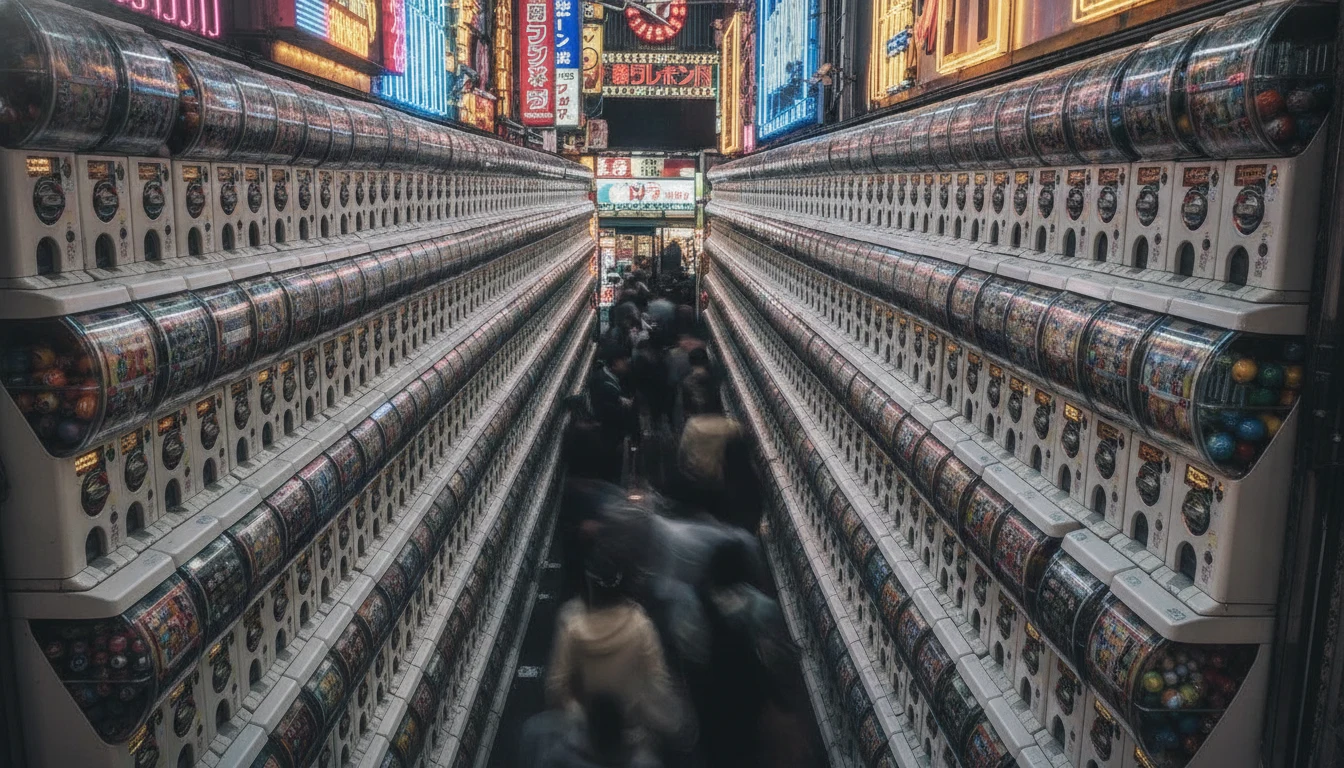
If you've ever walked through a Japanese train station, an arcade in Akihabara or any anime-adjacent retail space, you've seen them: walls of colorful vending machines, each one filled with rows of plastic capsules containing tiny figurines. These are gashapon — and they've become Japan's most successful pocket-money collectible, generating over $500 million in annual revenue just for Bandai's gashapon division (Bandai Namco Annual Report 2024).
This guide covers what they are, where they come from, how the business works, and how a serious collector outside Japan can buy them in 2026.
Direct answer: what is a gashapon?
A gashapon is a small collectible figurine sold inside a plastic capsule dispensed by a coin-operated vending machine. The word itself is Japanese onomatopoeia: gasha for the sound of the crank turning, and pon for the capsule dropping. The format originated in the United States in 1965 with the launch of the Penny King vending machine, but Japan took the concept and elevated it into a sophisticated collecting culture starting in 1977 when Bandai began producing high-quality licensed character figures.
The history in 4 stages
1965-1977 — American origin and Japanese imitation
The first capsule machines appeared in the US in the 1960s dispensing cheap toys, candy, and stickers. The first machines arrived in Japan in 1965 via importer Penny Co., dispensing similarly cheap goods until the format struggled commercially.
1977 — Bandai enters and changes everything
Bandai began producing capsule toys featuring popular anime and manga IPs (Kamen Rider, Mobile Suit Gundam), dramatically increasing production quality. The "gashapon" trademark was registered, and prices doubled from 20 yen to 100 yen — proving Japanese consumers would pay premium for quality.
1990s-2000s — Premium era and adult collectors
The introduction of HG (High Grade) and SR (Super Real) lines targeting adult collectors transformed gashapon from kids' candy machines to serious collectibles. Prices rose to 200-500 yen, figure quality reached small-batch dollmaker standards, and dedicated gashapon corners appeared in major retail spaces.
2010s-2026 — Global expansion and digital era
Gashapon Bandai Official Shops launched in Japan offering hundreds of machines under one roof. Specialized importers brought capsules to international markets. IC card payment systems replaced coins. By 2026, dedicated gashapon machines have appeared in Madrid, Berlin, London, New York and Los Angeles.
How a gashapon machine actually works
- Insert payment: 100, 200, 300 or 500 yen coins depending on the series price.
- Turn the crank: this rotates an internal drum that releases ONE capsule from the bottom row.
- Capsule drops: into the collection tray with the signature "pon" sound.
- Open the capsule: it contains the figure parts, an instruction sheet (for multi-part figures), and a series checklist showing all possible figures in the set.
- Assemble if needed: most modern gashapon are 2-5 parts that snap together without glue.
The randomness is the point. Each series typically has 4-8 different figures, and you can't choose which one. This is what creates the collecting compulsion that drives the multi-billion-yen industry.
The top 4 gashapon manufacturers in 2026
| Manufacturer | Specialty | Price range |
|---|---|---|
| Bandai | Anime/manga licensed (Gundam, One Piece, Dragon Ball) | ¥200-¥500 |
| Takara Tomy A.R.T.S | Realistic animals, food miniatures, daily objects | ¥300-¥500 |
| Kitan Club | Humorous designs, irreverent concepts (sleeping cats series) | ¥300-¥500 |
| Re-Ment | Highly detailed miniature food and household items | ¥600-¥1200 |
How to buy gashapon outside Japan in 2026
Online specialty importers (recommended)
- Solaris Japan: wide selection, international shipping, authentic guarantee.
- AmiAmi: largest Japanese hobby retailer, ships worldwide.
- HobbyLink Japan: established since 1995, reliable.
- Plaza Japan: smaller catalog, good for popular series.
Proxy services (for rare items)
- ZenMarket: lets you buy from Mercari Japan, Yahoo Auctions, etc.
- Buyee: similar function, good interface.
- Use these for limited or discontinued series unavailable through normal channels.
What to avoid
AliExpress, Wish, and unverified eBay sellers are flooded with bootleg gashapon — paint quality is worse, plastic is brittle, and figures can be entirely fabricated. The economic incentive of bootlegs is real: a 4-figure authentic Bandai set might cost $20 shipped from Japan; the bootleg version sells for $8. Detail in our guide to spotting fakes.
Gashapon vs blind box vs ichiban kuji
Three similar but distinct collectible formats:
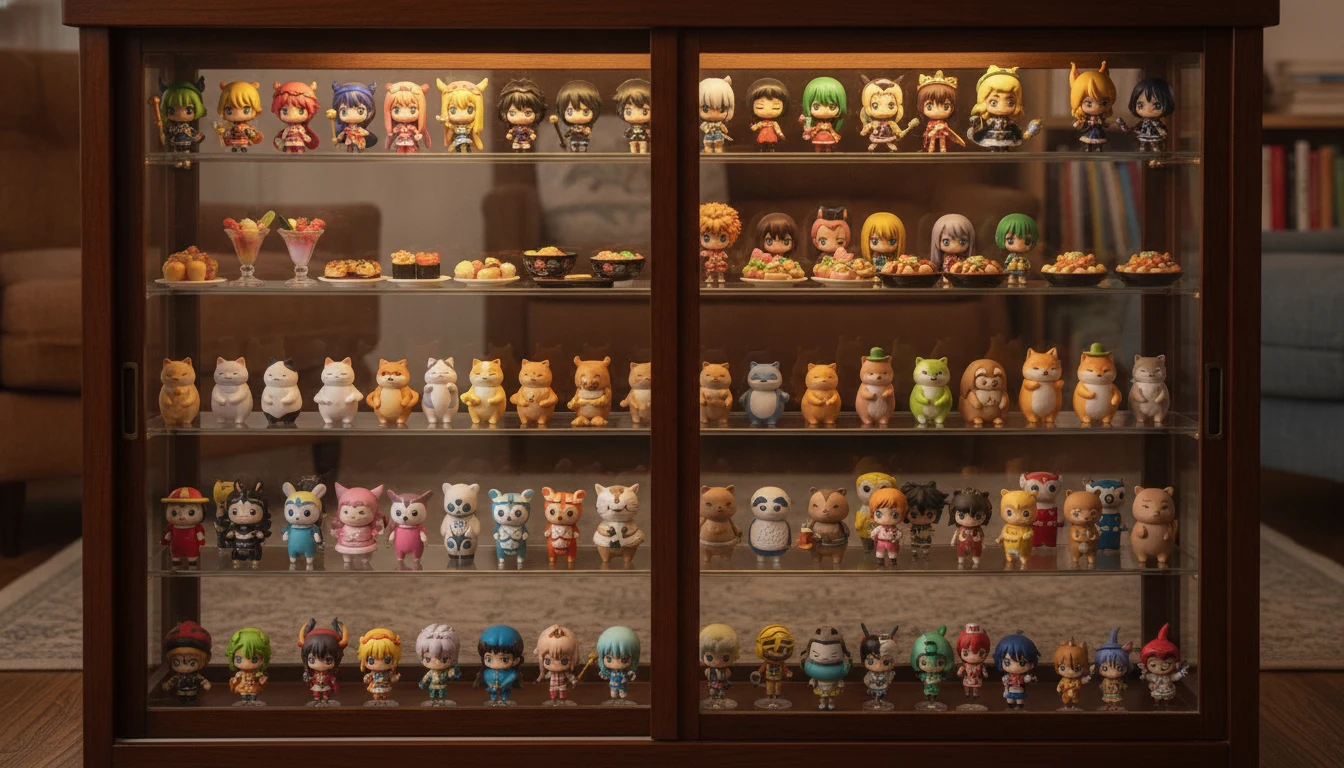
- Gashapon: random capsule dispensed from a vending machine, ¥200-¥500. Compact figures, often series of 4-8.
- Blind box: similar randomness but sold in sealed cardboard boxes instead of capsules. Larger figures, higher price ($5-20 USD), typically series of 6-12 (POP MART, How2Work). Detail in our blind boxes section.
- Ichiban Kuji: lottery system at retail stores. You buy a ticket and instantly receive a prize from tiers (A is best, F is worst), with all prizes guaranteed and visible. Higher quality, $10-30 USD per ticket. Detail in our Ichiban Kuji guide.
Why gashapon work as a business model
The psychological design is sophisticated. Each series creates a small collection goal (4-8 figures), variable-ratio reinforcement (you don't know what you'll get), and clear social proof (collectors share complete sets online, creating pressure to complete). Combined with the low individual cost (¥200-¥500 per pull), gashapon hit the sweet spot between affordability and aspiration.
This isn't accidental — it's the same mechanism behind loot boxes in video games and trading card packs. Gashapon just got there first and built it into vending machine hardware.
Where to go from here
If you're starting out, read our guides on Bandai's official gashapon shops, the best anime gashapon series of 2026, and where to buy gashapon in Spain if you're based there. For authenticity protection, our 12-point fake detection guide is essential reading before any purchase outside official channels.
Preguntas frecuentes
What does the word 'gashapon' mean?
Gashapon (ガシャポン) is a Japanese onomatopoeic word combining 'gasha' (the sound of the crank turning) and 'pon' (the sound of the capsule dropping into the tray). It's a registered trademark of Bandai, but is used colloquially in Japan and globally to refer to any capsule toy from a vending machine, regardless of brand.
How much does a gashapon cost?
Standard gashapon range from 200 to 500 yen (about $1.30 to $3.50 USD) per capsule in Japan, depending on size, complexity, and licensing. Premium series with major IPs (Pokemon, One Piece, Disney) and large figures can cost 500-1000 yen ($3.50-$7 USD). Outside Japan, individual capsules typically sell for $4-12 USD due to import costs.
Who makes gashapon?
The four major manufacturers are Bandai (the original creator and largest producer, hundreds of series per year), Takara Tomy A.R.T.S (high-quality animal and food figures, miniature replicas), Kitan Club (irreverent and humorous designs, Yujin licensed series), and Re-Ment (highly detailed miniature food and household items). Smaller players include Bushiroad, SO-TA, and Qualia.
How do you buy gashapon outside Japan?
Three main options: (1) Online retailers specializing in Japanese imports — Solaris Japan, AmiAmi, HobbyLink Japan, and Plaza Japan ship complete sets or singles worldwide. (2) Proxy services like ZenMarket or Buyee for direct purchases from Japanese sites including Mercari Japan and Yahoo Auctions. (3) Local specialty stores in major cities (London, Berlin, New York, LA) increasingly stock gashapon, though selection is limited. Avoid Aliexpress and unverified sellers — bootlegs are common.
What is a gashapon machine called?
The official name is 'gachapon machine' or 'capsule toy vending machine'. In Japanese they're called 'gashapon mashin' (ガシャポンマシン). They're mechanical dispensers requiring 100, 200, or 500 yen coins, with a crank handle that rotates a drum releasing one random capsule per turn. Modern versions (Gashapon Bandai Official Shop) use IC card payment systems instead of coins.
Why are gashapon so popular?
Three reasons: (1) The surprise element — you never know which figure of the series you'll get, creating excitement and 'gotta catch 'em all' collecting psychology. (2) Quality-to-price ratio — for $2-4 you get a professionally designed, well-painted miniature collectible. (3) Cultural depth — gashapon cover virtually every Japanese pop culture interest from anime and manga to bizarre niche concepts (sleeping cats, office workers, mythological creatures, food samples).