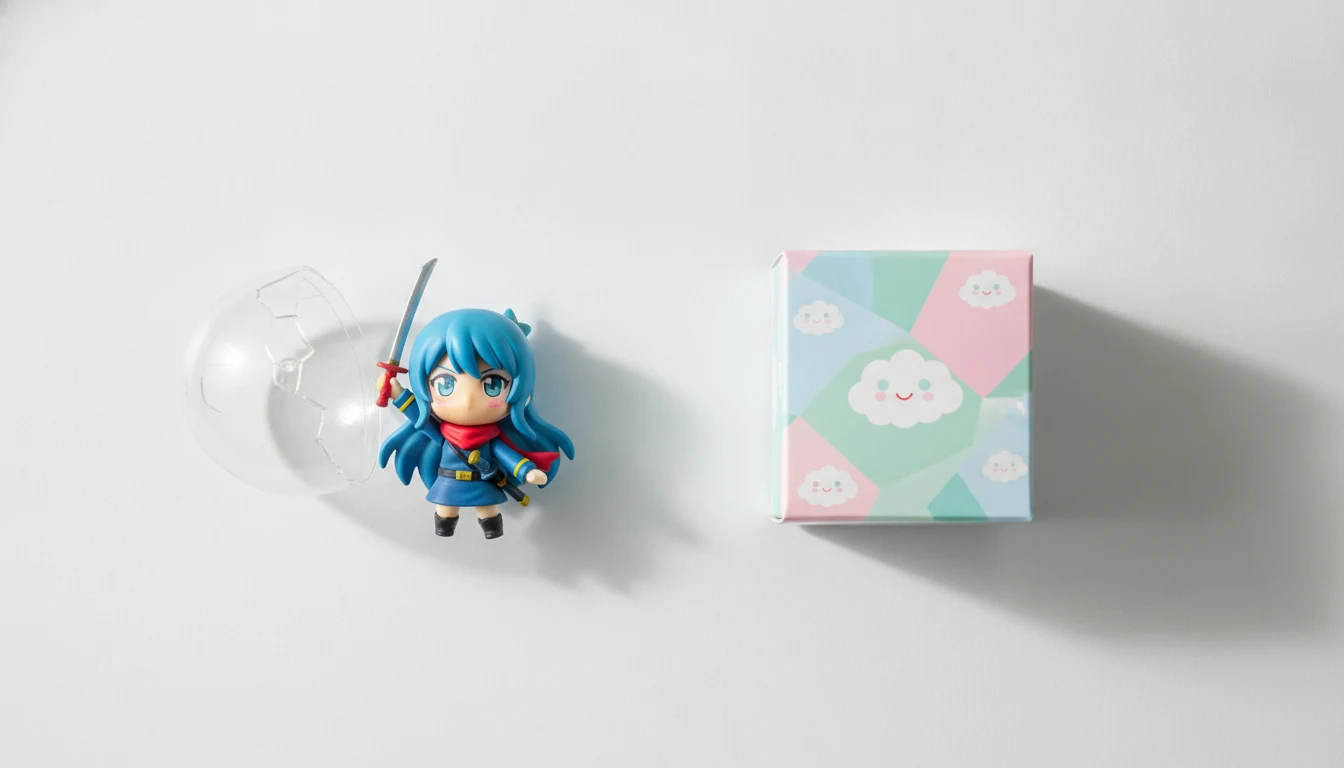
Both gashapon and blind boxes use the same psychological trigger — you pay, you get a random figure from a series, you want to complete the set. But the similarities end there. The two formats come from different countries, different industries, different price points and different aesthetic traditions. This guide breaks down exactly how they differ and which one fits which type of collector.
Direct answer
Gashapon is a Japanese capsule toy dispensed from a vending machine, originated 1977 with Bandai, priced ¥200-¥500 per pull (~$1.30-$3.50 USD), figures 3-7 cm in size, sold worldwide via import. Blind box is a Chinese-led collectible format using sealed cardboard boxes sold at retail, popularized 2016 by POP MART, priced $8-15 USD per pull, figures 8-15 cm in size, with strong secondary market. They overlap in the random-pull psychology but differ in scale, price, aesthetic and ecosystem.
Origin and culture
Gashapon: Japan, mechanical heritage
Capsule toy machines arrived in Japan from the US in 1965. The format took off when Bandai entered in 1977 with quality licensed character figures and registered the "gashapon" trademark (combining the sounds gasha for crank and pon for capsule drop). Today, the format is deeply tied to Japanese anime, manga and pop culture, with hundreds of new series released each year covering both mass IPs (Pokemon, One Piece) and absurdist niches (sleeping cats, sushi miniatures, sumo wrestlers in unusual poses).
Blind box: China, designer toy heritage
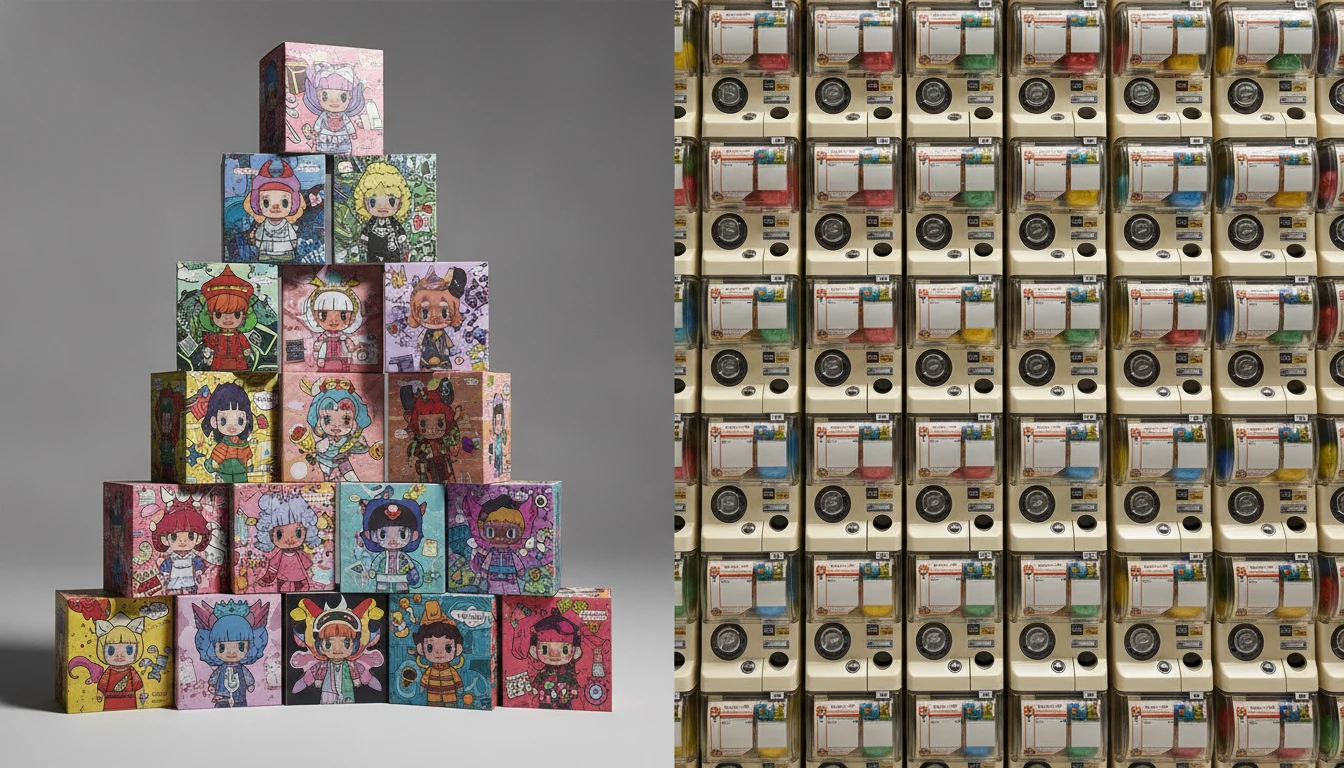
The blind box format as we know it traces to POP MART's launch of the Molly series in 2016. Unlike gashapon (which licenses external IPs), blind box brands typically build proprietary designer characters — Molly, Skullpanda, Dimoo, Crybaby — that exist only within the blind box ecosystem. The aesthetic is more contemporary art-toy than anime, leaning into vinyl figure traditions from the early 2000s.
Side-by-side comparison
| Aspect | Gashapon | Blind box |
|---|---|---|
| Country of origin | Japan | China (Hong Kong, mainland) |
| Founded/popularized | 1977 (Bandai) | 2016 (POP MART) |
| Packaging | Plastic capsule from vending machine | Sealed cardboard box from retail |
| Price per pull | $1.30-3.50 USD | $8-15 USD |
| Figure size | 3-7 cm | 8-15 cm |
| Series size | 4-8 figures | 6-12 figures |
| IP model | Licensed (anime, manga, brand) | Proprietary designer characters |
| Top manufacturers | Bandai, Takara Tomy, Kitan Club | POP MART, How2Work, FINDING UNICORN |
| Secret/chase figure | Rare (mostly all visible) | Yes (1 in 144 typical odds) |
| Secondary market | Compressed (1-3× retail) | Strong (5-15× for chase) |
The secret/chase figure economics
Blind boxes typically include a "secret" or "chase" figure with very low odds (1 in 144 boxes for POP MART standard series, 1 in 720 for special secrets). This rarity drives a strong resale market: a $12 POP MART blind box can yield a secret figure worth $150-400. Gashapon series rarely use chase figures — Bandai's philosophy is that ALL figures in a series should be desirable, so the rarity mechanic is largely absent.
This is the single biggest functional difference for serious collectors. Blind box collecting can become quasi-investment with active resale strategies. Gashapon collecting is purely about completing sets and enjoying the figures.
Which one should you start with?
Start with gashapon if...
- You're a fan of anime, manga, or specific Japanese IPs.
- You want a low-cost entry to collecting ($2-4 per pull).
- You prefer compact pieces that fit a small desk or shelf.
- You appreciate the diversity of niche concepts (food miniatures, animals in absurd poses, etc.).
- You don't care about resale value.
Start with blind boxes if...
- You're drawn to designer/contemporary art toy aesthetics.
- You want larger display pieces (8-15 cm).
- You're okay with higher per-unit cost ($10+ per pull).
- You want to participate in active secondary market culture.
- You enjoy chase/secret figure pursuit.
The hybrid: collecting both
Most serious collectors over time end up doing both. Gashapon for variety and impulse purchases ($2-4 hits the budget barrier so low that you try series on aesthetic curiosity alone); blind boxes for centerpiece display figures and dedicated collections. The two complement each other in scale — a shelf with both formats has a natural rhythm of large character statements (blind box) anchoring smaller satellite figures (gashapon).
If you want to go deeper, see our guides on the best anime gashapon series of 2026 and the dedicated blind boxes section for current POP MART and How2Work releases.
Final verdict
Gashapon and blind boxes aren't competitors — they're parallel collecting cultures with different aesthetics, price points and ecosystems. Try a $10 gashapon set first (4-5 pulls of a series you find visually interesting) and a single POP MART blind box to test which culture pulls you in. The economics let you experiment cheaply. Then commit to one as primary and use the other as occasional supplement.
Preguntas frecuentes
What's the difference between gashapon and blind box?
Gashapon are dispensed from vending machines in plastic capsules (200-500 yen, $1.30-3.50), made primarily in Japan by Bandai, Takara Tomy, Kitan Club and Re-Ment, with series of 4-8 small figures. Blind boxes are sold in sealed cardboard boxes at retail or online ($5-20 USD), originated in Chinese designer toy culture (POP MART, How2Work, FINDING UNICORN), and contain larger figures with series of 6-12. Both share random-pull mechanics but differ in scale, price and origin culture.
Which is more expensive: gashapon or blind box?
Per unit, blind boxes cost more ($5-20 USD vs $2-6 USD for gashapon). However, blind box figures are typically 8-15 cm tall vs gashapon 3-7 cm, so price-per-cm of figure is comparable. Premium blind boxes (Skullpanda, Molly, Dimoo) can reach $35-60 USD for special editions. Premium gashapon series (Premium Bandai, large-scale) rarely exceed $7 USD.
Are blind boxes the same as gashapon in Asia?
No. The terms refer to different industries with different histories. Gashapon comes from Japan, started in 1977, dominated by Bandai's IP-licensed figures. Blind boxes come from China, took off around 2016 with POP MART, dominated by original designer characters (Molly, Skullpanda, Crybaby). Cultural overlap exists — both formats sell figures using random-pull mechanics — but the production model, brand ecosystem and aesthetic are distinct.
Which is better for collecting: gashapon or blind box?
Depends on your priorities. Gashapon: choose if you love anime/manga IPs (Pokemon, Gundam, One Piece), prefer compact desk pieces, value Japanese craftsmanship, want $2-4 per pull. Blind box: choose if you prefer original designer characters, larger display pieces, are okay with $8-15 per pull, like collecting brand identity (POP MART aesthetic). Many serious collectors do both for variety.
Which has better resale value?
Blind box chase figures generally have stronger secondary market value. POP MART secret editions can resell for 5-15× retail. Gashapon secondary market is more compressed — even discontinued series rarely exceed 3× original retail except for very rare promotional or limited regional releases. If resale matters, blind box culture is more financialized; if pure collecting joy matters, gashapon offers more diversity at lower entry cost.