The Scale of the Plastic Problem
The gashapon industry in Japan is large by any measure. Bandai Namco's Vending Machine Business division — just one company, albeit the largest — operates over 350,000 gashapon machine units across Japan and internationally, and produces roughly 3 billion individual capsule turns per year across its network. Each of those turns produces one plastic capsule — the spherical or egg-shaped container in which the figure is housed — that is separated from the figure immediately upon opening.
Three billion capsules. Per year. From one company.
Japan's total gashapon industry (including Takara Tomy Arts, Epoch, Kaiyodo, Kitan Club, Kenelephant, and dozens of smaller manufacturers) is estimated by the Japan Toy Association at producing between 6–8 billion capsule units annually, a figure that has grown approximately 15% per year for the past decade as gashapon machines have expanded internationally into Southeast Asia, Taiwan, Hong Kong, and increasingly Europe and North America.
Most of this plastic — the capsule containers, not the figures inside them — is single-use. The figures are kept; the capsules are discarded. Japanese convenience stores, machine locations, and public spaces near machine banks accumulate discarded capsule containers as a visible environmental consequence of the industry's scale. In districts like Akihabara and Den Den Town, bins near machine concentrations fill with discarded capsules daily.
How Much Plastic Is in Each Capsule?
| Capsule Type | Diameter | Avg. Plastic Weight | Annual Waste (industry) |
|---|---|---|---|
| Small (¥100 tier) | 28–32mm | ~4g | ~24,000 tons |
| Standard (¥200–300 tier) | 40–45mm | ~8g | estimated majority of volume |
| Large (¥400–500 tier) | 50–65mm | ~15g | smaller volume, higher weight/unit |
| Egg/irregular shape | Varies | ~6–12g | growing segment |
The dominant plastic used in capsule containers is polypropylene (PP, Resin Code 5) — a thermoplastic that is technically recyclable but practically challenging. PP recycling infrastructure varies dramatically by region. In Japan, many municipalities accept PP in residential plastic recycling streams, and the actual recycling rate for capsule containers among collectors who make the effort is estimated at 30–40% (a figure from a 2022 Bandai Namco sustainability report). However, capsules discarded in public — at machine locations without dedicated recycling bins — have far lower recycling rates.
The figures themselves are primarily PVC (polyvinyl chloride) — a plastic that is significantly more problematic environmentally than PP. PVC contains chlorine compounds and plasticizers (phthalates, or increasingly phthalate-free alternatives) that make it difficult to recycle and potentially environmentally persistent. PVC is rarely accepted in residential recycling streams in any country. When a gashapon figure reaches end of life — either through damage, cleaning-out during a collection transition, or death of the collector — it almost certainly goes to landfill.
The Industry's Response: Slow but Moving
The Japanese toy industry has historically been slow to engage with environmental concerns. The toy industry trade body, the Japan Toy Association, published its first environmental guidelines in 2018 — late by comparison to similar industry bodies in Europe. However, the pace of change has accelerated significantly since 2020, driven by three factors:
- Government pressure: Japan's revised Resource Circulation Promotion Act (2021) set targets for plastics reduction across manufacturing sectors, including toy manufacturers. Bandai Namco cited regulatory compliance as a factor in their eco-capsule initiative.
- Consumer activism: Japanese collector communities — particularly younger collectors entering the hobby from 2018 onward — began publicly questioning the environmental cost of the hobby. Twitter discussions, YouTube commentary, and collector blog posts created visible demand for industry response.
- International market requirements: As gashapon machines expand into Europe, manufacturers face EU plastic regulations (including the Single-Use Plastics Directive) that require either material substitution or significant redesign for market access. This regulatory pressure is accelerating development of alternative capsule materials.
Bandai's Eco Capsule Initiative
In 2021, Bandai Namco announced its "Eco Gashapon" initiative — a commitment to transitioning its capsule container production away from conventional PP toward either recycled-content PP or paper-based alternatives. The company set a target of 30% eco-capsule deployment across its machine network by 2024 and 100% by 2030.
As of the company's fiscal year 2023 sustainability report, approximately 22% of new machine installations use eco-capsule formats — ahead of initial pace but behind the 2024 target. The "eco capsule" designation covers several different product formats:
- Recycled PP capsules: The same spherical capsule format, but manufactured with recycled polypropylene content (typically 30–50% recycled material). These are visually nearly identical to conventional capsules and function identically in machines. The environmental benefit is a reduction in virgin plastic demand rather than an elimination of plastic entirely.
- Reduced-material capsules: Capsules manufactured with thinner walls (reducing plastic weight per unit by approximately 25%) while maintaining structural integrity. Bandai calls these "Slim Shell" capsules in internal documentation.
- Bagless packaging: Some series have eliminated inner packaging within the capsule (small plastic bags that held figure parts) in favor of direct placement in the capsule with protective foam inserts — reducing a secondary plastic waste stream.
Paper Capsules: The Most Ambitious Alternative
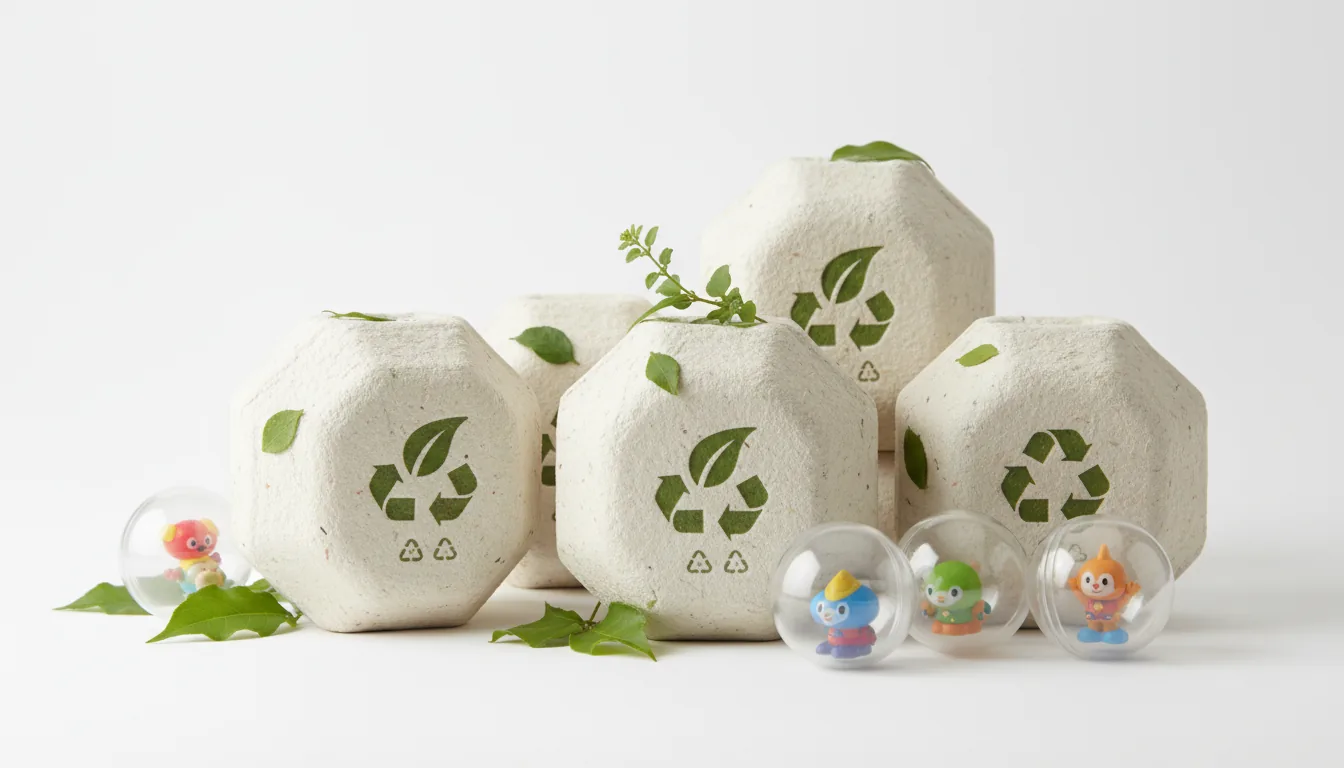
The most significant structural change under development is the paper capsule — replacing the polypropylene sphere with a container made from recycled paper pulp or sustainably sourced cardboard. Bandai Namco, Takara Tomy Arts, and several smaller manufacturers have all announced paper capsule programs at various stages of development.
The engineering challenges are substantial. A paper capsule must:
- Survive the mechanical violence of the vending machine's dispensing mechanism (current PP capsules experience significant physical stress during dispensing)
- Protect the contained figure from moisture during storage (in machines that may sit for weeks in humid environments)
- Open and close reliably for thousands of test cycles during machine loading and maintenance
- Achieve cost parity with PP capsules (currently paper capsules cost approximately 3x more to produce per unit)
Bandai's paper capsule prototype, tested in a limited deployment in 2022, used a biodegradable cardboard construction with a moisture-resistant coating. Consumer feedback was positive for concept but mixed on functionality — some consumers found the paper capsule harder to open than the familiar PP snap. Takara Tomy Arts' paper capsule prototype (announced 2023) uses a pulp-molded egg shape (similar to egg carton material) that is reportedly easier to open while maintaining structural protection.
Kitan Club, a smaller manufacturer known for producing high-quality biological subject gashapon series, deployed a paper capsule system for its "Capsule in Paper" product line in 2023 — the first commercially available paper capsule gashapon series sold in Japanese machines at scale. The series received significant media coverage and positive collector reception, and has been cited by competitors as a proof-of-concept for the format's viability.
Gashapon vs. Other Toy Industry Formats: A Fair Comparison
Understanding gashapon's environmental impact requires context. How does it compare to other toy formats?
| Toy Format | Packaging per Unit | Figure Material | Typical Lifecycle |
|---|---|---|---|
| Gashapon capsule | 4–15g PP capsule | PVC figure | Kept years–decades; capsule discarded |
| Blind box (e.g., Pop Mart) | Cardboard box + inner plastic tray | ABS plastic + PVC paint | Kept; packaging often discarded |
| Action figure (retail) | Large cardboard blister + plastic bubble | ABS/PVC hybrid | Varies widely; packaging usually discarded |
| Kinder Surprise (European market) | Foil wrapper + plastic egg | Small plastic components | Short; toy often discarded |
On a packaging-per-unit basis, gashapon's small PP capsule is more efficient than the cardboard-and-plastic blister packaging of retail action figures or the combined chocolate wrapper + plastic egg of Kinder Surprise products. Where gashapon falls behind is in the figure material: PVC is environmentally worse than ABS (acrylonitrile butadiene styrene, used in many Western market action figures) because it's harder to recycle and contains more potentially problematic additives.
The most significant environmental advantage gashapon has over Western toy formats is the secondary market — an advantage discussed in detail below.
The Secondary Market as a Sustainability Solution
Japan's gashapon secondary market is extraordinarily well-developed. The combination of platforms like Mercari Japan, Yahoo! Auctions Japan, Suruga-ya, and Mandarake's buying operation means that an unwanted figure doesn't have to be thrown away — it can be sold or traded quickly and finds a new collector home with minimal effort.
This is environmentally significant. A figure that stays in circulation through the secondary market has a much lower net environmental impact than one manufactured to replace a discarded predecessor. The extended product lifecycle of a well-maintained gashapon figure — potentially 20–30+ years, evidenced by the active secondary market for 1990s and early 2000s capsule series — is one of the hobby's genuinely positive environmental attributes.
Research on the toy secondary market (including a 2022 study by the Waste & Resources Action Programme on the UK toy resale market) consistently shows that collectors significantly extend product lifespans compared to non-collectors. A figure purchased by a collector has a high probability of being kept in good condition for resale rather than being discarded at the end of novelty interest — unlike the majority of mass-market toys, which end up in landfill within 2–3 years of purchase.
Practical secondary market sustainability practices for collectors:
- List duplicates on Mercari Japan (or local equivalents) promptly after identifying them — don't let them accumulate in boxes where they're more likely to eventually be discarded
- Use dedicated gashapon trading communities (multiple Discord servers, Reddit communities, Twitter collector networks) for direct trades that eliminate platform fees and shipping emissions where possible
- Participate in local collector meets where trades can happen in person
- Donate unwanted figures to charity shops or toy drives rather than discarding — gashapon figures in good condition are popular items at second-hand stores internationally
What Individual Collectors Can Do
Individual action can't substitute for industry-level structural change, but the aggregate behavior of Japan's estimated 15+ million active gashapon collectors (a figure derived from Bandai Namco's reported machine usage data) does matter. Here are evidence-based steps:
Recycle Your Capsules
PP (Resin Code 5) capsule containers are recyclable in many Japanese municipalities and increasingly in recycling programs internationally. In Japan: check your local ward's recycling guidelines; most classify PP as "Plastic Container/Packaging" (プラスチック容器包装) recyclable collection. Outside Japan: check local guidelines. In the UK, PP is accepted in household recycling collections in most local authorities as of 2023. Wash capsules (remove any residue from included stickers or accessories) before recycling.
Choose Quality Over Quantity
The most environmentally conscious collecting strategy is prioritizing high-quality, lasting pieces over high-volume spinning. A ¥500 Kaiyodo biological figure that you'll display for 30 years has a dramatically lower environmental impact per year of use than ten ¥100 figures that end up in a drawer within two years. This isn't a call to stop collecting — it's a call to be intentional.
Avoid "Completion Addiction"
The psychology of capsule toy collecting creates strong pull toward completing every series — getting all 8 (or 10, or 12) variants. This psychology, when combined with the random nature of machine dispensing, generates substantial duplicate waste. Strategies to reduce completion-driven overconsumption: buy singles from secondary market dealers rather than spinning for the last piece; trade duplicates rather than discarding; set personal limits on machine turns per series.
Support Eco-Capsule Series
When manufacturers release eco-capsule or paper capsule series, buying them signals demand. Market feedback matters. A series using paper capsules that sells well gives the manufacturer data to justify further eco-format investment.
Bioplastics and Future Materials
The longer-term material solution for both capsule containers and figure bodies involves bioplastics — plastics derived from biological sources rather than petroleum, which may be compostable under appropriate conditions. Several material approaches are under development or early deployment:
PLA (Polylactic Acid)
PLA is a bioplastic derived from fermented plant sugars (typically corn starch or sugarcane). It's the most commercially available bioplastic and is already used for 3D printing filaments and food packaging. PLA is compostable under industrial composting conditions (not in home compost bins, and not in the natural environment). Bandai has tested PLA capsule containers and found the material viable for the physical requirements of machine dispensing, but the higher cost (approximately 2–3x PP) and the compostability requirement (needs industrial facility rather than standard recycling) limit its near-term deployment.
PHA (Polyhydroxyalkanoate)
PHA bioplastics are produced by bacteria and are compostable in marine environments as well as industrial facilities — making them the most environmentally benign plastic alternative currently commercially available. PHA is used in medical applications and some specialty packaging. Its current cost (5–8x petroleum plastics) makes commercial gashapon capsule deployment impractical at current pricing, but costs are projected to fall significantly as production scales through the 2020s.
Cardboard-PLA Composite
The most commercially viable near-term solution for gashapon capsule containers may be a hybrid: a paper pulp exterior providing structural rigidity and recyclability/compostability, with a thin inner PLA coating for moisture resistance. This is the approximate format of Kitan Club's deployed paper capsule system and represents the industry's best current compromise between environmental performance, cost, and functional requirements.
Community Initiatives and Collective Action
Beyond individual practice and manufacturer programs, community-scale initiatives address gashapon's environmental impact:
Capsule Collection Drives at Events
Several major collector events (Wonder Festival, Nipponbashi Street Fes) have introduced capsule container collection bins — dedicated recycling points for PP capsules collected and batch-processed after the event. This captures recycling from the event context where discarded capsules are concentrated and would otherwise miss residential recycling streams.
Machine Location Recycling Bin Programs
Akihabara's Gashapon Bandai Official Shop introduced dedicated capsule recycling bins in 2022 — the first such installation at a commercial machine location. The bins collect PP capsules for sorting and batch recycling. Bandai reported collecting approximately 2 tons of capsule material at the Akihabara location in the first year of the program. The initiative has since expanded to additional official shop locations in Tokyo, Osaka, and Fukuoka.
Online Collector Communities
Multiple English-language and Japanese collector communities on Discord, Reddit (r/gashapon, r/capsule_toys), and Twitter have developed community norms around sustainability: discouraging posts that celebrate extreme duplicate spinning, normalizing secondary market trade discussions, and celebrating eco-capsule releases. Community norm formation in collector culture is a meaningful lever — collector communities shape individual behavior substantially.
Corporate Accountability Tracking
Several collector-run tracking projects monitor and publish corporate sustainability commitments and progress in the gashapon industry. Bandai Namco's sustainability reports (published annually in Japanese with English summaries) are widely read and discussed in collector communities. This transparency creates accountability — manufacturers know their environmental commitments are being tracked by the consumers who drive their revenue.
Gashapon culture's relationship with environmental sustainability is complicated: the hobby creates plastic waste that is real and substantial, but it also creates objects designed to last, a strong secondary market that extends product lifecycles, and a collector community that is increasingly engaged with the issue and capable of influencing industry practice. The path to a genuinely sustainable gashapon culture exists. It requires industry investment in alternative materials, regulatory frameworks that price in environmental cost, and collector communities that apply consistent demand for better practice. All three are moving. The pace needs to accelerate.