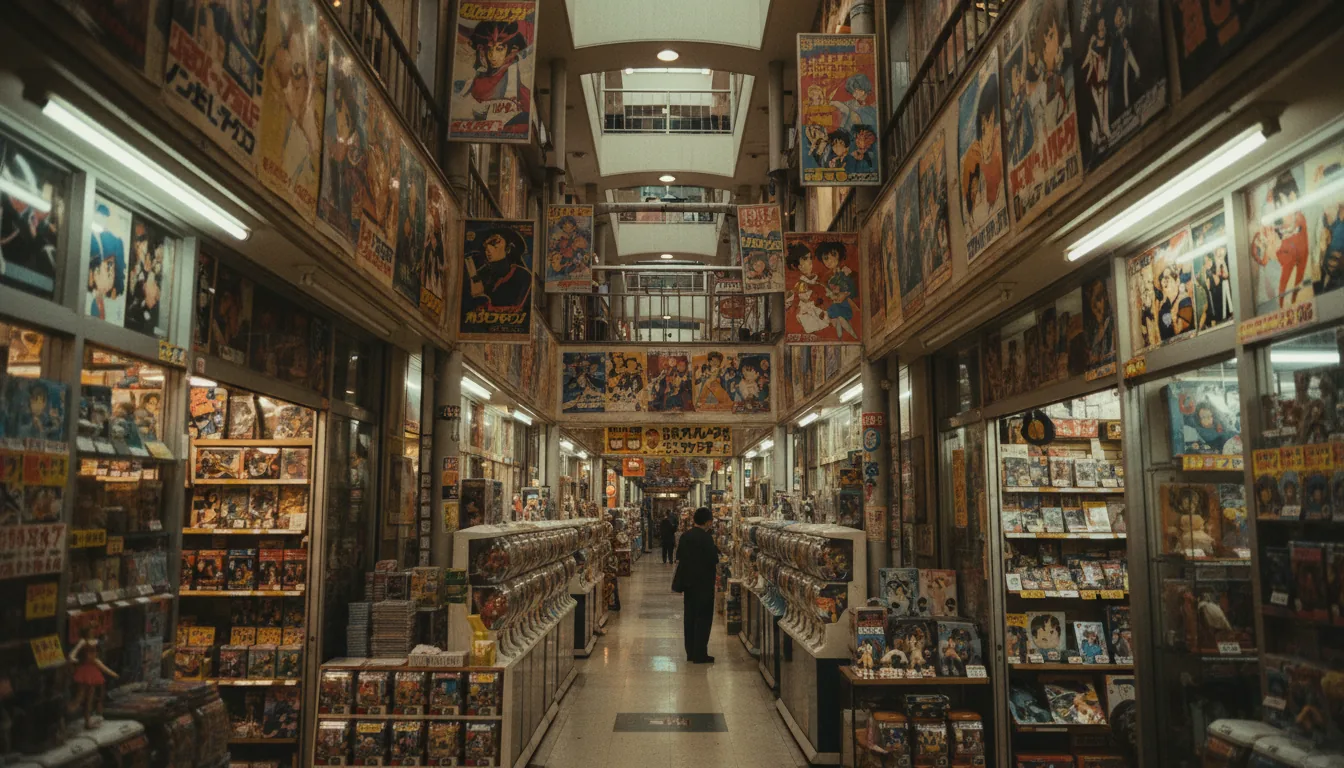
Why Nakano Broadway Deserves Its Own Pilgrimage
Nakano Broadway is not a shopping mall in any conventional sense. Built in 1966 as a residential-commercial complex — apartments on the upper floors, shops below — it gradually attracted otaku culture beginning in the 1980s when Mandarake, the legendary used anime goods chain, opened its first Tokyo location here. Over the following decades, the complex evolved into a self-contained otaku ecosystem: a labyrinthine network of over 300 small shops, stalls, and kiosks spread across four commercial floors, all connected by narrow corridors, steep escalators, and the constant ambient sound of anime theme songs leaking from a dozen different speakers simultaneously.
Today, Nakano Broadway is home to approximately 30 Mandarake specialty shops (each focusing on a different category), plus dozens of independent figure dealers, vintage toy stalls, doujinshi (self-published manga) shops, idol goods stores, cosplay supply vendors, and — critically for this guide — a surprisingly deep selection of gashapon machines and capsule toy dealers that most visitors walk right past.
The building's rough exterior, aging signage, and slightly chaotic layout are features, not bugs. This is where Japan keeps its collecting culture's soul — the part that predates Instagram aesthetics and influencer sponsorships.
Nakano Broadway vs. Akihabara: The Real Difference
| Factor | Nakano Broadway | Akihabara |
|---|---|---|
| New releases | Moderate — some machines, mostly secondhand | Excellent — restocked weekly |
| Rare/vintage finds | Exceptional — Mandarake stocks decades of history | Good but overpriced compared to Nakano |
| Crowd level | Manageable — locals and serious collectors | Heavy tourist traffic, especially weekends |
| Price level | Better value on secondhand; new items standard price | Standard retail pricing; resellers mark up rares |
| English friendliness | Limited but improving | High — tourist-oriented staff common |
| Best for | Vintage figures, completing series, deep collecting | New releases, wide variety, first-time visitors |
The veteran Tokyo collector strategy is to combine both districts. Hit Akihabara for current-release machines in the morning, then take the JR Chuo Line to Nakano in the afternoon to hunt for discontinued capsule singles and completed sets in Mandarake's glass display cases.
Floor-by-Floor Breakdown of Nakano Broadway
B1F — Food, Convenience, Arrivals
The basement level is primarily food service: a small supermarket, bakery, and a few take-out food counters. This is practical rather than collectible. However, near the escalators to B1F you'll often find a small seasonal machine display — typically 10–20 capsule machines that the building management rotates quarterly. These aren't the main attraction but they represent the building's casual audience (residents, local shoppers) rather than the dedicated collector floors above.
1F — The Entrance Gauntlet
The ground floor's Nakano Broadway shopping center section (separate from the Broadway proper, facing the sunroad covered shopping street) contains mainstream goods including a Animate presence and a few general hobby shops. As you walk toward the escalators deeper into the complex, the shops transition toward collectors. The 1F corridor leading to the escalators contains several fixed gashapon machine banks — typically 20–40 machines featuring current Bandai and Takara Tomy Arts series. These are the most accessible machines in the building and often have new series the same week as Akihabara deployments.
2F — The Mandarake Core Begins
Floor 2 is where Nakano Broadway starts to reveal itself. Several Mandarake storefronts occupy this level, including Mandarake's main comprehensive store and specialty branches for comics, anime goods, and idol merchandise. In the corridors between stores, independent vendors set up glass cases selling individual gashapon capsule figures. These cases are gold for completing a series — instead of gambling on machines, you can buy the exact variant you need (typically ¥200–¥800 per figure depending on rarity and condition, higher for sealed or early discontinued pieces).
3F — Figure Heaven and Specialty Mandarake Branches
Floor 3 is arguably the most valuable floor for figure collectors. This is where Mandarake branches specializing in figures, garage kits, and toys operate. Cases here contain figures spanning the 1980s through the present — you can find original Yujin animal figure sets from the late 1990s alongside 2023 Kaiyodo Capsule Q Museum pieces, all within a few steps. For gashapon specifically, there's a portion of 3F dedicated to capsule singles dealers with more systematic organization than 2F — some vendors maintain binders listing available series by manufacturer and year.
Look for the small independent shop (the name and tenant changes periodically) that specializes entirely in discontinued Bandai Gashapon series from 2000–2015. This is where nostalgic adult collectors find figures from childhood series that haven't been reprinted and are now essentially unavailable through any other retail channel in Japan.
4F — Doujinshi, Cosplay, and the Upper Reaches
The fourth floor skews more toward doujinshi (fan-made comics), idol goods, cosplay supplies, and vintage media. Capsule toy density drops here, but there are still a few cases mixed in with general hobby stock. The real draw on 4F is Mandarake's vintage toy section, which occasionally contains gashapon machine units themselves — not the capsules inside, but the actual vending machines, sold as collector items or for display. A working vintage Bandai machine from the 1990s can go for ¥15,000–¥50,000 depending on condition and rarity.
Mandarake: The Ecosystem Within the Complex
Mandarake (まんだらけ) deserves extended discussion because it dominates Nakano Broadway so completely. Founded by manga artist Masuzo Furukawa in 1980, Mandarake started as a used manga shop and expanded into every collectible category imaginable. Their Nakano Broadway complex now operates approximately 30 distinct storefronts, each focused on a specific category:
- Mandarake Complex (Main): General used anime goods, figures, DVDs
- Mandarake Henkya: Vintage transforming robots and mecha toys
- Mandarake Zenbu: Comprehensive mix across categories
- Mandarake Cream (idol): Idol group merchandise
- Mandarake Special: High-value figures, garage kits, limited editions
- Mandarake Dorama: Doujinshi and self-published works
For gashapon hunters, the most relevant branches are the main Complex store and Mandarake Special. The Complex maintains glass cases along its perimeter walls displaying hundreds of individual gashapon capsule figures with price tags. Mandarake Special occasionally carries sealed complete gashapon sets — a full set of 8 figures from a discontinued 2010 Dragon Ball series, for example, sealed in their original capsules and boxed in a specialty display case — these command significant premiums (¥3,000–¥15,000 for a complete vintage set) but represent impossible-to-find items through any other channel.
Mandarake's pricing is generally fair by secondary market standards — they use a condition grading system (S, A, B, C) and price accordingly. Unlike some Akihabara resellers who mark up anything with online buzz, Mandarake tends to price based on actual market data from their chain-wide sales tracking. Negotiation is generally not practiced at Mandarake — prices are what they are, and the staff doesn't have discretion to bargain.
Gashapon Machine Corners in Nakano Broadway
Active capsule machines in Nakano Broadway are fewer than Akihabara in raw numbers (~80–120 units versus Akiba's 3,000+), but they're worth seeking out because the selection is curated differently. Building management seems to favor:
- Bandai Premium Gashapon: Higher-price-point Bandai series (¥500 machines) that represent the brand's current best quality
- Kaiyodo Capsule Q Museum: The Museum series features exceptionally detailed sculpts of real-world subjects (fish, insects, architectural models, natural phenomena). These are beloved by adult collectors and found less commonly than franchise toys
- Epoch Capsule Figure Series: Epoch's gashapon arm produces high-quality animal figures and some of the best underwater creature capsule series available
- Collaboration limited series: Tied to events happening at Nakano Broadway or the surrounding area
Machine locations shift periodically but the corridor between the main escalator bank and the 1F Mandarake entrance has maintained a machine presence consistently for years. The 3F corridor outside the figure-specialist Mandarake branch also reliably hosts a small machine cluster.
Strategy for Finding Rare Capsule Figures
Nakano Broadway's real value for gashapon collectors is the secondary market infrastructure. Here's how to maximize your find potential:
Know Your Target Before You Arrive
Research the specific series, variant, and approximate secondary market price for any piece you're seeking before visiting. Apps like Mercari Japan and Yahoo! Auctions Japan (accessible with a proxy buying service) give real-time pricing. If you know a particular "secret color" variant of a Kaiyodo figure sells for ¥2,000 on Yahoo Auctions, you'll immediately recognize a ¥1,500 Mandarake case price as a genuine deal.
Check Every Case Methodically
Display cases are organized differently by each vendor — some by franchise, some by manufacturer, some by era. Spend time on each case rather than scanning. Items at the back of cases or on lower shelves are frequently overlooked by casual browsers.
Ask the Staff
For Japanese-literate visitors: Most Mandarake staff can search their own inventory system for a specific item. If you have the Japanese name of a series (written on your phone), showing it to staff and asking 「これありますか?」 ("Do you have this?") will often get you a direct answer or a redirect to the correct branch.
Visit on Weekday Mornings
Mandarake receives donated and purchased secondhand goods continuously. Staff price and case-display new arrivals before opening. Showing up when doors open (11:00 AM for most branches) after a busy weekend means you may find freshly cased items that arrived over the weekend.
Getting to Nakano Broadway
Nakano is remarkably easy to reach from most Tokyo tourist areas:
- From Shinjuku: JR Chuo Line (local), 5 minutes, ¥170. This is the primary access route. Take any Chuo local train westbound to Nakano Station.
- From Akihabara: JR Chuo-Sobu Line direct, approximately 25 minutes, ¥220.
- From Shibuya: Keio Inokashira Line to Meidaimae, transfer to Keio Line to Shinjuku, then JR Chuo to Nakano. Or take the bus. Total ~30 minutes.
- From Harajuku/Omotesando: Walk to Shinjuku (approximately 30 minutes through Yoyogi), or take the Chiyoda/Fukutoshin Line to Shinjuku 3-chome, then JR Chuo.
At Nakano Station, use the North Exit. Follow the covered Sunroad shopping street directly north from the station exit — Nakano Broadway is at the far end of the Sunroad, approximately a 5-minute walk. The Sunroad itself is worth a quick look: it contains mainstream shops and a few casual capsule machine kiosks near the Broadway entrance.
Hours, Budget, and Practical Details
Operating Hours
Most shops in Nakano Broadway open between 11:00 and 12:00 and close between 19:00 and 20:00. Mandarake branches typically open at 12:00 noon. The building itself (corridors, escalators) is accessible earlier and later than individual shops. Plan your visit to arrive around 12:00–13:00 to have maximum shop coverage.
Budget for Capsule Machines
Active machines in Nakano Broadway: budget ¥2,000–¥4,000 for a thorough run of the building's ~80–120 machines if you hit everything. Realistically most visitors target specific machines, so ¥1,000–¥2,000 is enough for a focused session.
Budget for Secondhand Capsule Figures
Individual figures from display cases: ¥200–¥3,000 depending on series, condition, and rarity. Plan ¥5,000–¥10,000 if you're specifically hunting for specific pieces to complete a collection.
Payment
Machines: coin only (¥100/¥500 coins). Most Mandarake stores accept credit cards and IC cards (Suica/Pasmo) at registers. Small independent vendors are mostly cash-only. There's a convenience store (Lawson) in the building for ATM access.
Collector Tips for Nakano Broadway
For First-Time Visitors
Allow at minimum 3 hours for a proper visit. The building is dense and disorienting — you will get lost, and that's fine. Some of the best finds happen when you wander into a corridor you didn't mean to enter. Bring a charged phone for translation (Google Translate camera works well on case labels) and enough cash for impulse buys.
For Serious Collectors
Create a want list before visiting. Mandarake's website (mandarake.co.jp) has a searchable inventory — you can check online whether a specific item is currently available in their Nakano Broadway stores before making the trip. Their inventory updates in near real-time as items are tagged and entered into the system. The website is in Japanese; using a browser translation plugin makes navigation manageable.
Selling to Mandarake
Mandarake buys as well as sells. If you have duplicates or items from your own collection you want to liquidate, Mandarake's buying counter (kaitori, 買取) is available at the main Complex location. They'll assess items and make a cash or store-credit offer. Store credit offers are typically 20–30% higher than cash. For sealed or near-mint items, offers are often reasonable — not as high as peer-to-peer selling on Mercari, but immediate and hassle-free.
The Local Rhythm
Nakano Broadway has a loyal local clientele distinct from the tourist tide of Akihabara. On weekday afternoons you'll rub elbows with regulars — collectors who visit weekly, vintage toy hunters who check fresh arrivals religiously, retirees who've been coming since the 1990s. This is part of what makes the experience irreplaceable. Engage respectfully, and you may find yourself in a conversation that leads to a tip about a hidden case of exactly what you've been looking for.