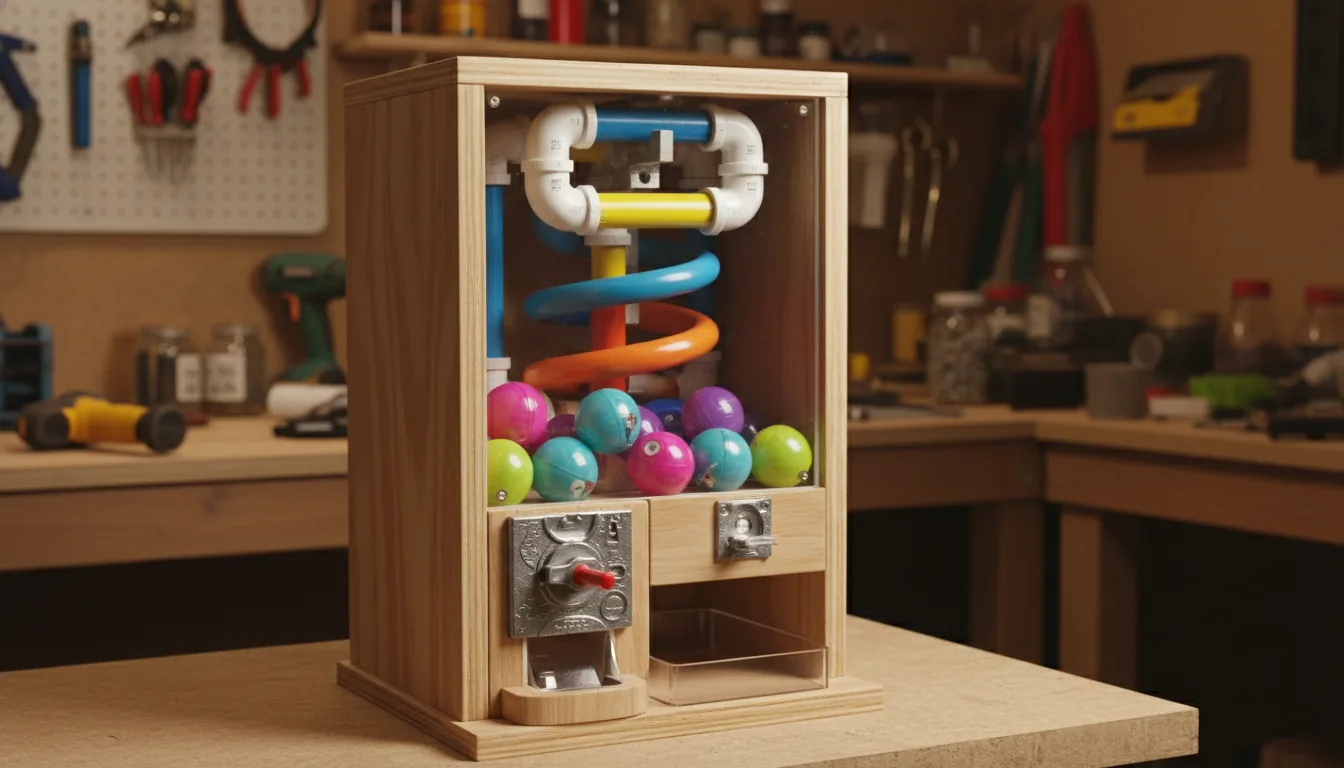
Why People Consider Building a DIY Gashapon Machine
The gashapon machine DIY impulse comes from three very different types of people, and the right approach varies dramatically by which one you are.
The cost-conscious entrepreneur is starting a capsule toy vending business and sees the $400–$800 price tag of a commercial gashapon machine as a significant barrier to entry. They wonder whether building their own machine could reduce startup costs enough to reach profitability faster. The math is worth examining seriously — more on that in the ROI section below.
The maker/hobbyist is not primarily motivated by money. They want to build something fun, display their own capsule toy collection in a working machine, or create a gifting station for friends and family. For this person, a $40–$80 PVC pipe build or a 3D-printed dispenser is genuinely a great option — the process itself is part of the value.
The event creator wants a gashapon-style experience for a specific event: a birthday party, a convention booth, a school fundraiser. They need something that works reliably for one occasion, looks cool, and doesn't cost $700. This is exactly the use case where DIY shines most clearly.
Understanding which category you're in before committing to a build will save you time, money, and the frustration of a solution that doesn't fit your actual need.
Commercial vs. DIY: An Honest Comparison
Before committing to any DIY approach, it's worth being clear-eyed about what commercial machines offer that's genuinely hard to replicate at home.
Reliability and durability: A commercial gashapon machine — made by Bandai, Takara Tomy, or one of several Chinese manufacturers — is engineered for tens of thousands of dispensing cycles with minimal maintenance. The dispensing mechanism is precision-calibrated to handle 55mm capsules consistently. A DIY build will struggle to match this unless you invest significant engineering effort and testing time.
Coin mechanism: A professional coin acceptor that correctly identifies and validates quarters, dollars, or tokens costs $40–$150 alone. It's one of the most technically challenging components to DIY or source correctly, and a coin mech that frequently jams or accepts slugs will destroy any commercial operation.
Aesthetics and attractiveness: Commercial machines have the iconic round-dome look that signals "gashapon" to anyone familiar with the format. DIY builds, even excellent ones, rarely achieve this visual cue — and the visual cue matters for capturing attention and impulse spending.
Legal and insurance compliance: Commercial machines typically carry UL or CE certification. DIY coin-operated devices exist in murky legal territory in many jurisdictions, which can affect your ability to place them commercially or cover them under business insurance.
The honest conclusion: for commercial vending use, buy commercial machines unless you have specific engineering expertise and a genuine cost advantage. For home, hobby, and event use, DIY is excellent and often the better choice.
DIY Options Ranked by Difficulty
1. 3D Printed Mini Dispensers — Easiest ($30–$80)
The most accessible entry point for a DIY capsule dispenser is a 3D-printed design downloaded from Thingiverse or Printables.com. Dozens of designs exist for gravity-fed capsule dispensers that deliver one capsule at a time with a rotating drum mechanism. The most popular designs have been downloaded thousands of times and are well-tested.
What you need: a 3D printer with a build volume of at least 150mm × 150mm × 150mm (an Ender 3 or similar entry-level printer works), PLA or PETG filament ($20–$30/roll), and basic hardware (M3 screws, a spring, optionally a cheap knob or handle). Total material cost runs $30–$80 depending on whether you have the printer already.
Print time for a full dispenser assembly is typically 8–14 hours. The most important print settings are wall thickness (3–4 perimeters for strength at the mechanism) and tolerance — drum dispensers require tight tolerances to avoid capsules jamming or falling through without turning.
No coin mechanism is typically included in these builds, which makes them perfect for honor-system gifting stations, event give-aways where staff control access, or home display purposes. Adding a coin mech to a 3D printed dispenser is theoretically possible but significantly increases complexity.
Capsule capacity in 3D printed designs is usually 6–15 capsules — much smaller than commercial machines (which hold 200+). This makes them unsuitable for any unattended commercial use but fine for supervised or personal applications.
2. PVC Pipe Builds — Easy ($20–$50)
PVC pipe builds are a beloved DIY tradition with dozens of YouTube tutorials covering every variation. The basic concept: a vertical PVC pipe section serves as the capsule reservoir, and a T-junction or custom-cut outlet at the bottom with a rotating handle dispenses one capsule at a time. The mechanism is gravity-fed and mechanically simple.
Materials are available at any hardware store: 3-inch diameter PVC pipe (the most common size for 55mm capsules), end caps, a T-fitting or custom elbow, and optionally a clear acrylic tube section to make contents visible. Total material cost: $20–$50 depending on size and finishing.
The primary advantage over 3D printing: no special equipment needed. Anyone can cut PVC with a handsaw and assemble with PVC cement. The disadvantage: it looks like what it is — a PVC pipe. Finishing with spray paint, wood cladding, or decorative wrap is necessary to make it presentable enough for any display context.
PVC builds can scale: a bank of four pipes on a simple wooden frame creates a passable multi-machine display for events or storefronts. Some creative builders have created remarkably attractive wooden-framed PVC builds that could work as permanent display pieces with proper finishing.
3. Modified Gumball Machines — Most Popular DIY Approach ($40–$120)
The modified gumball machine is the most successful DIY gashapon approach for most people, because you're starting with an existing working mechanism and adapting it rather than building from scratch. Gumball machines — available new from party supply stores or secondhand on eBay and Facebook Marketplace — use a rotating dispensing wheel that is very similar to a gashapon mechanism.
Standard 1-inch gumball machines won't accept 55mm capsules — the dispensing wheel and exit chute are too small. The key is finding machines designed for 1-inch or 2-inch bouncy balls, which use a larger wheel and exit throat that can be modified to accept capsules. Some operators source "capsule vending" gumball machines specifically designed for this purpose, available from Chinese wholesalers on Alibaba for $40–$80 shipped.
Modifications typically needed: enlarging the exit chute to prevent capsule jams (a Dremel or heat gun works), replacing the existing coin mechanism with a quarter-acceptor (or bypassing it entirely for honor-system use), and optionally adding a display dome for better visibility. Many standard 23cm-diameter globe gumball machines accept 2-inch bouncy balls with zero modification and work perfectly with large 72mm capsules.
This approach gives you a legitimate coin-operated mechanism, an attractive display dome, and a proven mechanical design — all for $40–$120. The tradeoff is capacity (gumball machines hold 50–200 capsules vs. 200–400 in commercial gashapon machines) and the visual identity (they look like gumball machines, not authentic gashapon machines).
4. Arduino-Powered Digital Dispensers — Advanced ($100–$300)
For makers with electronics experience, an Arduino-based dispenser opens up possibilities that commercial machines can't match: digital displays showing what series is loaded, QR code payment integration, LED lighting controlled by a timer, or even wireless monitoring of inventory levels. The core mechanical problem (dispensing one capsule at a time) is usually solved by a servo-controlled drum or a DC motor with a cam mechanism.
Components list for a basic Arduino gashapon dispenser: Arduino Uno or Nano ($5–$25), servo motor or small DC motor with encoder ($8–$20), coin acceptor module ($20–$40), optional OLED display ($5–$15), optional WS2812B LEDs ($8–$15), enclosure (3D printed or fabricated, $15–$50), and a 12V power supply ($10–$20). Total: $70–$145 for components alone, plus fabrication time.
The programming challenge is manageable for intermediate Arduino users: coin acceptor interrupt handling, servo position control for exact dispensing, and optionally serial or WiFi communication for monitoring. Libraries exist for all these components, and the gashapon maker community has published open-source projects on GitHub that provide starting points.
The result can be genuinely impressive — a custom-branded, digitally-managed dispenser that matches your branding perfectly and provides features commercial machines lack. The tradeoff is reliability in unsupervised commercial settings: custom electronics are more prone to failure than industrial-grade commercial machines, and troubleshooting a jammed servo at a remote location is a painful experience.
5. Full Custom Wooden Cabinet Builds — Advanced Carpentry ($200–$500)
The highest-effort, highest-quality DIY approach is a custom wooden cabinet build that recreates the full aesthetic experience of a gashapon machine with a hand-built enclosure. These projects typically combine a commercial or modified mechanical mechanism (usually a salvaged or inexpensive gumball machine mechanism) with a custom wooden housing that can include CNC-routed panels, acrylic windows, custom paint or vinyl wraps, and LED lighting.
Well-executed wooden cabinet builds can be genuinely stunning. The maker community has produced arcade-cabinet-quality gashapon machines with custom artwork, properly proportioned domes (sourced from display suppliers), and professional-grade coin mechs — all for $200–$500 in materials and significant build time (20–50 hours for a skilled woodworker).
These builds are suitable for permanent home display, boutique retail environments where the visual appeal matches the brand aesthetic, or as conversation pieces at events. They are not suitable for unattended commercial deployment, where they'd face the same reliability concerns as other DIY builds plus the additional risk of damage to hand-crafted components.
What Makes a Real Gashapon Machine Work
Understanding the engineering of a commercial gashapon machine helps explain why they're priced the way they are and what you'd need to replicate to build a functioning alternative.
The dispensing drum: At the heart of every gashapon machine is a rotating drum with precisely-sized cavities. Each cavity holds exactly one capsule. When the drum rotates a set amount, one cavity aligns with the exit chute and the capsule falls out. The drum then rotates to present an empty cavity to the capsule reservoir, which gravity-fills it. This mechanism must be calibrated to within fractions of a millimeter — too loose and capsules fall through without rotating, too tight and they jam.
The coin mechanism: A commercial coin mech uses a combination of physical sizing gates, magnetic sensors, and optical sensors to identify coins by diameter, thickness, and metal composition. Counterfeit detection is built in. The mech then triggers the drum release after the correct payment has accumulated. Quality coin mechs are expensive precisely because this detection process is complex and needs to work reliably hundreds of times per day.
The capsule reservoir: Commercial machines hold 200–400 capsules in a reservoir above the dispensing drum. Gravity feeds capsules to the drum continuously. The reservoir needs to be shaped to prevent capsule bridging (where capsules lock together and stop flowing) and to accommodate the slight size variation in real-world capsules.
The exit chute: The exit chute needs to guide capsules from the drum to the output bowl without jamming, without allowing manual capsule extraction from above, and without allowing coins to be fished out. Commercial machines use specific curve radiuses and chute widths developed over decades of iteration.
Capsule Compatibility Guide
Understanding capsule sizing is essential for any DIY build. There are two primary standard sizes:
55mm standard capsule: The most common size worldwide. Used in the majority of commercial gashapon machines in Japan and the US. The 55mm measurement refers to the diameter of the sphere when closed. Both halves are typically 28mm in height. Contents must fit within approximately 50mm diameter and 50mm height. These capsules are the basis for all standard gashapon machine mechanism designs.
72mm large capsule: The "big egg" format used for larger figures and multi-piece sets. Bandai uses this for their premium Gashapon series with larger scale figures. Not all machines accept 72mm capsules — they require a wider drum and larger exit chute. Some commercial machines are adjustable between 55mm and 72mm via interchangeable drum cartridges.
Empty capsules for DIY use are available from several sources. AliExpress and Alibaba offer bags of 100 empty capsules in both 55mm and 72mm for $8–$20. US suppliers including Winko and Vendstop sell 55mm capsules in bulk (250 units for $15–$25). Capsules come in solid colors or clear (which allow customers to see the product inside — useful for some applications, less exciting for the surprise element).
For DIY builds, always source capsules before finalizing your mechanism dimensions. Actual capsule diameters vary slightly between manufacturers — measure your specific capsules with calipers and design your drum cavities with 0.5–1mm clearance on each side.
Legal Considerations for DIY Machines
This is the section most DIY guides skip, but it matters enormously if you intend to place your machine anywhere beyond your own home.
Coin-operated device regulations: Most US states require a license or permit to operate coin-operated vending devices commercially. A DIY machine is still a coin-operated device if it requires payment to dispense. Operating without the appropriate license can result in fines and forced removal of your machine. Check with your state's department of revenue or business licensing office before deploying any coin-operated device commercially.
Electrical safety certification: Commercial machines sold in the US carry UL certification or equivalent, which verifies that the electrical components (power supply, coin mech, lighting) meet safety standards. A DIY machine using off-the-shelf components without this certification cannot legally be installed in commercial locations that require compliance with fire codes or tenant improvement standards — which includes most malls, airports, and retail chains.
Product liability: If a child chokes on a capsule or toy dispensed from your machine, and the machine is not certified commercial equipment, your personal liability exposure is significant. Commercial insurance policies for vending typically require the machines themselves to be commercially rated. A DIY machine may void your insurance coverage entirely.
Location-specific requirements: Schools, childcare facilities, and public spaces often have specific regulations about vending equipment, electrical devices, and products available to children. Always check with the venue management about their requirements before installing any device, DIY or commercial.
Best Use Cases for DIY Gashapon Machines
Despite the commercial limitations, DIY machines excel in specific contexts:
Home display and personal collection: A custom-built dispenser for your own collection is purely a win. You can design it to match your aesthetic, hold the series you love, and dispense capsules for your own enjoyment or to impress visitors. No commercial, legal, or reliability requirements apply. This is where DIY shines brightest.
Gifting station: A DIY gashapon machine loaded with treats or small toys makes an extraordinary gift display for birthdays, holidays, or housewarming. Recipients pay with tokens (not real coins) or no payment at all — you're the curator and refiller. The 3D printed or modified gumball machine approach is perfect here.
Small private events: A birthday party, anime club meeting, office holiday party, or gaming session benefits enormously from a gashapon machine loaded with relevant small prizes. The social experience of pulling a capsule — the anticipation, the reveal, the trading — is intrinsically valuable regardless of the prize. DIY builds are perfect here because you control the environment, supervise the machine, and can reload/reset as needed.
Low-stakes public events: School fundraisers, community fairs, and volunteer-run events often operate outside the strict commercial regulations that apply to permanent installations. A DIY machine at a school fair, supervised by volunteers, is typically acceptable. Always confirm with event organizers and venue management before deploying.
Display/demo prototype for commercial concept testing: If you're planning to start a gashapon business and want to test a location before committing to commercial machine purchase, a DIY machine can sometimes be used to validate the concept — getting permission from a venue, testing customer response, and estimating revenue before making the full investment.
When to Just Buy Commercial: The ROI Calculation
The break-even analysis almost always favors buying commercial machines for any serious business use.
A new commercial single-tower gashapon machine (Chinese-manufactured, new, with warranty) costs $350–$550 delivered. A used Bandai or Takara Tomy machine from Japan (imported, refurbished) costs $200–$400. These machines have 5–10 year operational lifespans with basic maintenance.
A DIY build that can genuinely match commercial machine capability (reliable coin mech, 200+ capsule capacity, durable dispensing mechanism) will cost $100–$300 in components, plus 15–40 hours of build and testing time. If you value your time at $20/hour, that's $300–$800 in time cost on top of materials — easily exceeding the cost of a commercial machine, with lower reliability and no warranty.
At a typical single-machine revenue of $500–$800/month gross, a $450 commercial machine pays for itself in less than 30 days of net revenue (after revenue share and restocking). The ROI math is so strong that even marginal time savings on building argue strongly for buying commercial if revenue generation is the goal.
The single exception: if you have significant fabrication skills, access to materials at below-retail cost (a CNC shop, an injection molder, a welding setup), and are building multiple machines simultaneously, DIY manufacturing at scale might make economic sense. A builder producing 10+ machines amortizes the design and tooling investment across more units. But this is essentially starting a manufacturing business, not a vending business.
DIY Option Comparison Table
| DIY Type | Cost | Difficulty | Capsule Capacity | Commercial Use? |
|---|---|---|---|---|
| 3D Printed Mini Dispenser | $30–$80 | Easy (need printer) | 6–15 capsules | No |
| PVC Pipe Build | $20–$50 | Easy | 20–60 capsules | No |
| Modified Gumball Machine | $40–$120 | Easy–Medium | 50–200 capsules | Limited (check local laws) |
| Arduino-Powered Dispenser | $100–$300 | Advanced | 50–200 capsules | No (no UL/CE cert) |
| Custom Wooden Cabinet | $200–$500 | Advanced | 100–300 capsules | No |
| Commercial Machine (comparison) | $350–$550 | None (plug and play) | 200–400 capsules | Yes (fully certified) |
Community Resources and Build Documentation
The DIY gashapon community is active and generous with documentation. If you're planning a build, these resources will save you significant time:
The r/gashapon subreddit has a dedicated wiki section for DIY builds with user-documented projects. Thingiverse (thingiverse.com) hosts dozens of capsule dispenser files — search "capsule dispenser" or "gashapon" for the most downloaded designs. YouTube channels dedicated to maker projects (like "Ivan Miranda" for 3D printing, or general arcade restoration channels) have produced full build-along videos for modified gumball machines.
The Japanese maker community on Twitter/X under the hashtag #ガチャガチャDIY has produced extraordinarily refined custom builds — Google Translate will get you through most build documentation. GitHub user "gashapon-maker" has published an open-source Arduino sketch specifically for capsule dispensers with coin acceptor integration.
Whatever approach you choose, document your build. The community is iterative — your modifications and learnings contribute to better builds for the next person. And if you build something genuinely new, you may find that sharing it generates more value than the machine itself.