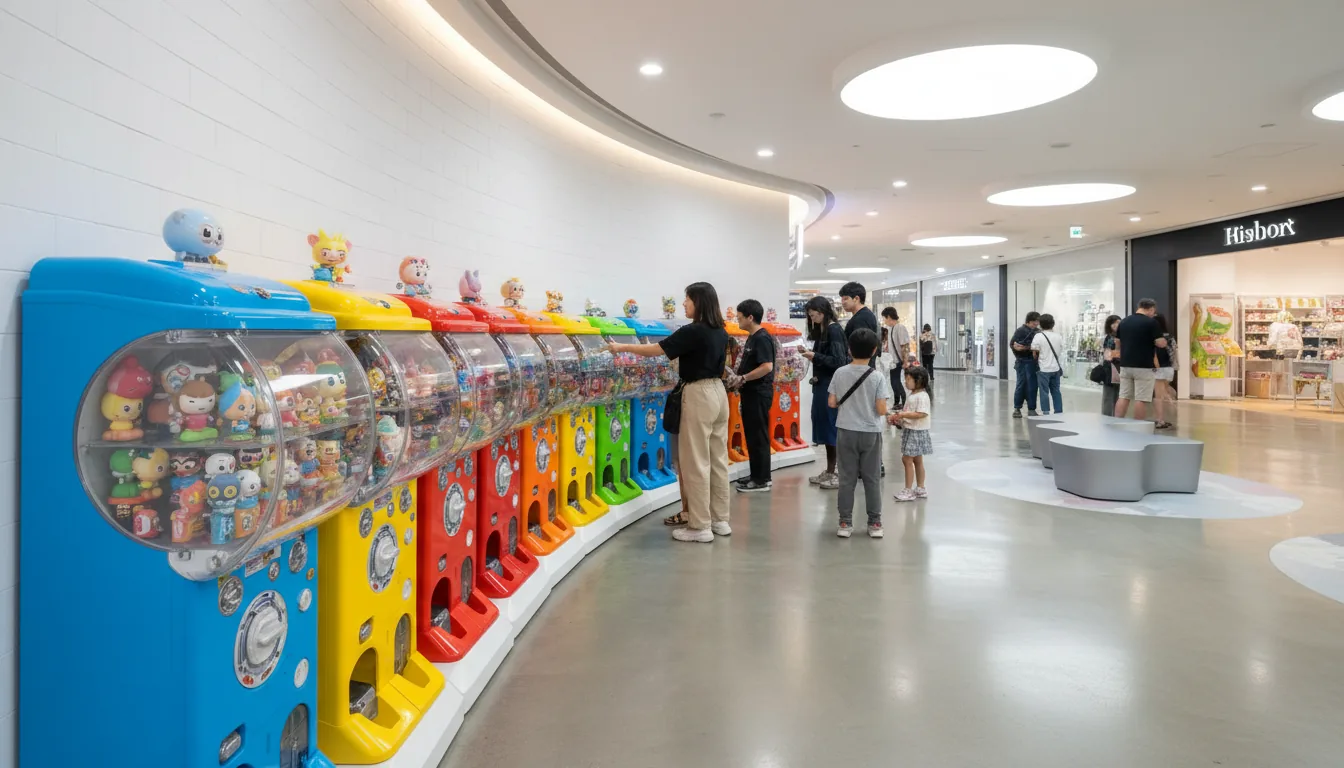
Why Location Is Everything in Gashapon Vending
Ask any experienced capsule toy operator what separates a $300-a-month machine from a $1,500-a-month machine, and they'll give you the same one-word answer: location. Product quality matters. Restocking frequency matters. Pricing matters. But none of these variables moves the needle like foot traffic and demographic fit combined.
The math is straightforward. A gashapon machine in a high-traffic mall sees 400–800 passers-by per day. Even a 2% conversion rate — extremely conservative for an impulse product priced at $2–$5 — generates 8–16 sales. At $3 average, that's $24–$48 per day, or $720–$1,440 per month before revenue share. In a low-traffic corridor seeing 60 people per day, that same 2% rate produces barely $65 per month. You'd be underwater on rent, restocking, and machine maintenance.
The data from the Japan Vending Machine Manufacturers Association consistently shows that locations with 3,000+ daily visitors deliver 4.7× the revenue of locations with under 500 daily visitors. That multiplier holds remarkably steady across different markets — the US, UK, Australia, and Southeast Asian markets all follow the same curve.
Foot traffic volume alone isn't sufficient, however. Demographics — specifically age range, disposable income, and cultural familiarity with collectibles — can swing revenue by another 2–3×. A university campus with 8,000 daily students will outperform a suburban grocery store with 10,000 daily visitors if the product mix is right, because the student demographic over-indexes on anime collectibles and novelty items relative to grocery shoppers.
Finally, dwell time is an underappreciated multiplier. People waiting — for a movie to start, for food to arrive, for a flight to board — are dramatically more likely to interact with a capsule machine than people in transit. This is why theaters and airports consistently outperform their raw foot traffic numbers would suggest.
Top 10 Proven Location Types with Revenue Data
1. Shopping Malls — Near Food Courts ($800–$2,000/month)
Shopping malls remain the gold standard for gashapon operators in Western markets. The combination of high foot traffic, long dwell times, and a mix of age groups creates near-perfect conditions. Placement near food courts is the single most valuable sub-location within any mall: people sitting and waiting generate 3× more gashapon interactions than people walking past.
The ideal mall placement is within 15–20 feet of the food court seating perimeter, or adjacent to a popular anchor tenant like a toy store, anime retailer, or family restaurant. Mall management increasingly recognizes capsule toys as "experiential retail" that differentiates their space from e-commerce competition, making them more receptive than ever to operator pitches.
Revenue range: $800–$2,000/month for a 4-machine bank. Top performers in tier-1 malls with premium anime products consistently report $1,800–$2,400/month. Revenue share typically runs 20–28% of gross to the mall.
2. Anime and Comic Shops — Captive Audience ($600–$1,500/month)
Specialty hobby retailers offer the highest demographic fit of any location type. Customers walking into an anime shop have already self-selected as collectible enthusiasts with disposable income allocated to exactly this category. Conversion rates in anime shops run 6–10% — roughly 3–5× the baseline for neutral retail locations.
The challenge is that these shops are smaller, foot traffic is lower in absolute terms, and owners are often collectors themselves who want a cut of the action. Revenue share here tends to be negotiated as a flat monthly fee rather than a percentage — typically $80–$200/month for floor space — which works in your favor once volumes climb.
Stock alignment is critical. An anime shop's customers will immediately notice if your machine is stocked with generic no-brand products. Match your inventory to what the store sells: if they're a Dragon Ball shop, fill your machine with Bandai Dragon Ball series. The complementary relationship also drives upsell for the host retailer, making them motivated partners.
3. Airports and Travel Hubs — Impulse Buy Goldmine ($1,200–$3,000/month)
Airports represent the single highest-revenue opportunity in the capsule toy vending industry. Several factors converge: passengers are bored, emotions are elevated (excitement or anxiety), cash is in hand from trip budgets, and the gift-buying mindset is already activated. A capsule toy at $3–$5 is a trivially small decision for someone who just paid $400 for a flight.
International terminal placements outperform domestic by 40–60%, largely because international travelers have longer wait times and a stronger souvenir impulse. Post-security placements significantly outperform pre-security because passengers can't leave — they're a captive audience with nowhere else to spend $3.
The barrier to entry is high. Airport retail concessions are controlled by large operators (HMSHost, SSP Group, Paradies Lagardere) who lease space from the airport authority. Getting a placement typically requires either a partnership with one of these concessionaires or applying directly to smaller regional airports where management is accessible. Expect revenue share of 25–35% and a competitive application process.
4. Movie Theaters — Wait Time Monetization ($500–$1,400/month)
Movie theaters are excellent gashapon locations for three reasons: mandatory dwell time (people arrive 10–30 minutes before showings), a demographic that already pays for entertainment experiences, and high frequency of visits from repeat customers. The lobby becomes a revenue opportunity during every pre-show period.
Placement near the concession stand or between the lobby entrance and the theater doors is ideal. Avoid placement in hallways between theaters — traffic there is directional and purposeful. The ticket-buying area is good; the line formation zone is better. Some operators report their best results placing machines adjacent to ticket kiosks where people are stationary and often with children.
Cinema chains are increasingly open to revenue-sharing partnerships as they seek to diversify lobby revenue beyond popcorn and drinks. Indie cinemas and small regional chains are far easier to approach than AMC or Regal, which have centralized procurement.
5. Arcades and Entertainment Centers ($700–$1,800/month)
Arcades are natural partners for gashapon machines — the customer base is identical. People already in an arcade have demonstrated willingness to spend discretionary money on game outcomes, which maps perfectly to the gashapon randomness model. The social environment also plays a role: people pull capsules in groups, creating peer pressure and fun that drives multiple purchases.
Family entertainment centers (FECs) like Dave & Buster's, Round1, and regional equivalents are particularly strong. Round1 — the Japanese entertainment chain expanding across the US — often installs their own gashapon banks, but independent arcades are almost always open to third-party placement with a reasonable revenue share.
Stock strategy matters enormously here: lean into gaming-adjacent IPs (Pokémon, Street Fighter, Final Fantasy) and avoid products that feel too "young child" or too "adult collector niche." The arcade demographic skews 14–28, which is the sweet spot for anime and gaming capsule toys.
6. Hotel Lobbies and Tourist Areas ($400–$1,000/month)
Tourist-heavy hotels — especially those catering to international travelers in cities known for anime culture (Los Angeles, New York, Chicago) — offer reliable if moderate revenue. The appeal is novelty: a capsule machine in a hotel lobby is unexpected, and unexpected delights generate impulse purchases more reliably than planned ones.
Focus on properties near conventions, theme parks, or entertainment districts. A hotel two blocks from an anime convention center will generate dramatically more capsule toy revenue during convention weekends than the average boutique hotel. Year-round performance is steadier than convention spikes suggest because the hotel demographic stays consistent.
Revenue here is modest because lobby traffic is lower than retail foot traffic. The advantage is low competition — very few operators think to target hotels — and low revenue share expectations from hotel management (often flat fee of $50–$100/month for a machine or two).
7. Grocery Stores — Near Entrance or Checkout ($300–$900/month)
Grocery stores are a more challenging but accessible location for new operators. The demographic is broad (which can mean lower conversion) but the foot traffic is extremely reliable and consistent. A mid-size supermarket sees 2,000–5,000 visitors per week — traffic numbers that smaller specialty retailers can't match.
The key is placement. Near-entrance placement captures attention on the way in; checkout-adjacent placement (near the self-checkout kiosks, specifically) captures impulse buying when people are already in spending mode and often accompanied by children. Avoid placement deep in the store or in a corner — discovery is everything.
Product mix needs to skew accessible: cute animals, food miniatures, and character toys with broad recognition (Pokémon, Sanrio) outperform niche anime series here. The grocery shopper demographic is not a hardcore collector, but they will spend $2–$3 on a cute capsule for a child or as a curiosity.
8. Libraries and Community Centers — Family Audience ($150–$500/month)
Libraries and community centers offer lower revenue ceilings but near-zero competition and extremely low placement costs. These are ideal for operators building a portfolio and needing low-risk locations while establishing business relationships. Libraries often have a waiting area, children's sections, and after-school programming that brings families in regularly.
Revenue expectations should be modest: $150–$400/month is realistic for a single machine. The demographic is heavily family-oriented, so stock accordingly — avoid anything edgy, adult-themed, or expensive per capsule. Animal figures, cartoon characters, and educational miniatures perform well.
Community centers and recreation centers often operate on a nonprofit or municipal basis, which means placement fees are minimal or zero, sometimes negotiated as a small donation. This makes them excellent training grounds for new operators learning the business without high financial stakes.
9. University Campuses — Student Foot Traffic ($500–$1,400/month)
University campuses represent an underutilized opportunity. The student demographic (18–25) over-indexes on anime, gaming, and collectibles more than almost any other group. University student centers, game rooms, and common areas see concentrated foot traffic during predictable hours, making inventory management easier.
Campus placements often require working with student services or facilities management rather than a private landlord, which can be slow but often yields favorable terms. Many universities see capsule toys as an enrichment amenity and charge minimal fees — flat rates of $50–$150/month are common.
The academic calendar creates strong seasonal variance: peak is September–November and January–April during semesters; near-zero during summer. Budget accordingly and consider pulling machines for maintenance during summer break. Stock strategy should emphasize anime, gaming, and cute/funny series — this is the most anime-literate demographic you'll encounter.
10. Pop-Up Events and Conventions — Peak Revenue ($500–$2,000 per weekend)
Anime conventions, comic cons, craft fairs, and pop-up markets are the highest-intensity, highest-revenue opportunity in the capsule toy business. A well-positioned machine at an anime convention with 20,000+ attendees can generate $800–$2,000 in a single weekend. The concentrated demographic (passionate collectors with convention budgets allocated) drives extraordinary conversion rates of 15–25%.
Event vending requires mobile setup — most operators use wheeled display carts with 2–4 machines, easy coin management, and quick restocking. Booth fees range from $100 for a local craft fair to $800–$1,500 for a major anime convention. Even at the high end, a single strong weekend covers the fee and generates significant profit.
Event exclusives and limited-edition stocking are the key differentiator at conventions. Collectors attending an anime con will skip your machine if it's stocked with products they can find anywhere. Stock with recently released, hard-to-find, or event-exclusive series and your conversion rate climbs dramatically.
Evaluating Any Location: A Systematic Approach
Step 1: Foot Traffic Counting
Never rely on estimates from a venue owner — their numbers are always inflated. Conduct your own count. Visit the location on three different days at different times and count actual passers-by for 15-minute intervals. Multiply to get hourly and daily estimates. A rough minimum threshold for a viable single machine: 500 unique daily passers-by. For a 4-machine bank: 2,000 daily.
Modern alternatives include using foot traffic data from services like Placer.ai or SafeGraph, which aggregate cell phone location data into visit counts. Some operators use simple tally counters and a clipboard to manually count during visits.
Step 2: Demographics Analysis
Observe who is actually walking by, not just how many. Note the approximate age breakdown, whether families with children are present, and whether the environment suggests discretionary spending behavior. A crowd leaving a discount store is different from a crowd leaving a cinema — even at identical volumes.
Look for indicators: Are people carrying shopping bags? Are there children present? Do you see anyone wearing anime merchandise? These visual cues tell you whether your product mix will find a receptive audience.
Step 3: Competition Check
Identify all existing vending — capsule machines, prize games, claw machines — within a 50-foot radius. Competition isn't always bad; a cluster of machines creates a "vending destination" that draws visitors intentionally. But a location already saturated with poorly maintained capsule machines signals that the category is already being served (or that the location hasn't proven out for previous operators, which is a red flag).
Also evaluate competition from nearby retail: if there's a toy store 30 feet away selling the exact series you'd stock, your machine faces a different competitive dynamic than one in a venue with no collectible retail nearby.
Negotiating Placement Fees: Revenue Share vs. Flat Fee
Revenue Share: 15–30% of Gross
Revenue share is the standard model in higher-traffic commercial locations. The venue earns a percentage of every dollar collected — typically 15–30% depending on the location type and your negotiating leverage. Revenue share protects you when the location underperforms: if you earn nothing, the venue earns nothing. It also aligns incentives — a good venue partner will promote your machines if they share the upside.
Offering revenue share to a new venue partner shows confidence: you're betting on your own ability to generate sales. Start negotiations at 15%, expect to land at 20–25% for premium placements, and don't go above 30% unless the location is genuinely exceptional (major airport, top-tier mall anchor position).
Flat Fee: $50–$300/Month
Flat fee arrangements favor the operator once volume is established. If you know a location reliably generates $1,200/month, a $150 flat fee beats a 20% revenue share ($240/month) significantly. Pitch flat fees to smaller venues — libraries, hotels, small retailers — where the owner doesn't have a sophisticated understanding of vending economics.
New operators should be cautious with flat fees at unproven locations: if the machine underperforms, you're still on the hook for the monthly payment. Consider negotiating a 60-day trial period before committing to a long-term flat fee arrangement.
What to Offer in Your Pitch
Venue owners respond to three things: money, convenience, and aesthetics. Lead with the revenue share offer, emphasize that you handle all maintenance and restocking (zero work for them), and bring photos or examples of clean, well-designed machines. Promise monthly revenue reports via email — transparency builds trust and reduces management anxiety.
Location Agreements and Legal Considerations
Always formalize a placement agreement in writing, even for small locations. A one-page agreement should cover: duration (12-month initial term with 30-day exit for either party), revenue share or flat fee terms, payment schedule (monthly, on the 1st), your right to access the machine for restocking and maintenance, liability for machine damage, and who handles coin collection logistics.
Check local regulations on coin-operated vending devices. Most US states and Canadian provinces require a vending machine operator license (typically $25–$100/year). Some municipalities require permits for each machine installed. In states with strict consumer protection laws (California, New York), ensure your product labeling complies with disclosure requirements for randomized products.
Tax considerations: revenue from vending is self-employment income. Keep detailed records of machine revenue by location (most modern coin mechs support this), as you'll need to report per-location income if your landlords issue 1099s. Set aside 25–30% of gross profit for self-employment tax if operating as a sole proprietor.
Seasonal Location Strategy
Gashapon revenue follows predictable seasonal curves that should inform your location strategy throughout the year.
Q4 (October–December) is peak season. Halloween, Black Friday, and Christmas drive gift-buying impulse dramatically. Mall locations see their highest traffic of the year; convention season wraps up with major events. Stock your best series, increase restocking frequency, and if you have the capacity, add temporary machines in high-traffic seasonal locations (holiday markets, pop-up shopping events).
Q1 (January–March) is the slowest period for most operators. Post-holiday traffic drops significantly. Use this period for machine maintenance, renegotiating location agreements, and exploring new location prospects. University campus machines maintain steady performance due to the academic calendar.
Q2 (April–June) marks the start of convention season. Anime North (May, Canada), Anime Central (May, Chicago), and dozens of regional cons launch. Begin booking event vending in January for spring shows — the best booth positions fill early.
Q3 (July–September) peaks with Anime Expo (July, Los Angeles — the largest US anime convention), Comic-Con International (San Diego, July), and otakon (Washington, DC, July). Summer school breaks drive family traffic at malls and entertainment centers. This is the second-strongest revenue quarter for most operators.
Red Flags: Locations to Avoid
Knowing where not to place machines saves you money, time, and frustration. These warning signs should make any operator walk away from a location prospect:
Low or unpredictable foot traffic: Any location that can't demonstrate consistent daily traffic of at least 400–500 potential customers is unlikely to perform. "We get busy on weekends" without verifiable weekday traffic means you'll run a break-even operation at best.
Wrong demographic: Foot traffic volume means nothing if the demographic doesn't match. A retirement community common room gets plenty of daily foot traffic; it is not a viable gashapon location. Always verify that the actual visitors match your buyer profile.
Hostile or indifferent management: If the venue owner or manager is unenthusiastic, frequently unavailable, or resistant to your access for restocking, the operational headache will outweigh any revenue. You need a willing partner, not a landlord who tolerated your pitch.
High theft and vandalism risk: Locations in areas with known petty theft problems will result in machine damage, coin theft, and capsule tampering. Look for locations with active security presence, good lighting, and camera coverage. Avoid any location where the owner mentions previous vandalism of their own fixtures.
Lease instability: A location that's "probably going to renew their lease" is a risk. If the host business closes or moves, your machine may be stuck in limbo or damaged. Always ask about lease terms and the business's stability before investing in a placement relationship.
Excessive revenue share demands: Any venue asking for 40%+ of gross is not worth it unless the location is truly exceptional. At 40% revenue share, your margin after restocking and machine costs makes the operation barely viable. Walk away from greedy partners.
Location Comparison Table
Use this table to quickly evaluate and compare location opportunities against each other.
| Location Type | Monthly Traffic Est. | Revenue Potential | Revenue Share Typical | Difficulty to Get |
|---|---|---|---|---|
| Shopping Mall (Food Court) | 50,000–200,000 | $800–$2,000/mo | 20–28% | Medium |
| Anime / Comic Shop | 3,000–15,000 | $600–$1,500/mo | Flat $80–$200/mo | Easy |
| Airport / Travel Hub | 100,000–500,000 | $1,200–$3,000/mo | 25–35% | Very Hard |
| Movie Theater | 15,000–60,000 | $500–$1,400/mo | 20–25% | Medium |
| Arcade / FEC | 10,000–50,000 | $700–$1,800/mo | 15–25% | Easy–Medium |
| Hotel Lobby / Tourist Area | 5,000–20,000 | $400–$1,000/mo | Flat $50–$100/mo | Easy |
| Grocery Store | 20,000–80,000 | $300–$900/mo | 15–20% | Medium |
| Library / Community Center | 2,000–10,000 | $150–$500/mo | Flat $0–$75/mo | Very Easy |
| University Campus | 10,000–40,000 | $500–$1,400/mo | Flat $50–$150/mo | Easy |
| Pop-Up Event / Convention | 5,000–50,000/event | $500–$2,000/weekend | Booth fee $100–$1,500 | Easy–Medium |
Building Your Location Portfolio
Experienced gashapon operators rarely rely on a single location. The most profitable operations run a diversified portfolio of 8–20 machines across 5–10 location types, which smooths out seasonal fluctuations, demographic mismatches, and the inevitable location that underperforms expectations.
A sensible growth trajectory for a new operator: start with 2 machines at 2 easy-to-access locations (an anime shop and a university campus game room). Learn restocking logistics, coin counting, and inventory management at low stakes. Reinvest revenue into 2 more machines after 90 days. By month six, target one premium location (a mall or arcade) that requires a more formal pitch. By month twelve, a well-run portfolio of 8–10 machines in varied locations can generate $5,000–$12,000/month gross revenue with 40–55% margins after product, revenue share, and operational costs.
Location scouting never stops. The best operators are always visiting new venues, building relationships with managers, and identifying opportunities before they become competitive. The gashapon industry in Western markets is still early — operators who establish strong location networks now will have significant advantages as the market matures and competition increases.