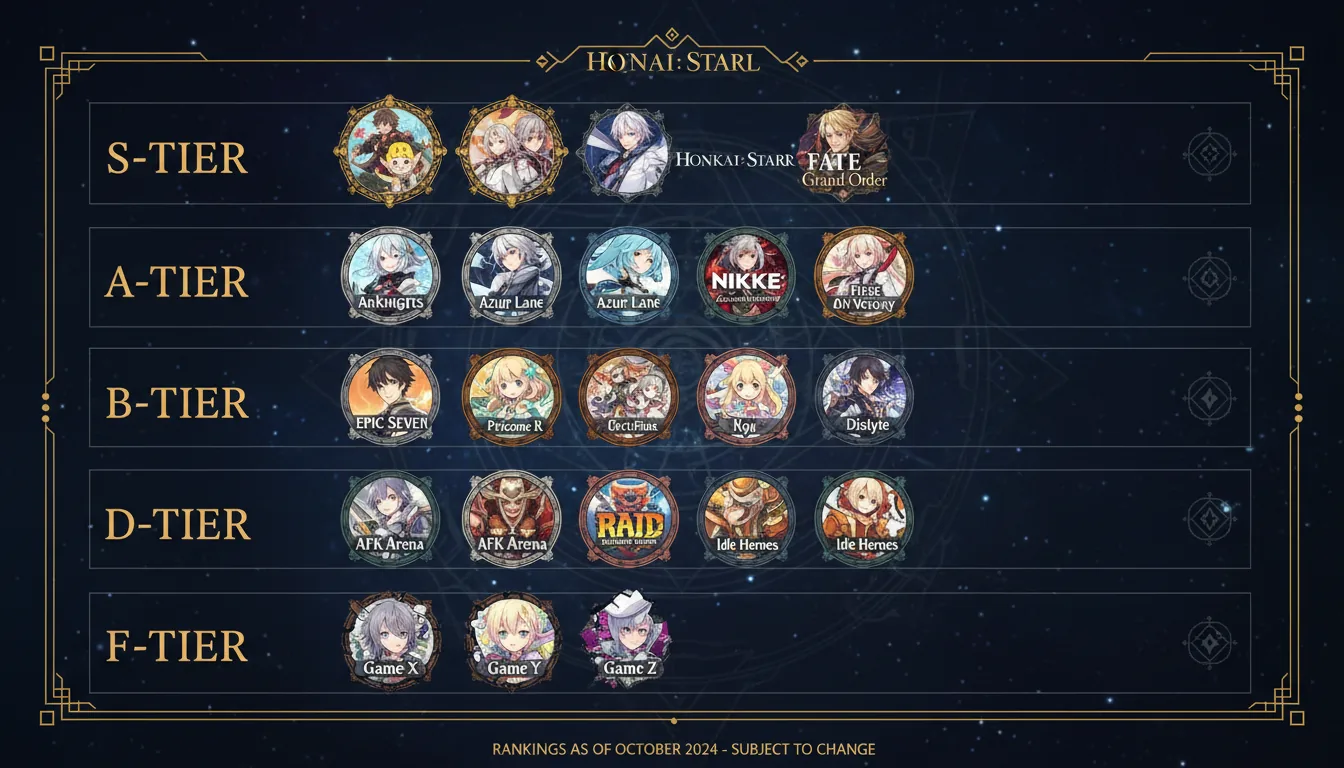
How We Rank Gacha Games: Our Five Criteria
Ranking gacha games fairly requires consistent criteria applied honestly across the entire field. Every game on this list is evaluated on the same five dimensions, each weighted to reflect what actually matters for long-term player satisfaction. This is not a graphics ranking, a popularity contest, or a tier list based on which game generates the most revenue. It's an honest assessment from the perspective of players who want to spend their time (and potentially some money) wisely.
1. F2P Value (30% Weight)
How much meaningful content can a free player access without paying? How many premium currency units does the game generate per month through consistent play? How long does it take to guarantee a specific character? F2P value is the most heavily weighted criterion because it determines whether a game respects all of its players or only those who pay. Games that gate endgame content, meaningful progression, or competitive viability behind paywalls score poorly regardless of their other qualities.
2. Pity System Quality (25% Weight)
A well-designed pity system provides players a clear, transparent path to obtaining characters they want without requiring infinite spending. We evaluate: the hard pity threshold (lower is generally better, but context matters), whether the guarantee carries over between banners, how transparent the system is, and whether the system applies equally to limited and standard characters. The worst pity systems — those with no carry-over, unclear mechanics, or effective pity thresholds of 200+ pulls — score F. The best provide clear guarantees, carry-over across banners, and transparent UI feedback.
3. Content Quality (20% Weight)
Is the gameplay itself fun, deep, and varied? Does the game have engaging story content? Does the endgame provide challenge and replayability beyond grinding the same missions? Content quality separates games that justify ongoing engagement from those that become mindless chores. Games with genuinely excellent gameplay systems — tactical depth, exploration, narrative quality — score higher even if their gacha economics are average.
4. Monetization Fairness (15% Weight)
How aggressive is the game's monetization relative to its free content? Does paying money provide a massive, gamebreaking advantage over free players (P2W), or does it simply accelerate progress (P2Faster)? Are bundles and purchases presented with psychological pressure tactics like countdown timers on "once only" offers? Gacha games are businesses and must monetize, but there's a meaningful spectrum between "fair" and "predatory."
5. Longevity and Active Development (10% Weight)
Is the game still actively developed and updated? Does it have a healthy playerbase? Has the developer demonstrated commitment to quality updates rather than maintenance mode? A brilliant game on life support scores lower than a slightly less polished game with an active development roadmap and a thriving community.
S Tier: The Best Gacha Games in 2026
S Tier games are those that excel across most or all criteria, deliver genuinely excellent experiences to free players, and justify the investment of your time as ongoing live service games in 2026.
Genshin Impact
Despite being four-plus years old at this point, Genshin Impact maintains S Tier status because of the sheer volume and quality of its free content. No other gacha game offers a comparable amount of story, exploration, and gameplay that is completely free to access. The pity system is functional and carries over between banners of the same type, the base pull income is adequate for targeting one character per cycle with discipline, and HoYoverse has maintained a consistent update schedule of major content every six weeks without slowing down.
Genshin's weaknesses are real: the Weapon Banner is a trap, the primogem income per month is lower than some competitors, and power creep has gradually forced players to engage more deeply with the Character Event banner system to keep up with Spiral Abyss expectations. However, these weaknesses are outweighed by Teyvat's extraordinary breadth of free content, the game's consistent quality of new regions and story arcs, and its accessibility across platforms (PC, mobile, PlayStation). If you haven't played Genshin or haven't visited since 2021, the game is significantly better and larger than you remember.
Honkai: Star Rail
Honkai Star Rail earns its S Tier position primarily through F2P economics and system transparency that surpass Genshin's. The monthly jade income — boosted by dual endgame modes in Memory of Chaos and Pure Fiction — grants roughly 29–37 warps per month versus Genshin's 22–28 wishes. The pity carry-over system is more clearly communicated in the UI, and the Simulated Universe provides engaging roguelite content that generates jade through strategic gameplay rather than mechanical repetition.
HSR's turn-based combat is strategically deep without the reaction-speed demands of action combat, making it accessible to a broader audience including players with disabilities that affect real-time gaming. The game's storytelling across worlds like Penacony and Amphoreus has drawn comparisons to classic JRPG narratives in terms of emotional impact and world-building ambition. Active development continues to add new Paths, new worlds, and systematic improvements to older content.
Arknights
Arknights is the most mechanically demanding game in S Tier, but it earns its place through extraordinary respect for player time and resources. The tower defense gameplay — where you place Operators on a grid to stop waves of enemies from reaching your base — has a depth curve that rewards mastery without punishing casual players in early content. The "Integrated Strategies" permanent roguelite mode is one of the best single-player endgame systems in any gacha game, providing hours of replayable content without requiring new unit purchases.
Arknights' gacha economy is among the most F2P friendly of any major gacha game. The hard pity for a 6-star (the highest rarity) is 99 pulls, and the guarantee carries across all banners. Headhunting Permits (the pull currency) are generated generously through story content, events, and monthly login bonuses. Furthermore, Arknights regularly offers limited units through non-gacha systems — players who don't pull for a limited character often receive them for free through event completion months later. Yostar's decision to offer "welfare operators" through events has built enormous goodwill. If you're interested in strategy gaming with some of the best gacha economics available, Arknights is S Tier without question.
A Tier: Excellent Games with Minor Compromises
A Tier games are excellent by any reasonable standard. They have strong gacha systems, good content, and justified fanbases. They fall short of S Tier due to one or two specific weaknesses that prevent them from being universally recommended to all player types.
Blue Archive
Blue Archive's emotionally resonant storytelling, distinctive aesthetic, and the thoughtful design of its Spark system push it into A Tier. The game genuinely respects its players' emotional investment — the relationship between Sensei and the students is written with unusual care for a mobile gacha game, and the narrative explores themes of connection, loss, and growing up with sincerity that most games at any budget level don't attempt.
The weaknesses are real but not dealbreakers: monthly Pyroxene income is lower than HSR or Genshin, the 200-pull Spark threshold means taking 7–12 months to guarantee a specific permanent student, and the hard pity at 200 pulls (without a specific character guarantee) is higher than competitors. For players who connect with the aesthetic and writing, these compromises are worth making. For pure F2P economists, other games offer better immediate returns.
Nikke: Goddess of Victory
Nikke launched in late 2022 and initially attracted attention for reasons that had little to do with gameplay, but what players found underneath the surface was a genuinely solid third-person shooter gacha with surprisingly compelling story writing. The game follows the Nikkes — android soldiers created to fight an alien invasion that drove humanity underground — and the narrative deals with themes of identity, sacrifice, and what it means to be human with more depth than the marketing materials suggest.
Nikke's gacha system improved significantly through 2023 and 2024, with pity mechanics that are now among the more player-friendly in the industry. The Mileage (pity) system grants a guaranteed SSR at 200 pulls and allows you to pick a specific unit from the current rate-up pool at 400 pulls — a double guarantee that provides meaningful certainty. Active events, consistent content updates, and a passionate development team that responds to player feedback have solidified Nikke's position as a long-term franchise.
Reverse: 1999
Reverse: 1999 is one of the most visually distinct gacha games ever made. Set in a surrealist alternate history where a temporal storm is erasing history one decade at a time, it features art direction inspired by mid-20th century European illustration, a turn-based combat system built around "spell cards," and writing that consistently surprises players with its sophistication. The English localization is unusually excellent — almost no flavor is lost from the original Chinese, and some dialogue has been noted as superior to comparable games translated at triple the budget.
The gacha system features a 70/30 rate-up (slightly better than Genshin's 50/50), hard pity at 70 pulls (better than HSR's 90), and a secondary "Bounty" system that allows direct purchase of specific resonators using in-game currency. These mechanics make Reverse: 1999 one of the most F2P friendly games in the market when it comes to actually obtaining the characters you want. It sits in A Tier rather than S primarily because its player base is smaller and the endgame is less developed than S Tier offerings, limiting its appeal to players who prioritize community and content volume.
AFK Journey
AFK Journey is the 2024 sequel to AFK Arena, adopting a 3D open-world format that dramatically expands on its predecessor's scope. The idle RPG foundation remains — heroes fight automatically, and offline progress continues while you're away — but the addition of exploration, seasonal world events, and guild content gives the game a social dimension that pure idle games lack. The gacha system is generous by industry standards, with a relatively low effective pity and regular free summons through exploration and daily activities. AFK Journey explicitly avoids the hard P2W monetization that plagued some earlier Lilith Games titles, sitting closer to the fair end of the spectrum.
B Tier: Good Games with Honest Caveats
B Tier games are enjoyable and have dedicated fanbases, but come with specific trade-offs that make them inappropriate recommendations for general audiences. They excel in at least one dimension — usually content quality or community — while underperforming in others, typically monetization or pity systems.
Fate/Grand Order
FGO is the game that proved gacha games could sustain a passionate paying audience through story quality alone. The narrative scale — Type-Moon's full mythos deployed across dozens of chapters, each as long as a JRPG's story — is genuinely impressive, and many players cite it as the best-written mobile game they've experienced. The fan community is enormous, creative, and passionate.
However, FGO has the worst pity system of any major gacha game still in active operation. The base 5-star rate is 1%, there is no hard pity (you could theoretically never pull a 5-star in hundreds of pulls), pity counters reset between banners, and there is no 50/50 or guarantee mechanic. Limited characters can go years without a rerun. For F2P players, FGO is essentially a game where you play with whatever the free story rewards give you and accept that pulling limited characters is a high-variance gamble. If you're joining for the story (which is free to read even without clearing the gameplay), it's excellent. If you want to play competitively or collect specific Servants, prepare for a rough F2P experience.
Dragon Ball Legends
DBL has sustained remarkable longevity by continuously releasing powerful new versions of beloved Dragon Ball characters and providing enough content to keep the franchise's enormous fanbase engaged. The gameplay — a real-time card-based combat system — is snappy and satisfying for quick sessions, and the presentation of Dragon Ball characters is consistently high quality. However, the power creep is aggressive, the paid character meta strongly favors spenders in PvP, and the exchange shop system (allowing direct character purchase) paradoxically emphasizes how much pulling is required to access premium units. B Tier for franchise fans; approach cautiously as a newcomer.
AFK Arena (Original)
With AFK Journey having taken the franchise's future, AFK Arena itself is in an awkward position — still maintained and updated, still played by millions, but no longer the priority game for Lilith. The idle mechanics remain satisfying and the art direction is distinctively beautiful, but the hard P2W monetization and significant investment gap between paying and free players has always been AFK Arena's most criticized quality. B Tier as a casual idle game for players who don't mind limited competitive viability.
C Tier: Decent Games for Specific Audiences
C Tier games aren't bad — they have their audience and their loyal players — but they're not what most newcomers should start with in 2026. They typically excel in a niche (specific IP, specific gameplay style) while underperforming in general gacha metrics.
One Piece Treasure Cruise
OPTC is one of the longest-running gacha games in operation, having launched in 2014 and maintained an active playerbase for over a decade. The rhythm-based combat (tapping characters in time with their attack animations) is uniquely satisfying once mastered, and the representation of One Piece's enormous cast is comprehensive and loving. For One Piece fans, OPTC remains the most complete and active One Piece gaming experience available on mobile.
For everyone else, the decade of accumulated content creates a steep onboarding curve, the gacha rates are not competitive with modern standards, and power creep has reached a level where older units are effectively useless. C Tier: excellent for dedicated One Piece fans, confusing and dated for everyone else.
Dragon Ball Dokkan Battle
Dokkan Battle is another decade-old franchise game with a passionate base and significant power creep issues. The gameplay — a puzzle-based board game where you match colored orbs to activate character abilities — is genuinely clever and deep at high levels, requiring real skill to execute optimally. Bandai Namco periodically provides extremely generous summon events and anniversaries that distribute free premium currency at rates unheard of in newer games. The community is expert-level at optimizing F2P play around these events. C Tier: fun if you commit to understanding the meta around its generous events; confusing and expensive otherwise.
D Tier: Games to Avoid in 2026
D Tier represents either games in significant decline, games with unacceptably predatory monetization, or generic auto-battlers that offer nothing a better game in this list doesn't provide more of.
Generic Auto-Battler RPGs
The mobile gacha market is saturated with auto-battling RPGs that offer beautiful character art, flashy animations, and gacha systems built entirely around creating infinite FOMO. These games — which exist in the hundreds and frequently shut down within 12–24 months of launch — share common warning signs: gacha rates of 0.1–0.3% for top rarity, no meaningful hard pity, energy-gated everything, and heavy emphasis on limited-time bundles rather than earned F2P currency. If a new game you're considering shares all of these characteristics, it belongs in D Tier regardless of its IP or art quality.
Games with Expired Operational Relevance
Several games that were relevant S or A Tier titles in previous years have declined to D Tier through neglect, server population collapse, or developer shutdown. Games in this category include several titles that were popular in 2020–2022 but have since entered maintenance mode with minimal new content and shrinking player bases. Starting a new account in a game without a healthy active community severely limits the social and cooperative aspects that make gacha games enjoyable long-term. Research active server populations before starting any game not mentioned in S or A Tier above.
Pure P2W Titles
Games where paying money confers a direct, unavoidable competitive advantage over free players in PvP content belong in D Tier on principle. This includes games where the strongest characters are locked behind paid-only systems, where top PvP rankings require spending that the game's own monthly free currency cannot support even in 12 months, or where the effective competitive ceiling for F2P players is fundamentally lower than for spenders in a way that isn't offset by skill or strategy. These games treat free players as advertising for paying players, not as a valued part of the community.
What Changed in 2026: New Games, Risers, and Fallers
New Entries in 2026
2026 brought several notable new gacha games that deserve attention. Wuthering Waves, which launched in 2024, has continued to mature into a serious Genshin competitor in the action combat space. Its open-world exploration, introduced with the Rinascita expansion, is genuinely beautiful, and HoYoverse-adjacent design quality is evident throughout. More critically, Kuro Games has been dramatically more generous with the game's gacha currency than HoYoverse, making Wuthering Waves legitimately more F2P friendly than Genshin on a pulls-per-month basis. Watch this space — Wuthering Waves is on the trajectory to S Tier if its development momentum continues.
Zenless Zone Zero, HoYoverse's third major release, also launched in 2024 and has found its footing as an action gacha set in a post-apocalyptic urban fantasy world. The stylized, high-energy aesthetic (think neon-lit city streets, anime aesthetics filtered through a hip-hop visual language) differentiates it from Genshin and HSR. Its gacha system is essentially identical to HSR's, which is a net positive, and the Signal Proxy (endgame mode) and Hollow Zero (roguelite) content have improved substantially since launch.
Games That Improved in 2026
Reverse: 1999 continued to earn goodwill through consistent quality updates, an expansion into 3D environments for exploration, and a growing international community. The developers have been unusually responsive to feedback, adjusting gacha rates and adding targeted-pull mechanics that improve F2P experiences. Nikke also maintained its A Tier trajectory through strong seasonal events and a development team that has consistently treated its players better than its early marketing suggested it would.
Games That Declined
Several games that ranked highly in 2022–2023 tier lists have declined through a combination of power creep, reduced content quality, and competitor pressure. Tower of Fantasy — which generated enormous hype as a "Genshin killer" on release in 2022 — has struggled to maintain its initial player base despite competent content and a genuinely competitive open-world offering. The combination of aggressive monetization decisions and a content pacing that left players between major updates for too long has eroded its community, dropping it from A Tier consideration in 2023 to B Tier in 2026.
Pity System Deep Comparison: The Numbers That Matter
No single metric matters more for F2P planning than pity system design. Here's an honest comparison of how the major games handle their guarantee mechanics.
Genshin Impact vs HSR
Both share a 90-pull hard pity and soft pity starting at 74, but HSR's carry-over is more transparent in the UI and applies to guarantee status more clearly. HSR's additional endgame mode (Pure Fiction) generates meaningfully more monthly pulls. Slight HSR advantage.
Arknights
Hard pity at 99 pulls sounds worse than 90, but the carry-over system applies to ALL banners without exception, the guarantee rate increases dramatically in the final 10 pulls before hard pity, and the welfare operator system effectively gives F2P players access to some limited characters for free months after their banner. The overall F2P experience is arguably the best in the industry for players who can handle the steeper gameplay learning curve.
Blue Archive
Hard pity at 200 pulls is the highest in the major gacha market, but the Spark system (200 Recruitment Certificates for any permanent unit) provides a reliable alternative path. The weakness is that the Spark excludes limited units, which are the most desirable characters in the game. For permanent units, Blue Archive is fine for patient players. For limited units, it's harsh.
Fate/Grand Order
No hard pity. No guarantee carry-over. 1% base rate for 5-stars. Every banner resets the accumulated pull count. This is by far the worst pity system among major ongoing gacha games, and it's a deliberate design decision that Aniplex has not changed despite community pressure for years. The only saving grace is that FGO's story is so extensive and free that most players don't need to pull limited units to enjoy the core product.
Reverse: 1999
Hard pity at 70 pulls (the lowest among major gacha games), 70/30 rate-up, and a secondary Bounty system for direct character purchases. The best pure pity system numbers in the industry. If Reverse: 1999 had a larger content library and player base, it would challenge for S Tier on the strength of its gacha mechanics alone.
Best Gacha Game for Your Playstyle
For Casual Players (Under 20 Minutes/Day)
Blue Archive and AFK Journey are the strongest options. Both have robust auto-battle and sweep systems that minimize mandatory active gameplay time. Blue Archive's story is engaging even in short sessions, and the emotional investment it creates doesn't require grinding. AFK Journey's idle progression means you're always advancing even when offline.
For Competitive Players Who Want to Top Rankings
Honkai Star Rail (Memory of Chaos leaderboards) and Blue Archive (Total Assault rankings) both have competitive endgame modes that reward optimization without being fully pay-to-win. Arknights' Challenge Mode (CM) stages are the most mechanically demanding competitive content in any gacha game and fully achievable by F2P players with the right Operators and strategy.
For Free-to-Play Purists
Arknights is the undisputed king for players who refuse to spend anything. The welfare operator system, generous event drops, and developer goodwill toward free players mean a truly F2P Arknights account can access almost all content and obtain many limited characters without spending. HSR is second place in this category.
For Players Who Want to Spend a Little (Welkin/Pass Equivalent)
Genshin Impact's Welkin Moon ($4.99/month) provides the best value-to-purchase ratio in the gacha industry. HSR's equivalent Express Supply Pass is similarly excellent. Both roughly double a free player's monthly pull income for the cost of a streaming service subscription.
For Players Who Care Most About Story
FGO has the most content, but Genshin Impact has the highest production values. HSR offers the most emotionally impactful recent storylines. Reverse: 1999 has the most distinctive writing style. Blue Archive has the deepest character relationships. This is genuinely a matter of taste — all four are legitimate choices for narrative-focused players.
For PC Players
Genshin Impact and HSR have the best native PC clients with full keyboard/mouse support and consistently higher-quality visual options than their mobile counterparts. Arknights is fully playable on PC through the Yostar game client. Most other games listed here are primarily mobile experiences that work on PC through emulators with varying quality.
Full Gacha Games Comparison Table 2026
| Game | Tier | Hard Pity | F2P Rate | Monthly Pulls | Platform | Active? |
|---|---|---|---|---|---|---|
| Genshin Impact | S | 90 pulls | 50/50 | ~22–28 | PC / Mobile / PS | Yes — major updates |
| Honkai: Star Rail | S | 90 warps | 50/50 | ~29–37 | PC / Mobile | Yes — major updates |
| Arknights | S | 99 pulls | 50/50 | ~30–40 | PC / Mobile | Yes — full roadmap |
| Blue Archive | A | 200 pulls | ~0.7% (rate-up) | ~16–29 | Mobile | Yes — active events |
| Nikke: Goddess of Victory | A | 200 pulls | ~0.5% (rate-up) | ~25–35 | PC / Mobile | Yes — consistent |
| Reverse: 1999 | A | 70 pulls | 70/30 | ~20–30 | PC / Mobile | Yes — growing |
| AFK Journey | A | ~100 pulls | Variable | ~25–35 | PC / Mobile | Yes — seasonal |
| Fate/Grand Order | B | None | 1% (no rate-up) | ~15–20 | Mobile | Yes — legacy updates |
| Dragon Ball Legends | B | ~300 pulls | Low | ~20–25 | Mobile | Yes — IP driven |
| One Piece Treasure Cruise | C | Variable | ~0.5% | ~15–20 | Mobile | Yes — niche |
| Dokkan Battle | C | Variable | Low | ~10–20 (events) | Mobile | Yes — event-focused |
| Generic Auto-Battlers | D | None or high | Very low | Minimal | Mobile | Often closing |
Monthly pull estimates assume consistent daily play and full endgame mode participation. Rates vary by current banner; figures represent approximations based on community-verified data as of early 2026.