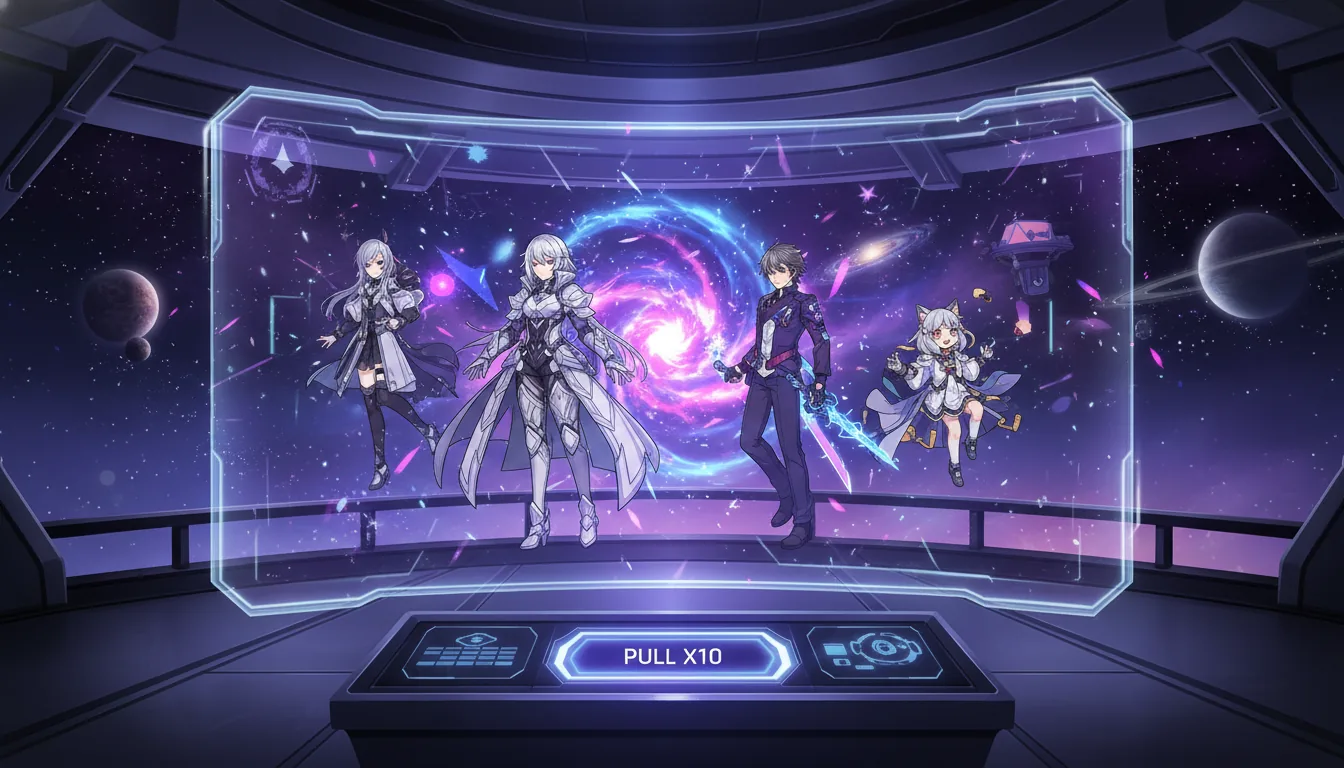
Honkai Star Rail Overview: HoYoverse's Space Epic
Honkai: Star Rail launched globally in April 2023 and quickly became one of the most popular gacha games ever released. Developed by HoYoverse — the same studio behind Genshin Impact and Honkai Impact 3rd — Star Rail distinguishes itself from its siblings through its turn-based RPG combat, a galaxy-spanning science fiction narrative, and a cast of characters drawn from a rich expanded universe that HoYoverse had been building since 2014.
The game follows the Trailblazer, a mysterious traveler who awakens aboard the Herta Space Station with powerful abilities related to Stellarons — catastrophic, world-destroying seeds of destruction. Alongside the Astral Express crew — the wise doctor Bailu, the enigmatic Welt, the cheerful March 7th, and the determined Dan Heng — the Trailblazer journeys across planets and space stations to confront the threat of Stellaron corruption while unraveling their own origin.
Unlike Genshin's real-time action combat, HSR uses a traditional turn-based system where each character acts in order of their Speed stat. This design makes the game significantly more accessible to players who find real-time combat demanding, and it opens the door to deeper strategic complexity in endgame content. A well-constructed team in HSR requires thinking about action value (how often a character acts), break mechanics (a system where enemies have a Toughness bar that, when depleted, causes a Break effect unique to each element), and skill point management across four characters.
By 2026, Star Rail has expanded to include six fully explorable worlds — Herta Space Station, Jarilo-VI, The Xianzhou Luofu, Penacony, Amphoreus, and several additional locations — each with its own culture, mythology, and major story arc. The story quality has earned praise from players who previously thought compelling narrative was incompatible with gacha games.
Warp Types: Understanding Every Banner in HSR
Honkai Star Rail calls its gacha currency system "Warps," and the act of pulling is called warping. The core currency is Stellar Jade (equivalent to Genshin's Primogems), and each warp costs 160 Stellar Jade or one Special Star Rail Pass/Star Rail Pass depending on the banner type.
Departure Warp (Beginner Banner)
The Departure Warp is a one-time banner available to new players. It guarantees a 5-star character within the first 50 pulls, and the pool is limited to a selection of Standard Banner characters. It costs Star Rail Passes (the standard currency) rather than Special Star Rail Passes. Every new player should complete this banner before doing anything else, as it provides a guaranteed 5-star at a discount compared to normal pity.
Stellar Warp (Standard Banner)
The Stellar Warp is the permanent banner, equivalent to Genshin's Standard Banner. It contains the six Standard 5-star characters (as of 2026): Bronya, Gepard, Bailu, Clara, Himeko, Welt, and newer additions like Yanqing and Argenti. This banner uses Star Rail Passes, which are rarer than Special Star Rail Passes. Importantly, when you lose the 50/50 on a Character Event warp, you receive a Standard 5-star — making your familiarity with the Standard pool important for planning.
Character Event Warp (Limited Banner)
This is the primary destination for most players' Special Star Rail Passes. New limited 5-star characters debut on these banners, which run for approximately three weeks before rotating. The featured rate-up character has a significantly enhanced drop rate, and the 50/50 system applies: hitting 5-star pity gives you a 50% chance at the featured character and 50% at a Standard character. Unlike Genshin, HSR also features one rate-up 4-star character on limited banners alongside the standard pool, which provides more consistent 4-star value.
Light Cone Event Warp (The Trap Banner)
The Light Cone banner — HSR's equivalent of Genshin's Weapon Banner — features two 5-star Light Cones (the game's equivalent of weapons). It operates on a 75/25 system and has a hard pity of 80 warps. Like Genshin's Weapon Banner, it can require up to 240 pulls to guarantee a specific Light Cone. This banner is almost never recommended for F2P players. We cover this in depth in the Light Cone Trap section below.
Pity Mechanics: The Key Differences from Genshin
On the surface, HSR's pity system looks nearly identical to Genshin's. In practice, one crucial difference makes HSR more F2P friendly: the guarantee carries over between banners, and it's more explicit about this in the UI.
Soft Pity at 74 Warps
Just like Genshin, HSR's Character Event banner begins dramatically increasing the 5-star rate starting at the 74th warp without a 5-star. The base 5-star rate on Character Event warps is 0.6%, and soft pity makes the rate climb sharply from pull 74 onward. Most players hit their 5-star somewhere between pulls 74 and 90, with the statistical average landing around pull 80.
Hard Pity at 90 Warps
Pull 90 is an absolute guarantee of a 5-star. This hard pity is identical to Genshin's Character Event banner. The pity counter is visible in the warp history screen and resets to 0 after every 5-star pull — but the count itself carries over between different Character Event banners. If you have 60 pity on one banner and don't pull the character, that 60 pity transfers to the next Character Event banner automatically.
The 50/50 System and Guarantee Carry-Over
This is where HSR shines above Genshin. When you hit a 5-star and lose the 50/50 (you get a Standard character instead of the featured one), HSR gives you a "guaranteed" status that carries over not just to the next banner of the same type, but across all future Character Event banners. The game's interface shows this guarantee status prominently — a gold star next to the warp button indicates you're guaranteed the next 5-star will be the featured character. There's no ambiguity, no need to track it manually. This transparency is a meaningful quality-of-life improvement over Genshin's system.
4-Star Pity
4-star characters are guaranteed within every 10 warps, and the featured 4-stars on Character Event banners are drawn from the same 50/50 rate-up pool concept. If the featured 4-star is one you want, the banner becomes even more valuable as a targeted resource.
Stellar Jade Farming Guide: Every Source That Matters
Stellar Jade is the lifeblood of the HSR gacha system. Here's every meaningful farming source in 2026, ranked by consistency and yield.
Daily Missions (60 Stellar Jade/Day)
HSR's Daily Missions are brief tasks — explore the map, use skills in battle, synthesize materials, etc. — that reset each day. Completing all four Daily Missions plus the daily quest objectives rewards 60 Stellar Jade per day, totaling 1,800 per month. As with Genshin's daily commissions, these are the most reliable single source of jade and should never be neglected by a serious F2P player. The daily missions in HSR are faster than Genshin's commissions on average, often completing in under 10 minutes.
Memory of Chaos (600 Stellar Jade per Reset)
Memory of Chaos is HSR's equivalent of Genshin's Spiral Abyss — a 12-stage endgame challenge that resets every two weeks. Each stage offers up to 60 Stellar Jade for three-starring it, making a full clear worth 720 Stellar Jade per reset (1,440 per month). Even partial clears yield substantial rewards, and the rotating modifiers each cycle keep the content fresh. Players who invest in at least two capable teams can reliably full-clear Memory of Chaos and should treat it as a cornerstone of their monthly jade budget.
Pure Fiction (600 Stellar Jade per Reset)
Introduced in a later patch, Pure Fiction is a second endgame mode that complements Memory of Chaos. It emphasizes different team archetypes — particularly AOE damage-focused compositions — and has its own 14-day reset cycle independent of Memory of Chaos. Strong players who maintain multiple diverse teams can earn up to 1,400+ Stellar Jade per month from these two endgame modes combined.
Simulated Universe (Weekly Jade Budget)
The Simulated Universe is a roguelite mode where you navigate through nodes, fight enemies, pick blessings (power-ups), and defeat a boss. Each week you have a Simulated Universe point budget that, when filled, rewards Stellar Jade directly. The amount varies by difficulty — higher difficulty Simulated Universe worlds reward more jade. We cover optimal strategies in the Simulated Universe section below.
Events and Story Content
Every major update delivers new story content, side quests, and limited events. First-time story completion rewards Stellar Jade in bulk — a new world's main storyline typically grants 400–800 Jade just for playing through it. Limited-time events add another 300–600 Jade per patch. Active players during a new patch release period can earn a significant boost to their reserves.
Redemption Codes
Like all HoYoverse games, HSR releases redemption codes during livestreams, milestones, and special occasions. Codes grant 50–100 Stellar Jade each. Following the HSR subreddit or official social accounts ensures you catch codes before they expire, typically within 24 hours of release.
Exploration and Achievements
Each world contains Jade locked behind exploration — hidden chests, puzzles, and side objectives. New worlds typically release 500–1,000 Jade of exploration content on launch. The Achievement system is also a substantial Jade source: many achievements are simple to unlock and collectively grant hundreds of Jade to attentive players who check the achievement list periodically.
Monthly Stellar Jade Income: The F2P Math
Here's a realistic monthly Stellar Jade budget for a consistent, active F2P player in 2026:
- Daily Missions: 60 × 30 = 1,800 Stellar Jade
- Memory of Chaos (2 full clears): ~1,200–1,440 Stellar Jade
- Pure Fiction (2 full clears): ~800–1,200 Stellar Jade
- Simulated Universe (weekly caps): ~400–600 Stellar Jade
- Events and Story: ~400–700 Stellar Jade
- Codes and Miscellaneous: ~100–200 Stellar Jade
Total Monthly Range: approximately 4,700–5,940 Stellar Jade. At 160 Jade per warp, this equals approximately 29–37 warps per month. Over a six-month cycle, a consistent F2P player accumulates 174–222 warps — comfortably guaranteeing one character per banner cycle in most scenarios. HSR's higher monthly warp income (compared to Genshin) is one of its most player-friendly qualities, and it stems from having two separate endgame modes that both refresh bi-weekly.
Light Cone Banner: The Real Trap
The Light Cone Event Warp is the single most predatory feature in Honkai Star Rail for free-to-play players. Understanding exactly why it's a trap is essential before you ever consider pulling on it.
Light Cones are HSR's equivalent of weapons in Genshin — equipment that each character equips for passive bonuses and additional abilities. Every character has a "signature" Light Cone designed specifically for them, which typically provides a 25–35% damage increase over the best 4-star alternative in an ideal setup. The Light Cone banner has two featured 5-star Light Cones, operates on a 75/25 rate-up (compared to 50/50 on character banners), and has a hard pity of 80 pulls.
The catastrophic math: in the worst case, you might need 240 pulls to guarantee a specific Light Cone (miss the 75% twice, requiring a full third pity cycle). At 160 Jade per pull, that's 38,400 Jade, or roughly 7–8 months of a dedicated F2P player's entire income. The investment required for a signature Light Cone is three to four times the investment for the character themselves.
The performance gain is real but not necessary. Characters in HSR are designed to function excellently with 4-star Light Cones — particularly craftable 4-stars from the Herta Store or event rewards. The gap between a signature 5-star Light Cone and a well-selected 4-star Light Cone is meaningful in competitive endgame contexts but does not lock F2P players out of any content. All Memory of Chaos and Pure Fiction content is clearable with 4-star Light Cones on properly built characters.
The recommendation is clear: never pull on the Light Cone banner as a free-to-play player. Use your jade exclusively for character banners, prioritize getting the characters you want at C0, and build them with the best available 4-star Light Cones until you have surplus resources. Some of the best 4-star Light Cones — like "In the Night" for DPS characters — can be crafted directly in the Herta Shop using in-game currency.
Path System and Team Building Basics
Every character in HSR belongs to both an Element (Fire, Ice, Wind, Lightning, Physical, Quantum, Imaginary) and a Path — a cosmic alignment that defines their combat role. Understanding Paths is the first step to building effective teams.
The Hunt
The Hunt characters specialize in single-target damage, making them excellent for boss fights where you're attacking one powerful enemy. Seele, Dan Heng: Imbibitor Lunae, and Boothill are notable Hunt characters. They deal the highest burst damage against individual targets but can underperform in content with multiple weak enemies.
Erudition
Erudition characters deal AOE damage to all enemies simultaneously, making them invaluable in Pure Fiction (which rewards AOE damage) and any wave-based content. Himeko, Argenti, and Jade are prominent Erudition characters. Pure Fiction meta heavily rewards strong Erudition characters.
Harmony
Harmony characters are supports who buff allies' damage through attack bonuses, critical rate boosts, speed amplification, or skill point regeneration. Bronya and Tingyun are the most impactful Harmony characters, dramatically amplifying the damage output of the DPS characters they support. A strong Harmony support can increase a damage dealer's effective output by 50–80%.
Nihility
Nihility characters inflict debuffs on enemies — reducing their resistances, applying damage-over-time effects, or lowering their action value. Kafka and Black Swan form one of the strongest DoT teams in HSR, applying burning and shock effects that tick for enormous damage each turn.
Preservation and Abundance
Preservation characters (Gepard, Fu Xuan, Aventurine) provide shields and damage mitigation, while Abundance characters (Luocha, Bailu, Huohuo) heal and cleanse debuffs. Every team needs at least one sustain character from either Path to survive endgame content.
Destruction and Remembrance
Destruction characters (Clara, Blade) blur the line between tank and DPS, often benefiting from taking damage. Remembrance, introduced in 2024, is a newer Path centered around summon-based mechanics that enable unique team compositions.
Best F2P Characters 2026: Build These First
HSR gives new players a solid roster of powerful free characters. Here are the ones most worth investing in immediately.
March 7th — The Universal Shielder
March 7th is given free to every player early in the game's story. Her Preservation path provides reliable shields to the entire team, protecting against one-shot scenarios and reducing healing requirements. She's not the strongest sustain character in the game, but she's an excellent free option that remains useful throughout the entire game's story content. Her Hunt form, available after a certain story point, transforms her into a strong single-target damage dealer — essentially a free second character in one.
Asta — The Universal Speed Support
Asta is a free 4-star Harmony character who specializes in buffing the entire team's speed and fire damage. Speed is one of the most impactful stats in HSR — characters who act more frequently deal more damage, generate more skill points, and trigger more effects. Asta's speed buff is accessible, reliable, and team-wide, making her a staple in beginner rosters. She remains useful even in endgame content as a budget speed support.
Natasha — The Indispensable Healer
Natasha is the game's primary free healer, obtained early in the Jarilo-VI storyline. As an Abundance path character, she provides HP regeneration and cleansing for the entire team. For players who haven't yet obtained a premium healer like Luocha or Huohuo, Natasha is a fully capable sustain unit for all story content and lower floors of endgame modes. Investing in her early ensures your teams can survive while you acquire better options.
Trailblazer — Multiple Forms, Multiple Roles
The Trailblazer (your main character) is free and receives new Path forms as the story progresses. The Fire Trailblazer (Preservation) provides shields and functions as a capable defensive support. The Imaginary Trailblazer (Harmony) became a powerful support in later patches, buffing allies' Break damage and enabling strong Break-focused team compositions without requiring any limited characters. The Imaginary Trailblazer in particular is so strong that many players use them as their primary support even after pulling premium options.
Serval — F2P Electro AOE
Serval is a free 4-star obtained through early story content. As an Erudition character who applies Lightning DoT and deals AOE damage, she's a valuable unit for Pure Fiction content. She won't replace meta AOE characters like Argenti or Jade, but she provides F2P players access to AOE damage output before they pull dedicated DPS characters.
Simulated Universe Guide: Fastest Path to Extra Jade
The Simulated Universe is a weekly roguelite that provides Stellar Jade through a points-based system. Each week, you can earn up to a capped amount of Jade by accumulating "Simulated Universe Points" through runs. The system is one of the better-designed F2P jade sources in HSR because it rewards strategic thinking rather than pure gear investment.
Which World to Run
Each numbered "World" in the Simulated Universe has a different difficulty and corresponding point cap. The higher the World, the more Jade you earn per run, but also the more challenging the final boss. As of 2026, most established players target World 7 or 8 as the sweet spot — manageable difficulty with maximum Jade payout. World 3–5 is appropriate for newer players who haven't yet built their characters fully.
Blessing Selection Strategy
The roguelite element of Simulated Universe comes from choosing "Blessings" — passive buffs that accumulate over a run. Each run has a "Resonance" (Path alignment) that determines which Blessings appear most often. Choosing a Path that matches your strongest characters creates powerful synergies. The Hunt Resonance amplifies single-target damage for DPS-heavy runs; the Preservation Resonance makes your team nearly unkillable for longer, more methodical clears. Choosing Blessings that complement each other — rather than picking the one with the highest damage number — is the key to efficient runs.
Weekly Point Cap Optimization
You don't need to run the Simulated Universe until you've exhausted every possible point — just until you hit the weekly cap. Tracking your current point accumulation in the SU menu and stopping once you've hit the Jade reward cap prevents wasted time. Many players find they can cap the weekly SU Jade in two or three focused runs rather than grinding indefinitely.
HSR vs Genshin Impact: Which Is More F2P Friendly?
Both games come from the same developer and share similar structural DNA, but there are meaningful differences in F2P experience that make HSR the winner on several key metrics.
HSR Advantages
Higher monthly warp income: HSR's dual endgame modes (Memory of Chaos + Pure Fiction) provide roughly 2,000–2,600 more Jade per month compared to Genshin's single Spiral Abyss. This translates to 12–16 more warps per month, allowing faster character accumulation.
Transparent guarantee carry-over: HSR explicitly shows your guarantee status in the UI. You never need to remember whether you lost your 50/50 because the game tells you directly. This reduces player confusion and accidental resource waste.
Turn-based accessibility: The turn-based system allows players to take their time, read enemy buffs, and make strategic decisions. This is less demanding than Genshin's real-time combat for players who struggle with reaction-speed gameplay.
Less exploration pressure: Genshin's one-time primogems from chest exploration create a mentality where "not opening every chest" feels like leaving money on the table. HSR's progression is more focused on repeatable weekly and bi-weekly content, reducing FOMO around exploration completionism.
Genshin Advantages
More exploration and open world content: Genshin's continuous open-world content gives F2P players more to do without spending, and new regions provide Primogem windfalls that HSR doesn't replicate at the same scale.
Chronicled Wish: Genshin's Chronicled banner for past limited characters is more developed than HSR's equivalent systems, giving lapsed players better access to missed characters.
Lower weekly time commitment: Genshin's daily content (commissions) takes 10–15 minutes. HSR's daily missions plus Simulated Universe can take 30–45 minutes for players aiming to cap all jade sources.
The verdict: for pure F2P resource efficiency, HSR edges out Genshin thanks to higher jade income and more transparent pity systems. For players who value open-world exploration and real-time action combat, Genshin remains unmatched. Both games reward consistent engagement, and many players enjoy both simultaneously.
Warp System Comparison Table
| Warp Type | Rate (5-star) | Hard Pity | Guarantee Carry | Cost per 10 |
|---|---|---|---|---|
| Character Event Warp | 0.6% (50/50) | 90 warps | Yes — cross-banner | 1,600 Stellar Jade |
| Light Cone Event Warp | 0.8% (75/25) | 80 warps | Yes — Fate Points | 1,600 Stellar Jade |
| Stellar Warp (Standard) | 0.6% | 90 warps | Standard pool only | 1,600 Stellar Jade |
| Departure Warp (Beginner) | 0.6% | 50 warps (discounted) | Guaranteed within 50 | Star Rail Pass (not Jade) |