Blue Archive Overview: The School Battle RPG with a Global Fanbase
Blue Archive is a mobile RPG developed by Nexon Games (the Korean studio, not the Japanese game giant) in collaboration with Yostar for publishing outside Asia. It launched in Japan in February 2021, followed by global release later that year. Despite a rocky initial reception in some markets, Blue Archive has grown into one of the most beloved gacha games in the world — an outcome few predicted at launch.
The game is set in Kivotos, a vast futuristic city-state governed entirely by students organized into schools and academies. You play as Sensei (Teacher), a mysterious adult advisor who guides and mentors students across the various clubs and factions of Kivotos. The relationship between Sensei and the students — which the game portrays with warmth, humor, melancholy, and genuine emotional depth — is the core of Blue Archive's appeal. The writing, composed by a small team led by creative director Yostar, has earned a reputation for making players cry in a game about anime schoolgirls with guns.
Combat in Blue Archive is a hybrid real-time/auto system. Players position three "Strike" students (who deal damage) and one "Special" student (who provides a unique effect) in a formation, then engage enemies on auto-battle. Players manually activate each student's "EX Skill" by spending Action Points (AP), and precise timing of these skills — to chain buffs, heal at the right moment, or kill high-priority targets — is the difference between clearing content efficiently and losing. Higher-difficulty content like Total Assault (raids) and Tower missions require genuine tactical thought.
Blue Archive's aesthetic is distinctive: hand-drawn character art in a style influenced by Japanese light novel illustration, detailed 3D chibi models in combat, and a consistently high-quality soundtrack composed by Mitsukiyo, KARANDA, and other artists who've built a dedicated following. The music alone has been cited by many players as their primary reason for staying with the game through difficult content.
Recruitment System: Pickup, Regular, Sparkling, and Character Shop
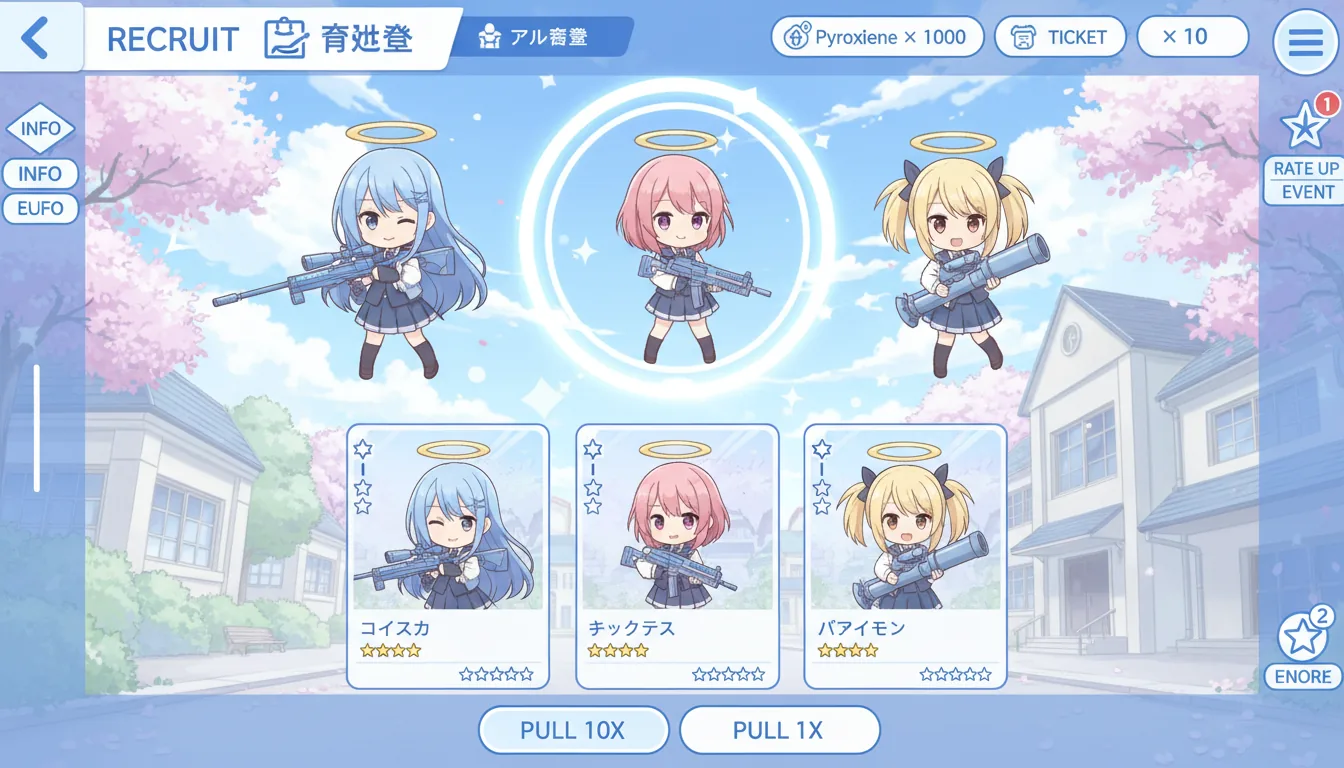
Blue Archive calls its gacha system "Recruitment," and the currency is Pyroxene — the blue crystalline gems that accumulate through gameplay. The standard exchange is 120 Pyroxene per single recruitment or 1,200 Pyroxene per 10-pull.
Pickup Recruitment (Limited and Rerun Banners)
Pickup Recruitment banners are the primary destination for Pyroxene spending. These banners feature one or two highlighted 3-star (the highest rarity in Blue Archive) students with significantly increased draw rates. Limited Pickup banners are further divided into actual "limited" students — who cannot be obtained from any other source — and "rate-up" students who appear on Pickup banners periodically but also exist in the standard pool.
The distinction matters enormously for planning. True limited students (characters marked as "Limited" in the game) can only be obtained when their specific Pickup banner is active. Missing a limited student's banner means waiting for a rerun, which can take 6–18 months in the global server. Rate-up (non-limited) students can theoretically be obtained from the standard permanent pool, though at dramatically lower rates.
Regular Recruitment (Standard Banner)
The Regular Recruitment banner is the permanent pool containing all non-limited students. It has a lower 3-star rate than Pickup banners and no featured student — every 3-star pull is random from the entire non-limited roster. This banner is generally not worth spending targeted Pyroxene on, but it has its own pity counter separate from Pickup banners.
Sparkling Recruitment (Targeted Recruitment)
The Sparkling Recruitment system is Blue Archive's most player-friendly mechanic. Every time you pull from any banner, you accumulate Recruitment Certificates. At 200 Recruitment Certificates (equivalent to 200 pulls), you can spend them in the "Sparkling Recruitment" shop to select any non-limited 3-star student directly. This functions as a hard pity system for the entire non-limited roster, giving F2P players a reliable path to obtaining specific permanent students without gambling.
Student Exchange Shop
Blue Archive also features a direct exchange shop where select students can be purchased using "Eligma" — a special currency obtained by pulling duplicate students above their maximum star level. The shop rotates its roster, and obtaining students directly this way is possible with enough Eligma accumulation, though it's a secondary resource compared to direct pulls.
Pity System: 200-Pull Hard Pity and the Spark
Blue Archive's pity system is distinctive from other major gacha games. Understanding it fully prevents the common mistake of misallocating resources across banners.
Base Rates
The base rate for pulling a 3-star student in Blue Archive is 2.5% per single pull on Pickup banners (compared to Genshin's 0.6% for 5-stars). This sounds dramatically better, but the key difference is that Blue Archive's entire 3-star roster is the "ultra-rare" tier — there are no intermediate "4-star" characters. A 3-star pull might be the specific limited character you want, or it might be a generic standard character you already have copies of. The effective rate for the specific Pickup character is much lower than the base 2.5% figure suggests.
Soft Pity Mechanics
Blue Archive has a soft pity system that begins increasing the 3-star rate around pull 80–90 of a single banner. The increase is gradual and less dramatic than Genshin's soft pity cliff at pull 74. In practice, players often hit a 3-star somewhere between pull 80 and 130 on a given banner, though variance is high due to the mechanics' structure.
Hard Pity at 200 Pulls
Blue Archive's hard pity is 200 pulls — significantly higher than Genshin (90) or HSR (90). However, this is counterbalanced by the Spark system (explained in its own section) and by the higher base 3-star rate. The 200-pull hard pity guarantees a 3-star student but does not guarantee it's the featured Pickup student — you might receive any 3-star from the banner's pool. This is an important distinction from Genshin's system, where reaching hard pity gives you a featured character (accounting for 50/50). In Blue Archive, reaching 200 pulls means you're guaranteed a 3-star, but you need to hit the Spark (separate mechanic) to choose the specific student you want.
Rate-Up Mechanics
On a Pickup banner, the featured student accounts for approximately 0.7% of the total pull rate — this means even at the soft pity threshold, the specific student you want is not guaranteed. The Spark system (200 Recruitment Certificates) is the true safety net for guaranteed acquisition of a specific student, not the pull pity alone.
Pyroxene Farming: Every Source in 2026
Pyroxene is Blue Archive's premium recruitment currency. Here are all meaningful farming sources available to consistent free players.
Daily Missions
Blue Archive's daily task system rewards Pyroxene for completing simple in-game activities — battle missions, story reading, item crafting, and more. Daily missions contribute roughly 30–40 Pyroxene per day, or approximately 900–1,200 per month. This is lower than comparable sources in Genshin or HSR, but Blue Archive compensates through other channels.
Main Story and Side Story Missions
Every new chapter of the main story and every event side story releases Pyroxene as mission completion rewards. New chapters typically grant 100–300 Pyroxene for first-time clears. In the global server, which runs several months behind the Japanese server, major story updates arrive frequently enough to maintain a steady supplementary income stream for newer players catching up on content.
Total Assault (Raids)
Total Assault is the game's weekly cooperative raid system where all players attack the same giant boss. Rankings are based on total damage dealt, and higher ranking tiers award more Pyroxene. Top-ranking players earn 600+ Pyroxene per raid cycle, while casual participants in lower tiers earn 100–300 Pyroxene. Raid performance is the most significant differentiator between optimized and casual F2P players in Blue Archive.
Crafting and Commission Missions
The Cafe system, where students spend time resting and generating Comfort points, also contributes small amounts of Pyroxene through Momo's Grocery event tasks. These are passive background tasks that require minimal attention but accumulate over time.
Events
Blue Archive runs frequent limited-time events — typically one major event per month — that provide Pyroxene through mission completion, story reading, and event-specific challenges. Events are a crucial Pyroxene source, often granting 500–1,000 Pyroxene across their full duration. The event schedule is consistent enough to be relied upon for monthly income calculations.
Monthly Pyroxene Income Analysis
Estimating Blue Archive's monthly F2P income requires accounting for the variable contribution of Total Assault (which depends heavily on roster quality) and event cycles.
- Daily Missions: ~900–1,200 Pyroxene
- Total Assault (mid-rank performance): ~400–800 Pyroxene
- Events (1–2 per month): ~500–1,000 Pyroxene
- Story and Side Story: ~100–300 Pyroxene
- Login Bonuses and Miscellaneous: ~100–200 Pyroxene
Total Monthly Range: approximately 2,000–3,500 Pyroxene. At 120 Pyroxene per pull (or 1,200 per 10-pull), this equals approximately 16–29 single pulls per month, or roughly 1.6 to 2.9 ten-pulls. Converting to Recruitment Certificates (since you earn one per pull), F2P players accumulate 16–29 Certificates per month, reaching the 200-Certificate Spark threshold in approximately 7–12 months of consistent play.
This is the most significant limitation of Blue Archive's F2P economy: the path to guaranteeing a specific student via Spark is a long-term commitment. The game rewards patient savers who pick one or two priority targets per year and commit to them, rather than players who spread resources across every appealing banner.
Spark System Explained: The 200-Pull Safety Net
The Spark system is Blue Archive's defining F2P mechanic — and understanding it correctly is the difference between a satisfying long-term experience and constant frustration.
How Recruitment Certificates Work
Every pull on any banner (Pickup or Regular) generates one Recruitment Certificate. These certificates are a permanent currency — they don't expire, don't reset between banners, and accumulate continuously across your entire play history. The 200-Certificate threshold is not per-banner; it's a global counter that climbs with every pull you make across the entire game.
The Sparkling Recruitment Shop
Once you have 200 Recruitment Certificates, you can exchange them in the Sparkling Recruitment shop for any non-limited 3-star student of your choice. This is a free choice — no randomness involved. You pick the exact student you want, confirm, and they're added to your roster. The shop's roster includes all permanent (non-limited) 3-star students in the game.
Critical Limitation: Limited Students Are Excluded
The Spark system does not include limited students. Characters that are designated "Limited" on their Pickup banner cannot be purchased from the Sparkling Recruitment shop, even with 200 Certificates. Limited students can only be obtained by pulling during their specific banner or by accumulating enough pulls on that specific banner to receive them through the banner's own pity mechanics.
This distinction fundamentally changes how players should approach limited versus permanent students. Permanent students: patience pays off, save Certificates for your favorite via Spark. Limited students: calculate whether you have enough Pyroxene to pull naturally or whether the character is important enough to dedicate your savings to during their banner window.
Strategic Use of the Spark
The optimal Spark strategy for most F2P players is to identify two or three permanent students who are both powerful and personally appealing, then use the Spark on the one you value most. Since the shop roster changes periodically, verifying that your target student is currently available in the Sparkling shop before spending 200 Certificates is essential — don't assume. The shop typically rotates to include newly released non-limited students several months after their debut.
Best Students by Role 2026
Blue Archive's meta evolves with new character releases and raid environments, but several students have established themselves as consistently excellent across a wide range of content.
Healers
Koharu is considered one of the best healers in the game. As a Healer-type student with a powerful area heal EX Skill, she provides consistent HP restoration that keeps teams alive through prolonged fights. Her value is particularly high in outdoor content (she's an Outdoor-type student, which determines her effectiveness in different mission environments). Getting Koharu to at least 3 stars (her base rarity) and investing in her Bond level improves her healing output substantially.
Shizu is a newer addition who provides targeted single-unit healing with a unique mechanic: her heals scale with the target's maximum HP, making her exceptionally effective at sustaining high-HP tank characters. She pairs excellently with students like Hoshino who intentionally take damage to activate damage-reduction mechanics.
Nodoka is a free healer obtainable through story missions and serves as an early-game option while players save for premium healers. She's not meta-defining but provides reliable healing for campaign content.
DPS / Damage Dealers
Hoshino is one of the most iconic Blue Archive characters and a genuine game-changer in raids. She's a tank-healer hybrid who intentionally allows herself to be attacked, converting incoming damage into a defense buff and gaining increased offensive output when under pressure. In Elimination content (outdoor raids), Hoshino is essentially mandatory for top-ranking teams. She's worth heavy Pyroxene investment.
Iori is a single-target burst damage dealer who excels in urban environments. Her EX Skill delivers massive damage to a single target, making her a top-tier pick for bosses with single large hitboxes. She's been in the game since launch and remains relevant despite power creep, a testament to her fundamentally strong kit design.
Aru is another consistent high-tier DPS whose fire-based attacks perform well in outdoor and elimination raid contexts. Her accessibility from early event rewards made her many players' first strong damage dealer, and she remains a solid investment in 2026.
Support / Buffers
Himari is arguably the most important support student in the entire game for 2026. Her EX Skill provides a substantial ATK buff to the entire team AND applies "Armor Break" — a debuff that dramatically reduces the target enemy's DEF stat. The combination of team buff and enemy debuff makes her presence in a raid team worth approximately 30–50% more total damage compared to not having her. If you can obtain only one support student, Himari should be the top priority for most players.
Ako is a legendary buff support who provides critical rate and critical damage bonuses to the frontmost student. She's a mainstay of explosion-damage teams (teams that maximize critical hit performance) and appears in virtually every top-ranked Total Assault team composition. Her kit is straightforward but the numbers are exceptional.
Haruna (New Year variant) provides attack speed buffs and applies healing reduction to enemies, filling a niche that few other students can. She's primarily a specialized pick for specific raid bosses rather than a universal support, but in her niche she's irreplaceable.
Reroll Guide: What to Aim For on Your First Account
Rerolling — creating a new account, clearing the tutorial to gain a cache of free pulls, pulling, and restarting if unsatisfied — is a common practice in gacha games. Blue Archive is relatively reroll-friendly because the tutorial grants enough Pyroxene for approximately 10–20 free pulls, and the account creation process is quick.
How to Reroll
Start the game, complete the mandatory tutorial (approximately 20–30 minutes), collect the tutorial Pyroxene and any login bonuses, and pull on the current Pickup banner. If you don't get a satisfying 3-star student, delete the account data and restart. Using the game's guest account feature avoids the need to create a new email for each attempt.
What Counts as a Good Reroll Result
In 2026, the target for rerolling depends on the current banner. Generally, obtaining any of the following students as part of your starter pulls constitutes a strong foundation worth keeping:
- Himari — the meta's premier universal support
- Ako — the explosion team's best buffer
- Hoshino — the Elimination raid cornerstone
- Any current limited student (if the banner is active during your tutorial window)
It's worth noting that rerolling in Blue Archive is less impactful than in some other gacha games because the Spark system and consistent Pyroxene farming allow F2P players to target specific permanent students over time. A good reroll gives you a head start, but a mediocre reroll doesn't doom your account. Many veteran Blue Archive players advise against spending more than one or two hours on rerolling and just starting with whatever the tutorial provides.
Priority Order for New Players
If you're starting fresh without rerolling, focus on the following priorities in order: complete all main story missions to unlock endgame modes, build Natasha or any free healer for early survival, participate in every Total Assault event even at low damage to earn ranked Pyroxene, and save your Pyroxene for the next appearance of Himari or Ako on a Pickup banner.
Blue Archive for Casual Players: A Lower Time Commitment Gacha
One of Blue Archive's most underappreciated qualities is its suitability for players who don't want to dedicate hours per day to a gacha game. Compared to Genshin Impact or HSR, Blue Archive's daily engagement requirement is significantly lower.
Daily Time Investment
Most daily tasks in Blue Archive can be completed in 10–15 minutes: checking the Cafe for Comfort points, running a few sweep tickets through campaign missions (which auto-clear missions you've already beaten without watching combat), collecting mission rewards, and doing the quick daily missions. The auto-combat and sweep systems mean you spend almost no time watching actual gameplay for routine daily activities.
PvP Is Optional
Blue Archive features a PvP mode called the Tactical Competition, but it's structurally optional for F2P players. The ranked PvP rewards are nice but not essential for progression, and the competitive pressure of PvP is far lower than in games where PvP-exclusive currency is gate-kept behind high ranks. Casual players can largely ignore the Tactical Competition without meaningfully harming their gacha income or character progression.
Story Accessibility
The main story missions and event stories in Blue Archive are readable as visual novel segments even before you have a team strong enough to clear the associated combat. This means players who fall behind on combat power can still enjoy the narrative — a design choice that respects the time of players who engage with the game primarily for its writing and characters.
The Sweep Ticket System
Once you've cleared a campaign mission for the first time, you can spend Sweep Tickets to instantly collect the mission's rewards without watching the combat again. This is identical to auto-repeat systems in other gacha games but is particularly well-implemented in Blue Archive because Sweep Tickets are earned in abundance. The practical effect is that daily resource farming requires almost no time — queue up your sweeps, collect the drops, done.
Blue Archive Student Priority Table 2026
| Student | Role | Rarity | Pull Priority (2026) | Notes |
|---|---|---|---|---|
| Himari | Support / Buffer | 3-star | S — Top Priority | Universal ATK buff + DEF break; works in all raid types |
| Ako | Support / Buffer | 3-star | S — Top Priority | Best Crit buffer; essential for explosion damage teams |
| Hoshino | DPS / Tank | 3-star | S — High Priority | Cornerstone of Elimination raids; unique tank-DPS hybrid |
| Koharu | Healer | 3-star | A — Strong Pick | Best area healer for outdoor content; Spark candidate |
| Iori | DPS (Single-target) | 3-star | A — Strong Pick | High single-target burst; great for boss content |
| Shizu | Healer | 3-star | A — Situational | Max-HP scaling heal; pairs best with Hoshino |
| Aru | DPS | 3-star | B — Solid | Reliable outdoor DPS; good early-game investment |
| Serika | DPS | 3-star | B — Solid | Strong urban single-target damage; accessible via Standard pool |