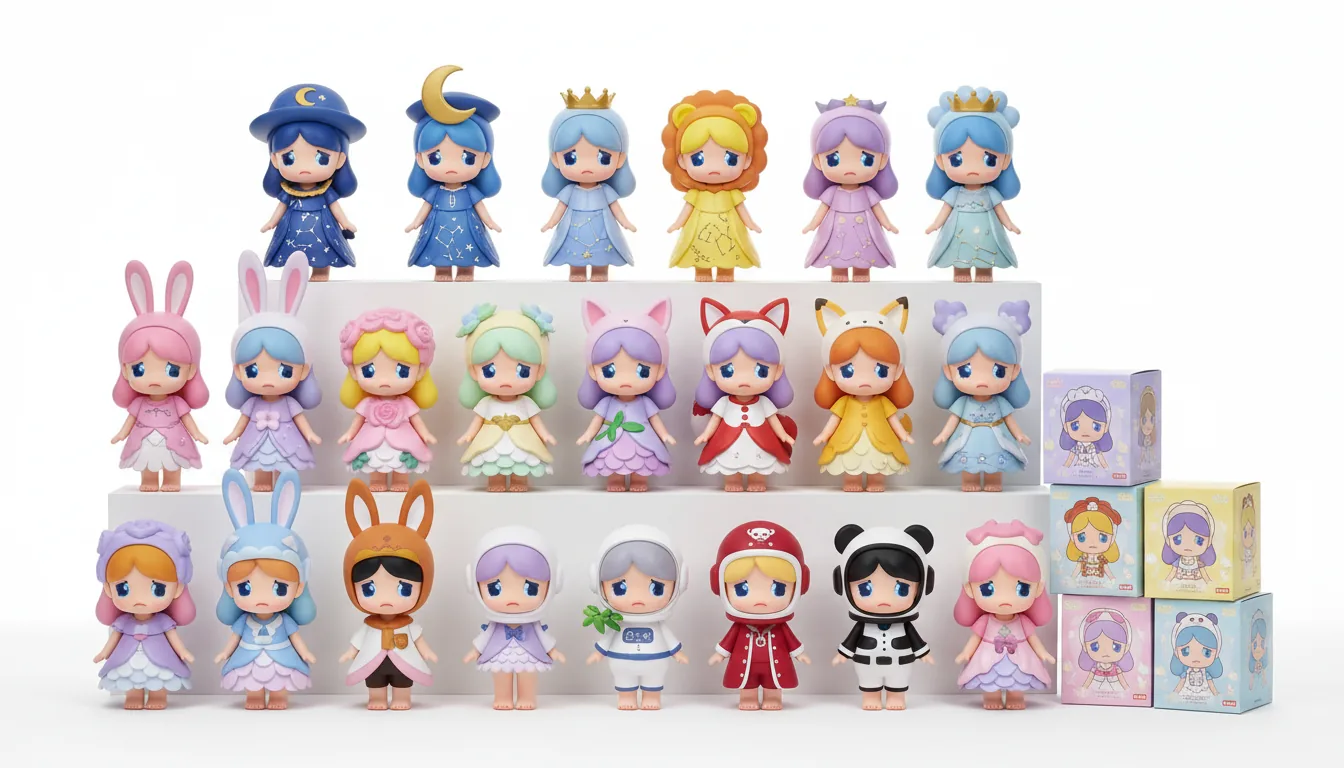
Kenny Wong and the Kennyswork Studio
Kenny Wong (王信明) is a Hong Kong-born illustrator, character designer, and the creative force behind the Kennyswork studio. Born in the 1970s and raised in Hong Kong's vibrant visual culture environment, Wong developed his artistic sensibility through formal illustration training and extensive commercial work across advertising, editorial design, and character creation before Molly — his most famous creation — brought him global recognition.
The name "Kennyswork" reflects a simple and direct personal branding choice: the studio is Kenny's work, nothing more and nothing less. This directness extends to his design philosophy. Wong is not interested in conceptual complexity or narrative mythology in the same way as, say, Kasing Lung. His approach is about emotional precision — designing characters whose visual language communicates a specific feeling with maximum efficiency and minimum ornamentation.
Kennyswork operates as both a design studio and an art practice. The commercial arm handles the Pop Mart collaboration and related licensing arrangements. The art practice produces limited edition pieces, gallery works, and collaborative projects with companies like Japan's INSTINCTOY, a premium vinyl toy manufacturer whose production values align with the higher-end collector market.
Wong's position in the global designer toy hierarchy is singular: he created the character that gave Pop Mart its foundation, its first identity, and its initial collector base. Without Molly, Pop Mart as we know it likely does not exist. This gives Kennyswork a historical importance in the blind box world that extends far beyond the commercial success of any individual series.
The Creation of Molly
Molly was born from a single emotional observation. Kenny Wong has described, in multiple interviews, the genesis of the character as his attempt to capture the feeling of a child on the verge of crying — not in the moment of tears, but in that suspended instant of held emotion before release. The face that results from this observation is Molly's entire identity: large blue eyes brimming with feeling, a slightly pursed expression suggesting emotions too complex for a small figure to contain, and an overall presence that is simultaneously childlike and strangely adult in its emotional weight.
The character was developed around 2006 (though various sources cite 2004–2008 as the creation window, with the first commercial release occurring in 2016 through Pop Mart). Wong spent years refining Molly's proportions — the specific ratio of head to body, the exact arc of the eyes, the precise thickness of the lips — before arriving at the design that became the foundation for all subsequent Molly products.
The design's deceptive simplicity is its genius. Molly has no horns, no special costume, no fantastical elements. She is a small girl with an enormous capacity for feeling, communicated through subtle facial geometry that would make a studio animation director envious. The challenge — and the achievement — was encoding maximum emotional complexity into minimum visual information. The result is a character that different viewers project different emotions onto: some see sadness, some see resilience, some see mischief, some see wisdom. This emotional openness is what makes Molly universally relatable across cultures, ages, and demographics.
The blue eyes are a deliberate design choice that created some of the character's cross-cultural resonance. Blue eyes on an Asian-designed character in Asian retail contexts read as foreign, dreamlike, and slightly otherworldly — not the eyes of anyone's neighbor, but of a figure from somewhere more liminal. This visual foreignness gave Molly an immediately unique identity in toy market contexts where dark-eyed designs are the norm.
Why Molly Became Iconic
Molly's iconicity is not accidental. Several intersecting factors combined to make her Pop Mart's defining character and one of the most recognized designer toy figures in the world.
First, the design is simple enough to be instantly recognizable and complex enough to be endlessly reinterpretable. Molly in a space suit is still immediately Molly. Molly in Zodiac-themed costume is still immediately Molly. The core design elements — those eyes, that expression, those proportions — are so distinctive that they survive any thematic overlay. This adaptability means Pop Mart can produce hundreds of different Molly series without the character ever losing her identity.
Second, the emotional resonance is genuinely universal. The held-emotion face that Molly presents is not culturally specific — it is a human expression that every person recognizes from their own experience. This gives Molly a cross-cultural accessibility that characters tied to specific cultural references (anime aesthetics, Western cartoon traditions, etc.) do not possess.
Third, Molly's blank-slate quality invited collector projection. Collectors who buy Molly figures frequently describe feeling that a particular figure "looks like how I feel today" or represents a specific moment in their emotional experience. The character becomes a mirror for the collector's own interior life, which creates attachment far deeper than aesthetic preference alone.
All Molly Series 2018–2026: Chronological Overview
Rarest Molly Figures
Molly's long production history and status as Pop Mart's flagship character mean her rarity hierarchy is more complex than most series. Understanding which pieces command the highest premiums requires knowledge of what was rare at the time of release and what has become rare through attrition and time.
First Generation Career Series (2018)
The original Career Series figures, particularly the Astronaut (which many collectors cite as their first or most-wanted Molly piece), are the de facto vintage classics of the Molly catalog. Mint condition figures from this initial series with original packaging regularly sell for $80–$250 depending on which figure and the condition of the packaging. The Secret figure from Career Series has sold for up to $400 in documented secondary market transactions.
Special Colorways and Limited Production Runs
Pop Mart has produced numerous Molly figures in limited colorways — metallic finishes, glow-in-the-dark variants, transparent vinyl editions — that were available for limited windows through specific retail channels. These are among the most aggressively sought-after pieces in the entire Molly catalog because their scarcity is structural (small production run) rather than circumstantial (series retirement).
Secret Figures Across Series
Molly Secret figures maintain consistent secondary market performance across series. The 1-in-144 Secret from popular series typically enters the secondary market at 8–15x retail, then stabilizes at 5–10x retail as supply from additional pulls reaches the market. The most valuable Molly Secrets are from early series (2018–2019) where the total production volume was smaller than current standards.
INSTINCTOY Collaboration Pieces
The highest-value Molly pieces outside of one-of-a-kind artist customs are the limited vinyl collaboration figures produced with INSTINCTOY. These figures are typically produced in editions of 200–500 pieces total, priced at $150–$500 at retail, and rapidly appreciate to $500–$3,000+ on the secondary market. The combination of Kenny Wong's design with INSTINCTOY's premium soft vinyl production represents the apex of the Molly collectible hierarchy.
Kennyswork Beyond Molly
While Molly dominates the Kennyswork commercial profile, Kenny Wong's creative output extends significantly beyond his most famous character. Understanding the full scope of his work reveals an artist with a broader vision than any single character can capture.
Wong has produced a range of other character designs that have appeared in limited vinyl form, as sticker art, in illustration projects, and through gallery exhibitions. His secondary characters tend to share Molly's emotional register — figures on the edge of feeling something, caught in moments of suspended emotional expression — but explore this territory through different visual languages and demographic contexts.
His illustration work extends into editorial and commercial contexts, where his character design sensibility informs advertising, product packaging, and visual communication projects for Hong Kong-based brands. This commercial practice keeps his design skills sharp across different output formats rather than narrowing exclusively to collector figure production.
Wong has also participated in the broader art toy community through customization events — occasions where artists paint or otherwise transform standard toy blanks into unique artworks. His customs for events like the annual "Molly Custom" exhibitions create one-of-a-kind pieces that demonstrate the range of application for his character beyond standard production colorways.
INSTINCTOY Collaboration Works
INSTINCTOY is a Japanese toy manufacturer and brand founded by Hiroto Ohkubo that occupies the premium segment of the designer toy market. Where most blind box manufacturers optimize for accessible price points and mass production efficiency, INSTINCTOY focuses exclusively on small-batch, premium-material figures aimed at serious adult collectors. Their signature material is a translucent, high-quality soft vinyl that achieves visual effects impossible to replicate in standard production PVC.
The Kennyswork x INSTINCTOY collaboration produces Molly figures in INSTINCTOY's premium format: translucent vinyl in candy-glass colorways, metallic effects, and specialized finishes that the mass-production process cannot achieve. These collaboration pieces are announced through limited channels, sell through quickly at retail, and enter an active secondary market where they are treated as prestige collector items rather than blind box speculations.
The aesthetic difference between standard Pop Mart Molly figures and INSTINCTOY collaboration pieces is immediately apparent. Where Pop Mart Molly is produced in opaque PVC with painted surface details, INSTINCTOY Molly uses translucent vinyl where color exists throughout the material itself — light passes through the figure, creating depth and luminosity impossible to achieve with surface painting. This production technique places INSTINCTOY pieces in direct conversation with fine art glass sculpture and premium art objects rather than mass-market toys.
For collectors building a serious Kennyswork collection, INSTINCTOY collaboration pieces represent the premium tier — less accessible, more expensive, but qualitatively different from anything in the Pop Mart catalog. A focused collector might have 50 Pop Mart Molly figures and 3–5 INSTINCTOY pieces, with the latter representing a disproportionate share of both emotional and financial investment.
How to Build a Molly Collection
Molly's long production history and large catalog can be overwhelming for new collectors. A strategic approach to building a collection saves money, reduces decision fatigue, and results in a more personally meaningful outcome.
Starting Point: Choose Your Focus
Rather than trying to collect all Molly series (an expensive and space-intensive endeavor), identify what draws you to the character. Are you drawn to specific themes (astronomy, art history, fashion)? A specific era (early 2018–2020 series vs current releases)? A specific format (standard blind box figures vs INSTINCTOY premium pieces)? Clarity on your focus prevents impulsive purchases that dilute your collection's coherence.
Budget Strategy
For most collectors, a combination of new-release purchasing (at retail) and selective secondary market buying works best. Buy current series at retail as they launch. Identify specific figures from older series that fill thematic gaps in your collection and purchase those as needed on secondary markets. Avoid speculative purchases of large quantities of current-series boxes unless you have a specific resale plan — the odds of pulling every figure you want are poor and the alternative cost is high.
Entry-Level Recommendations
For new Molly collectors, the best entry series are those with strong thematic coherence and active secondary market supply: the Career Series (widely available at reasonable resale prices), the current-release seasonal series (at retail prices), and any Molly series tied to a license or theme you personally connect with. Avoid immediately pursuing the most expensive vintage pieces — build familiarity with the character first.
Molly Authentication Guide
The Molly secondary market attracts counterfeiting at multiple price points. Here are the key authentication signals:
- Eye whites: The whites of Molly's eyes should be a clean, slightly warm off-white — not stark white and not cream or yellowish. Counterfeits often use paint that appears too bright white or has a slightly yellow cast under natural light.
- Tear detail: Many Molly figures include a small sculpted tear droplet on the cheek. On authentic pieces, this detail is a precise, gently rounded form with clean edges. On counterfeits, the tear is often blurry, asymmetrical, or absent entirely.
- Pupil reflection highlight: Each eye pupil on an authentic Molly has a small white highlight dot in the upper-right quadrant, applied consistently across both eyes. Counterfeits frequently misplace this highlight or omit it.
- Base markings: "POP MART," the series name, and relevant copyright text should appear molded into the base of the figure with clean, legible lettering and consistent depth across all text elements.
- Vinyl texture: Authentic Molly figures have a consistent matte texture on skin areas and a semi-gloss finish on painted costume elements. Counterfeits often use a single uniform finish across the entire figure.
- Hair detail: Molly's hair has specific sculpted detail lines indicating individual hair strands. These should be cleanly defined and consistent in depth. Counterfeit hair modeling is frequently shallower and less detailed.
The Future of Kennyswork
Kennyswork and Molly enter 2026 in a position of established strength and active evolution. Molly is no longer Pop Mart's most commercially explosive character — that distinction belongs to Labubu following the 2024 viral moment — but she remains the foundational character on whom the company built its initial identity and collector community. That historical status grants Molly a permanent relevance that newer characters cannot match.
Kenny Wong has indicated interest in expanding the Kennyswork universe beyond Molly — developing secondary characters who can carry their own series rather than always serving as supporting cast. Whether this expansion will reach the same commercial scale as Molly or serve primarily as artistic development remains to be seen.
The INSTINCTOY collaboration is expected to continue producing multiple limited releases per year, sustaining the premium collector market for Kennyswork product independent of Pop Mart's mass-market trajectory. This dual-channel strategy — mass market through Pop Mart, prestige market through INSTINCTOY — gives Kennyswork unusual resilience and allows Wong to serve different collector audiences without compromising either market.
Molly Series Reference Table
| Molly Series | Year | Figures | Secret | Retail | Market Value (Secret) |
|---|---|---|---|---|---|
| Career Series | 2018 | 12+1S | Yes | $12 | $200–$400 |
| Zodiac Series | 2018 | 12+1S | Yes | $12 | $150–$300 |
| Flowers Series | 2019 | 12+1S | Yes | $12 | $100–$250 |
| Wonderland | 2019 | 12+1S | Yes | $12 | $120–$280 |
| Painter Series | 2020 | 12+1S | Yes | $12 | $100–$200 |
| Ancient China Myths | 2021 | 12+1S | Yes | $14 | $80–$180 |
| Molly x Disney | 2022 | Special | Yes | $15 | $150–$350 |
| Fairy Tale | 2024 | 12+1S | Yes | $15 | $80–$180 |
| INSTINCTOY Collab (various) | 2020–2026 | 1–3 variants | N/A | $150–$400 | $500–$3,000 |
| 2026 Anniversary | 2026 | TBD | Yes | $15 | TBD |
Values reflect April 2026 secondary market data from eBay, StockX, and community trading reports. INSTINCTOY values vary significantly by specific edition and condition.
Why Molly Matters for the History of Blind Boxes
Molly's place in blind box history is not simply commercial. The character represents a specific argument about what designer toys can be and who they are for. Before Molly and Pop Mart's success, the dominant narrative of designer toy culture positioned the hobby as a niche interest for male collectors of anime figures and American art toys. The audience was understood to be specific, subcultural, and bounded.
Molly broke those assumptions. Her emotional register — the held feeling, the suspended moment of pre-cry expression — spoke directly to an audience that the designer toy world had largely ignored: young women who found in the character a reflection of their own complex emotional experience. This audience proved enormous, deeply engaged, and willing to spend on figures that resonated with them at an emotional rather than merely aesthetic level.
The commercial success of Molly demonstrated that the designer toy market could expand dramatically beyond its existing customer base, setting the stage for Pop Mart's global growth and for the subsequent explosion of the blind box market as a whole. In this sense, Kennyswork and Molly did not merely participate in the blind box revolution — they initiated it.