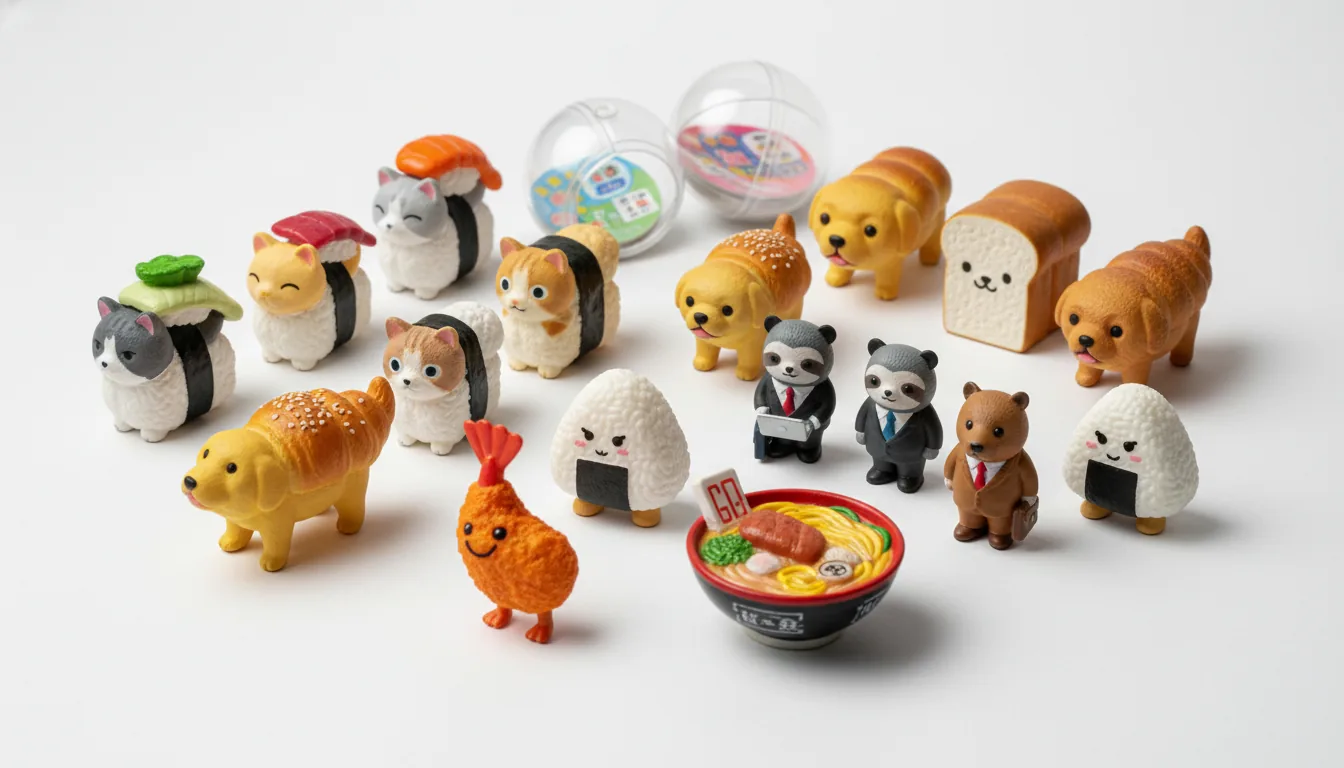
The 25 Weirdest Gashapon Series Ever Made
1. Sushi Neko (Sushi Cat) — Kitan Club, 2018–2020
Cats lying on top of pieces of sushi as if the sushi was a bed. Not cats eating sushi — cats sleeping on sushi, posed as contented as only a Japanese street cat can be. The series includes Tuna Neko (on maguro), Salmon Neko, Tamago Neko, and the rare Uni Neko (sea urchin). Each figure is approximately 5cm long and features a remarkably detailed sculpt of both the fish and the cat. Price range at machines: ¥200–¥300 (about $1.50–$2.25). Secondary market: $5–$20 per figure. Why it's weird: because this is apparently the most logical thing a cat can do on food. Available now on AliExpress, Mercari Japan, and occasionally at Western anime retailers.
2. Shiba Inu Bread (Dog Bread / Paninu) — Various, 2019–2021
Shiba Inu dogs whose fluffy bodies are replaced by bread loaves. Not wearing bread. Not next to bread. Their body is the bread, seamlessly merging dog and carbohydrate at some indeterminate anatomical boundary. The series existed in multiple iterations from different manufacturers, all building on the same deeply confusing core concept. The most popular version by Kitan Club had six variants including white bread, whole wheat, and croissant. Price range: ¥200–¥300. These photographs spectacularly well, which explains their massive social media following when released. Secondary market: $8–$25.
3. Office Worker Salaryman Crisis Figures — Kenelephant, 2017–2019
A series depicting Japanese office workers (salarymen) in various states of exhaustion and professional despair. Poses include: face-down on desk asleep, collapsed under workload paperwork, sitting in conference room with dead eyes, and the hauntingly familiar "nodding off on the train." Each 5–6cm figure is wearing a suit and expressions of profound existential fatigue. This series became a viral sensation in Japan because it accurately depicted the lived experience of millions of workers. Price: ¥300. Current secondary market: $10–$30 for the more relatable poses.
4. Mini Toilet Figures — Bandai, 2016 and multiple subsequent series
Miniature toilets. Japanese-style toilets, Western toilets, squat toilets, and deluxe bidet toilets, all in 1:18 scale with functioning hinged lids. Why do these exist? The answer is mundane: Japanese toilet culture is genuinely fascinating — Japan leads the world in toilet technology, and miniaturizing the national bathroom fixture was apparently a natural outcome. The series has been revived multiple times due to demand. Each toilet opens and closes. Some feature tiny toilet paper rolls. Price: ¥300. Current market: $5–$15. Extremely popular as gag gifts.
5. Kyushoku (School Lunch Tray) Miniatures — Re-Ment and Kitan Club, Various
Hyper-realistic miniature Japanese school lunch trays — complete with tiny milk cartons, small bowls of rice, little pieces of tamagoyaki (rolled omelette), and miniature curry portions on individual compartmented trays. The accuracy of the sculpting and painting on these 1:12 scale trays is extraordinary; food coloring, sauce application, and the specific color of Japanese school milk cartons are all correct. Deeply nostalgic for Japanese adults, deeply confusing for everyone else. Price: ¥300–¥500. Current market: $8–$30.
6. Realistic Mantis Shrimp — Colorata/Kaiyodo, 2015–2018
Not cute shrimp. Not cartoon shrimp. Biologically accurate, terrifyingly detailed mantis shrimp — the alien-looking crustaceans with club-like appendages capable of striking with the force of a bullet. Kaiyodo's figure series includes correct coloration, articulated striking appendages, and the haunting compound eyes that have made the mantis shrimp the internet's favorite bizarre creature. Multiple species are represented. Kaiyodo is known for scientific accuracy in their figure work; these are legitimately museum-quality miniatures. Price: ¥300–¥500. Current market: $15–$40 for rare species.
7. Human Ear Figures — Megahouse, 2012
Life-size (or near-life-size) hyperrealistic human ears as fridge magnets and standalone figures. Made from soft material that approximates the texture of real ear cartilage. These exist for ear anatomy education, apparently, but the actual market was people who wanted to disturb their roommates. The series includes left and right ears, multiple skin tones, and optional "earwax" detail (a detail we would prefer had not been included but here we are). Price at time of release: ¥300. Current secondary market: $20–$60 because they are so profoundly unsettling that collectors seek them specifically. Available on Mercari Japan.
8. Real-Scale Fish (Life-Size Fish Gashapon) — Bandai, 2016–2018
Soft rubber figures of common Japanese fish at 1:1 (life-size) scale — actual size replicas of a Japanese flounder, a sardine, a mackerel, and a sea bream, rendered in accurate color and detail. The concept: these were promoted as educational tools for children to learn about fish species. The reality: they're extremely realistic rubber fish that are exactly as large as actual fish, which makes them excellent for pranking people when placed in unexpected locations. A real-looking 30cm rubber flounder is genuinely difficult to distinguish from an actual flounder at a glance. Price: ¥300–¥500. Current market: $20–$50 for the larger species.
9. Cat in a Bag (Neko ni Bukuro) — Kitan Club, 2018
Cats stuffed into transparent shopping bags, as cats are known to climb into. The concept is simple, the execution is perfect: each figure shows a cat in a different position inside a plastic shopping bag, with the bag's texture accurately rendered in clear plastic and the cat's expression ranging from content to mildly surprised. The series was inspired by the genuine cat behavior of bag-obsession and became a massive seller. Price: ¥200. Current market: $5–$15. Widely available internationally.
10. Salary Man Commuting Strap Figures — Various, 2018–2020
Phone strap figures depicting salaryman commuters in the specific poses of exhausted Japanese train commuters: gripping the overhead strap with one hand, eyes closed, suit wrinkled, briefcase in the other hand. The beauty of these is the specificity — the posture of a person who has been standing in a crowded train for 40 minutes after a 10-hour workday is extremely specific, and these figures capture it perfectly. They hang from phone or bag straps, making your personal accessories into a tiny social commentary installation. Price: ¥300. Current market: $8–$20.
11. Tanuki Okimono (Tanuki Scrotum Figures) — Various Traditional Manufacturers
This requires cultural context. The tanuki (Japanese raccoon dog) is a trickster figure in Japanese folklore, and one of its traditional symbolic attributes is an improbably large scrotum — which is depicted in traditional tanuki statues outside Japanese restaurants and shops as a symbol of good fortune and wealth. Miniature gashapon versions of this traditional imagery exist, because of course they do. These are sold as good luck charms following an established centuries-old tradition, which makes them simultaneously culturally significant and extraordinarily weird by Western standards. Price: ¥200–¥300. Finding them now requires Japanese second-hand markets.
12. USB Drive Character Figures — Bandai, 2014–2016
Functional USB drives built into miniature character figures — the figure's arm, leg, or head pulls out to reveal a USB connector. Series included popular game and anime characters with 2–8GB storage. This was a genuine product innovation — combining collectible figure with functional tech accessory — executed in gashapon scale. The crossover of tech utility and figure collecting was oddly successful. Price at release: ¥500. Current collectible value: $15–$50 depending on character and storage amount, though the USB standard they use is now obsolete.
13. Mini Pantyhose Heads — Kitan Club, 2019
Soft figures depicting common fruits, vegetables, and foods squashed into pantyhose/stockings, creating the disturbing compression shapes that become visible when you put produce in mesh fabric. Think an orange squashed into nylon, creating the characteristic bulge patterns. Why do these exist? Because the internet found photos of vegetables in pantyhose amusing in approximately 2017, and Kitan Club understood their demographic. The figures are soft, squeezable, and aggressively weird. Price: ¥200. Current market: $8–$20.
14. Shoelace Tie Figures — Kitan Club and Others, 2017–2018
Gashapon figures featuring characters or animals in the act of tying their shoelaces — a seemingly mundane activity rendered in miniature form with remarkable attention to the specific awkward posture of shoe-tying. The appeal is the hyper-mundane subject matter elevated to collectible status. It's a perfect example of the "weird gashapon" philosophy: absolutely nothing is too ordinary to become a collectible if you execute it with enough craft and specificity. Price: ¥200–¥300.
15. Realistic Human Teeth (Denture) Figures — Various, 2014–2016
Miniature realistic human teeth as standalone figures and keychains. Sculpted with the same accuracy applied to the ear figures above — correct enamel color variation, accurate crown shapes for incisors vs. molars vs. canines. The intended market was dental students. The actual market was people who wanted something viscerally unpleasant to leave in their co-workers' coffee mugs. Price: ¥200–¥300. Current market: $10–$30 for complete sets.
16. Stretching Cat Yoga Poses — Kitan Club, "Neko no Yoga," 2017
Cats performing human yoga poses — downward dog (extra ironic as cats doing a dog pose), warrior one, pigeon, and the splits — rendered in 5cm PVC with the serene expression cats actually have when stretching. These are less "weird" than many entries and more "conceptually delightful." The yoga pose accuracy is genuine; these were designed with reference to actual yoga pose references. A yoga instructor friend may or may not find these as funny as you hope. Price: ¥200. Current market: $5–$12.
17. Salaryman Kintaro (Historical Hero as Office Worker) — Various, 2015
Kintaro is a beloved Japanese folkloric hero — a wild child raised in the mountains with supernatural strength, typically depicted in bright red clothing. This gashapon series reimagines Kintaro as a modern office worker: his red loincloth replaced by a red tie, his bear companion replaced by a briefcase, his mountain replaced by a cubicle. The collision of ancient folklore and corporate modernity is pure Japanese humor. Price: ¥200–¥300.
18. Cat Taiyaki (Cat-Shaped Fish Waffle) — Kitan Club, 2016
Cats shaped like taiyaki (the traditional fish-shaped Japanese waffle pastry filled with red bean paste), or perhaps taiyaki shaped like cats — the ambiguity is part of the point. The series plays on the visual similarity between a cat's curled sleeping form and the curved shape of a taiyaki fish. Each figure is a cat whose body has been baked into the taiyaki mold. This is comfort food and comfort animal merged into one soft, round, philosophically destabilizing object. Price: ¥200. Current market: $5–$15.
19. Futon Cat (Cat Sleeping in Futon) — Kitan Club, 2019
Cats tucked into tiny traditional Japanese futon bedding sets — the complete setup including the futon mattress, pillow, and blanket, with only the cat's head and perhaps a paw peeking out. The sculpting accuracy of the futon fabric patterns and stitching detail is remarkable for a $2 capsule toy. The series became extremely popular on social media because they capture the specific cozy satisfaction of a cat sleeping in exactly the spot it shouldn't. Price: ¥200–¥300. Widely available.
20. Tired Duck (Tsukare Duck) — Bandai, 2018
Rubber ducks in positions of existential exhaustion: face-down, splayed out, sitting with wings drooping, floating upside-down. The series was created during a period of high national conversation about karoshi (death from overwork) in Japan, and the tired duck resonated as mascot for exhausted workers. They became popular desk accessories and gifts. The crossover of cute bath toy aesthetic with mental health commentary is very specific to this era of Japanese pop culture. Price: ¥300. Current market: $8–$20.
21. Japanese Vending Machine Miniatures — Bandai, Takara Tomy ARTS, Various
Miniature replicas of Japanese vending machines — themselves icons of Japanese culture — accurate to specific real machine models with working doors and tiny beverage cans inside. The irony of a gashapon machine that dispenses miniature vending machines is apparently not lost on Japanese consumers, as these have sold extremely well across multiple series. Some versions light up with a battery. Price: ¥300–¥500. Current market: $10–$40 depending on machine model replica. Extremely popular internationally.
22. Human Skeleton Posable Figure — Bandai, 2017
A fully posable 10cm human skeleton with articulated joints at every anatomical point — shoulders, elbows, wrists, hips, knees, ankles, and individual vertebrae. Not a cartoon skeleton. A biologically accurate skeleton with correct bone proportions, marketed as an anatomy education tool and sold in capsule machines near medical schools. The gashapon context makes it ten times stranger than it would be in a toy store. Price: ¥500. Current market: $15–$40 for the fully posable version.
23. Ojisan Baths (Old Man Bathing) — Kitan Club, 2018
Middle-aged Japanese men (ojisan) relaxing in tiny bathtubs. Specifically, ojisan with visible belly, receding hairline, and contented expression, sitting in 4cm bathtubs with small towels on their heads. This is pure bathhouse culture encoded in miniature — the Japanese public bath (sento) is a place of relaxation and social ritual, and the ojisan relaxing in it is an archetype. The figures are soft, the ojisan look profoundly satisfied, and everything about them is the opposite of what you expect from the gashapon format. Price: ¥200–¥300.
24. Realistic Face Masks (COVID Era Figures) — Various, 2020–2021
Released during the COVID-19 pandemic, this series depicted animals and cute characters wearing miniature but realistic surgical masks — the mask itself sculpted in accurate detail with correct elastic, pleating, and nose wire. These were simultaneously commentary on the times, adorable, and deeply strange as collectible objects. A miniature Shiba Inu wearing a surgical mask while looking directly at you with full eye contact is difficult to categorize. Price: ¥200–¥300. Current market: $5–$15.
25. Ojiichan Walking Sticks (Grandfather with Cane) — Various, 2016–2017
Miniature figures of elderly Japanese grandfathers (ojiichan) in specific poses of old age: walking with cane, sitting on a park bench feeding pigeons, tending a garden, or sleeping in a chair with a newspaper. These were designed with genuine affection — the sculpting captures the dignity and warmth of Japanese grandfathers with remarkable care. In a gashapon landscape dominated by anime characters and cute animals, a tiny respectful tribute to elderly men is genuinely unexpected. Price: ¥200. Current market: $5–$20.
Why Japan Makes Weird Gashapon
The density of bizarre gashapon in Japan isn't accidental. It emerges from a specific intersection of cultural, economic, and retail factors that exist almost nowhere else.
Gift culture and the impulse buy: Japan has an extraordinarily well-developed gift-giving culture. Bringing back small, unexpected omiyage (souvenirs/gifts) from any trip is a social obligation, and gashapon fills this role perfectly. The weirder and more Japan-specific the item, the better it functions as a conversation piece and cultural export. A miniature toilet or a tired duck is the perfect gift precisely because it's inexplicable without cultural context.
Salary man humor: Japanese corporate culture is intensely pressured, and the gashapon format provides a safety valve. A series depicting office workers collapsing under workload is funny because it's true, and its $2 price point makes it accessible catharsis for the exact people it depicts. This is a specific cultural function that gashapon serves and that has no direct equivalent in Western toy markets.
Shock value as marketing: The Japanese retail and media landscape is competitive and noise-saturated. A genuinely surprising product cuts through the noise instantly — a hyperrealistic human ear goes viral on social media, generating attention that no advertising budget could buy. Weird gashapon is a content marketing strategy embedded in the product itself.
The randomness premium: Gashapon's random dispensing means you can't buy exactly what you want. You buy a series and hope. This transforms even mundane products into a gambling-adjacent experience and transforms bizarre products into legendary ones. The rarity of the "good" figure in a weird series creates collector intensity that straightforward retail never achieves.
Manufacturing economics: Japan's gashapon manufacturing infrastructure — particularly Bandai, Kitan Club, Kaiyodo, and Megahouse — can produce short print runs economically. A weird concept doesn't need to sell 100,000 units to justify production. A niche series of 10,000 units that goes viral is more valuable to a manufacturer than 100,000 units of generic anime figures that generate no attention.
How Weird Gashapon Sell: The Collector Demand for the Bizarre
Weird gashapon doesn't just sell to people who appreciate the weirdness — it sells to multiple overlapping collector demographics simultaneously.
The viral souvenir buyer purchases one of each weird series specifically to show people. The human ear. The tanuki figure. The realistic fish. These objects function as social objects — they spark conversation, provoke reactions, and serve as proof that Japan is exactly as strange as everyone says.
The completionist collector buys weird gashapon as part of a complete Kitan Club or Bandai collection. If you're collecting every Kitan Club series, the ojisan bathtub figures are part of the catalog whether or not you find them appealing in isolation.
The secondary market speculator recognizes that limited runs of genuinely bizarre series appreciate faster than character figures (which can be restocked indefinitely). A sold-out run of realistic mantis shrimp or human teeth figures becomes a finite commodity immediately upon cessation of production, driving secondary market prices up significantly.
The gift buyer specifically seeks weird. A gift that provokes a strong reaction — even confusion or mild discomfort — is more memorable than a safe gift. Weird gashapon is gifting weaponized for maximum impact.
The Economics of Weird
From a manufacturer's perspective, weird gashapon is a rational business strategy with specific economic advantages over standard character licensing deals.
Character-licensed gashapon requires royalty payments — typically 8–15% of wholesale revenue — to intellectual property holders (Bandai, Toei, Shueisha, etc.). Original concept series like Kitan Club's various cat and ojisan series require no royalty payments. This dramatically improves margins on original concept series, making them financially attractive even at lower unit volumes.
Viral marketing value is significant and difficult to quantify but real. When the human ear gashapon went viral on Japanese Twitter in 2012, Megahouse's brand visibility increased dramatically with zero marketing spend. Subsequent series from the same manufacturer benefited from the reputation as "the company that made the ear gashapon." The reputational value of viral weirdness is a genuine asset.
International collector export markets have grown dramatically. Weird, Japan-specific gashapon — items that could not have been made by any other culture — command premium prices on international secondary markets. The Japanese toilet series, realistic fish, and salaryman figures sell for 3–5× their original price on international platforms precisely because their cultural specificity makes them unavailable anywhere else. This international demand has encouraged manufacturers to produce more culturally specific (and therefore weird by outside standards) series.
Where to Find Weird Gashapon Now
Most of the series above are out of active production, but the secondary market for weird gashapon is healthy and international.
Mercari Japan (jp.mercari.com) is the primary secondary market for Japanese gashapon. Most figures can be found here, often at reasonable prices, though shipping to non-Japan addresses requires a proxy service like Buyee, Tenso, or ZenMarket. Many weird series appear here for ¥300–¥1,000 per figure.
AliExpress carries many Kitan Club series directly shipped from China, often at near-machine prices for the more popular series. Quality is identical to machine-purchased originals as they're the same factory production.
eBay has international gashapon sellers, though prices tend to be 2–3× higher than Mercari Japan for the same items. Useful for rare series without a proxy service.
Otaku USA, AmiAmi, and Big Bad Toy Store carry some Japanese gashapon series internationally, particularly from Bandai and Kitan Club, with the more mainstream weird series (cat in bags, sushi cats) sometimes in stock at $8–$15/figure.
For the rarest and most bizarre entries on this list — particularly the human ear, human teeth, and tanuki figures — dedicated Japanese secondhand market access via proxy is essentially required. These series had limited runs, no international distribution, and strong collector demand that has driven secondhand prices to 3–5× original retail.