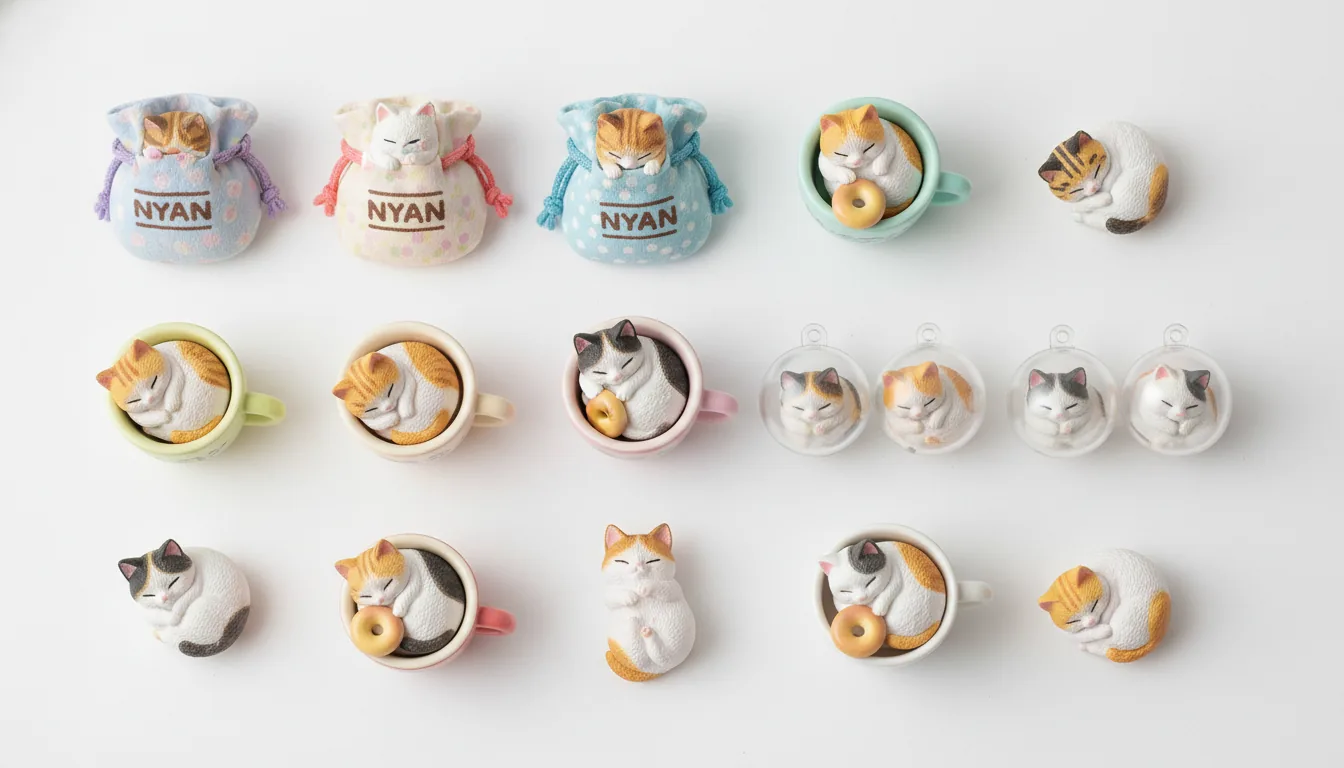
Why Cat Gashapon Dominate Capsule Toy Sales
The dominance of cat-themed gashapon in Japan and internationally is not accidental. It emerges from a specific intersection of Japanese cultural context, social media dynamics, and the unique properties of cats as subjects for small-format figure design.
Japanese Cat Culture
Japan has one of the highest densities of cat cafes in the world, a long history of cat iconography in traditional art (from Hiroshige's cat illustrations to the ubiquitous Maneki Neko lucky cat), and a specific internet culture around cats (neko) that predates Western "cat content" by several years. The Japanese term "kawaii" (cute) is arguably best exemplified by domestic cats, and the entire aesthetic category of kawaii overlaps almost completely with cat imagery.
Japanese cats — specifically the mixed-breed shorthair cats that populate urban Japan — have a specific visual character: round faces, expressive eyes, compact bodies, and a range of expression from serene to slightly annoyed that maps perfectly onto the gashapon figure format. The variety of natural cat poses (sleeping, stretching, sitting, staring, kneading) provides endless series concepts without repetition.
The Social Media Multiplier
Cat content and gashapon photography are individually among the most-shared content categories on Japanese social media. Their combination is exponentially more powerful. A photograph of a well-crafted cat gashapon in a clever context — a cat sleeping on a plate of sushi, a cat stuffed into a shopping bag, a cat contentedly tucked into a futon — reliably generates large-scale sharing on Twitter/X, Instagram, and LINE (Japan's dominant messaging platform).
This organic virality has been recognized by Kitan Club, which designs many of its cat series specifically with shareable moments in mind. The "cat on sushi" concept is photographically perfect: the scale mismatch (a cat on a human-sized sushi piece) is inherently amusing, the warm colors of sashimi contrast beautifully with cat fur colors, and the scene tells a complete story in one image. Series that generate this kind of shareable content drive their own demand through social media exposure.
Collectibility Drivers
Cat gashapon series satisfy multiple collecting motivations simultaneously. They're suitable for non-collector casual buyers (a cat in a bag is inherently appealing to almost anyone who likes cats), deeply satisfying for completionists (series of 6–8 cat poses feel achievable), and visually cohesive on a display shelf in a way that mixed-series collections rarely achieve. A shelf of nothing but Kitan Club cat series — various poses, sizes, and contexts, all consistent in aesthetic — is one of the most visually harmonious displays in gashapon collecting.
Cat Life by Kitan Club — The Foundation Series
The "Cat Life" branded series from Kitan Club represents Kitan Club's core cat identity — a recurring line of cat-themed gashapon that uses the same aesthetic vocabulary across many series. Unlike a single finite series, Cat Life is a brand umbrella under which Kitan Club releases new concepts regularly. Understanding the Cat Life family requires understanding its constituent subseries.
Cat Life Vol.1 — Basic Poses (2015)
The foundational series. Six cats in fundamental poses representing the full range of domestic cat behavior: sleeping curled up (the most universally appealing pose), sitting upright with closed eyes, mid-stretch (front legs extended, back arched), lying on back showing belly, sitting with one paw raised (the "high five" pose), and walking with tail raised. Each cat is a generic mixed-breed domestic shorthair in different colorings: orange tabby, grey tabby, calico, tuxedo (black and white), all-black, and all-white.
These are not stylized or "kawaii-exaggerated" cats — the proportions and anatomical detail are remarkably accurate. Kitan Club's reference approach for Cat Life Vol.1 involved extensive photography of actual domestic cats (documented in interviews with the design team) and sculpture that prioritized feline anatomical correctness over the tendency to make cats rounder, larger-headed, or more humanized than they actually are.
Current secondary market: $8–$15/figure. Complete set: $50–$80. Still widely available on AliExpress and occasionally restocked at retail.
Cat Life Vol.2 — Relaxation Poses (2016)
Expanding on Vol.1's pose vocabulary with more specific relaxation behaviors: the "loaf" (cat with all four paws tucked under, body forming a perfect loaf shape), the "sploot" (cat lying flat with back legs extended behind), the "meatloaf with tail around" variant, a cat sitting in a sunbeam (base simulates a light patch on floor), a cat reaching up to touch a wall, and a cat mid-yawn with eyes closed and mouth wide open.
The yawning cat is the most photographed figure from Vol.2 — the combination of eyes-closed contentment and the specific shape of a cat's open mouth during a full yawn is both accurate and almost unbearably cute. Secondary market for yawning cat specifically: $15–$25. Complete set: $55–$85.
Cat Life Vol.3 — Social Behaviors (2017)
Expanding into cat social behaviors — behaviors that require multiple cats or interaction with humans, represented through implied context: a cat sitting on a laptop keyboard (the laptop is part of the base), a cat staring into a fish tank (tank base with tiny fish visible), two kittens sleeping together (the only multi-figure release in the Cat Life base line), a cat pressing its face against glass, a cat sleeping on a pile of books, and a cat with a bird sitting on its head.
The two kittens sleeping together figure is technically a single capsule toy but contains two figures on a shared base — the only instance in the Cat Life core line. It's consistently the most sought-after piece in Vol.3 and commands a secondary market premium. Current price: $20–$35. Complete Vol.3 set: $60–$90.
Neko ni Bukuro — Cat in a Bag (Kitan Club, 2018)
The series that introduced many international collectors to Kitan Club. Neko ni Bukuro (literally "cat in a bag/sack") shows cats in various positions inside transparent shopping bags — the signature Japanese plastic bag seen at every convenience store and supermarket. Six figures, each showing a different cat in a different position within the bag:
Figure 1: Orange tabby sitting upright inside bag, looking out with standard cat expression. The bag is rendered in clear plastic with characteristic crinkle texture.
Figure 2: Grey tabby lying on its side inside the bag, legs extending against the bag wall.
Figure 3: Calico cat sitting with head emerging from the bag's open top.
Figure 4: Black cat curled into a perfect circle inside the bag, the bag's shape conforming to the cat's form.
Figure 5: Tuxedo cat in the process of climbing into a bag — mid-entry, rear legs visible outside.
Figure 6: White cat that has somehow gotten the bag handle looped over its head, looking mildly perturbed.
The transparent bag rendering is the technical highlight: the plastic bag material simulation uses a semi-transparent plastic that accurately captures the translucency and slight blue tint of Japanese shopping bags, with the cat visible but slightly distorted through the plastic — exactly as it would be in real life.
Rarity: equal probability for all 6. No chase or secret. Current prices: $3–$6/figure from AliExpress (very accessible), $5–$8 from Western retailers. Complete set: $18–$35. This is one of the best value entry points in all of Kitan Club's cat catalog — high quality, widely available, affordable.
Futon Neko — Cat in Futon (Kitan Club, 2019)
Cats tucked into traditional Japanese futon bedding, with only varying amounts of the cat visible depending on the figure. This series generated significant social media attention in Japan and was among the first Kitan Club cat series to gain widespread international following.
Figure 1: Cat fully tucked in with just head on pillow visible. Futon pattern: traditional blue geometric Japanese pattern.
Figure 2: Cat tucked in with one paw peeking out from side. Futon pattern: red and white wave pattern.
Figure 3: Cat sitting up in the futon, quilt draped over shoulders, looking suspicious. Futon pattern: brown and cream plaid.
Figure 4: Cat lying on its back in the futon, four paws in the air, quilt draped across middle only. Futon pattern: green botanical print.
Figure 5: Two cats in one futon (a double futon, slightly wider than the others), sharing the sleeping space. The rarest figure in the series due to extra manufacturing complexity. Futon pattern: pink sakura/cherry blossom.
Figure 6: Cat sitting up with futon completely off and crumpled behind — the "just woke up" cat with morning face.
The futon patterns are culturally specific Japanese textile designs — a collector with knowledge of Japanese fabric patterns will recognize the references immediately. International collectors often appreciate these as an introduction to Japanese domestic textile culture encoded in a $3 toy.
Figure 5 (two cats in shared futon) is the most sought-after in the series and the most expensive on secondary market: $15–$25. Other figures: $5–$10 each. Complete set: $35–$60.
Cup Neko — Cat in Various Cups (Kitan Club, 2017–2020)
A multi-volume series exploring the concept of cats sitting in cups, mugs, and bowl-shaped containers. The concept is rooted in real cat behavior — domestic cats compulsively sit in any container that fits them. The series expanded across three volumes:
Cup Neko Vol.1 (2017)
The original concept with 6 cats in classic ceramic mugs: coffee mug, teacup, yunomi (Japanese tea cup), glass/tumbler, espresso cup (very small cup, very compressed cat), and matcha bowl (chawan). The espresso cup figure, showing a full-size cat somehow occupying a cup designed for 60ml of liquid, captures the essential absurdity of the series perfectly. Vol.1 figures: $5–$10 each.
Cup Neko Vol.2 (2018)
Expanding the vessel vocabulary: a ramen bowl (cat curled inside with space around edges suggesting broth), a donburi rice bowl (cat sitting on rim, looking in), an ice cream sundae glass (cat perched on top looking at you), a soup cup with lid partially open and cat emerging, a sake cup, and a boba/tapioca tea cup with a straw sticking up next to the cat's head. The ramen bowl cat is the breakout piece from Vol.2 — it generated enormous social media response for the visual comedy of a cat lounging inside what should be a bowl of noodles. Vol.2 ramen cat secondary market: $12–$20. Other figures: $6–$10.
Cup Neko Vol.3 (2020)
The final expansion to plant pots and unusual containers: a terracotta flower pot, a tin watering can, a wooden Japanese sake cask (komodaru), a traditional Japanese lacquer box (jubako), a bucket, and a glass fish bowl (with tiny decorative fish also visible). The fish bowl figure is particularly beloved — it shows the cat peering into a fish bowl from the inside, reversing the expected observer relationship. Vol.3 fish bowl: $15–$22. Other figures: $6–$10.
Sushi Neko — Cats on Sushi (Kitan Club, 2018–2020)
One of the most viral cat gashapon series ever produced. Each figure shows a cat sleeping on top of a piece of sushi as if using it as a bed — the scale relationship makes the cat approximately life-size relative to the sushi, implying the sushi itself is enormous, which is part of the visual absurdity.
Vol.1 (2018, 6 figures): Maguro (tuna nigiri) — orange tabby lying lengthwise on tuna, Sake (salmon nigiri) — white cat sleeping curled on salmon, Tamago (egg nigiri) — grey tabby with one paw on the yellow egg surface, Ikura (salmon roe) — black cat sitting on the roe top, Uni (sea urchin) — calico cat nestled in the roe nesting of the uni, and Ebi (shrimp) — tuxedo cat lying with head at shrimp head end. Vol.1 complete set: $30–$50.
Vol.2 (2019, 6 figures): Expands to maki rolls: Kappa maki (cucumber roll), Tekkamaki (tuna roll), Negitoro maki, Inari (fox sushi, deep-fried tofu pouch — the rarest due to extra material complexity), Temaki (hand roll, with cat inside the cone), and California roll. The temaki cat — inside the cone-shaped hand roll like a cat in a trumpet — is the standout piece from Vol.2. Secondary market: $12–$18 for temaki specifically.
Nekomata Mythology Series
The Nekomata series represents a different artistic direction in cat gashapon — rather than cute domestic cat scenarios, these figures draw on Japanese folklore's mythological cat-demon (nekomata) tradition. Nekomata are supernatural two-tailed cats that develop magical powers with age, appearing in stories as tricksters, shape-shifters, and occasionally malevolent spirits.
Nekomata Legends Series — Kaiyodo / Multiple Manufacturers (2016–2019)
Multiple manufacturers produced nekomata-inspired figures, ranging from the explicitly supernatural (blue flames from tails, floating, with magical effects bases) to the more subtly atmospheric (an old cat with knowing eyes in a traditional Japanese room setting). Kaiyodo's version is the most artistically sophisticated, bringing their museum-quality sculpting standards to the mythological subject.
These figures appeal to collectors who appreciate Japanese folklore alongside cute aesthetics. The nekomata tradition spans from Noh theater to modern anime (various anime feature nekomata characters, most famously in Noragami and certain episodes of Spirited Away's spirit world), giving these figures both historical cultural depth and contemporary pop culture recognition.
Rarity varies by manufacturer. Kaiyodo nekomata figures are limited production and command $25–$60 secondhand. Generic nekomata capsule figures from smaller manufacturers are $8–$15.
Maneki Neko Capsule Series
The Maneki Neko (招き猫, "beckoning cat") is one of the most globally recognized symbols in Japanese culture — the cat with one paw raised, traditionally placed in shops and restaurants as a good luck talisman attracting customers and wealth. Multiple manufacturers have produced gashapon series exploring every variation of the Maneki Neko tradition.
Traditional Maneki Neko Series
Series focusing on historically accurate Maneki Neko representations across different regional styles and material traditions: the classic porcelain Maneki Neko from Tokoname (the traditional pottery capital), wooden carved versions from different craftwork traditions, fabric textile versions (nuigurumi style), and bronze patinated versions. These series are appreciated by collectors interested in Japanese craft traditions rather than simply cute cat figures.
The classic porcelain white/red/gold Maneki Neko appears in every series. Color variations have specific meanings: white with raised right paw attracts money, white with raised left paw attracts customers, black Maneki Neko wards off evil, gold attracts wealth, red attracts good health. Collectors who understand these meanings approach the series as a miniature survey of Japanese talisman culture.
Modern Crossover Maneki Neko
Later series from Bandai and others produced Maneki Neko figures in crossover formats — anime characters rendered in Maneki Neko poses and format, video game character Maneki Neko, and even Maneki Neko versions of famous paintings (Maneki Van Gogh Sunflowers cat, etc.). These are more commercially driven but enormously popular as gift items. Crossover Maneki Neko gashapon: $5–$15/figure.
Realistic Cat Breed Series
Beyond concept series, multiple manufacturers produce gashapon figures representing specific cat breeds with realistic proportions and accurate breed-characteristic coloring.
Kaiyodo "Real Cats" Series
Kaiyodo's realistic cat breed series applies their museum-quality sculpting to domestic cat breeds: Scottish Fold, Norwegian Forest Cat, Bengal, Siamese, Maine Coon, Ragdoll, Japanese Bobtail, and British Shorthair. Each figure is accurately proportioned to the breed's actual build (not uniform "cute" proportions) with breed-correct coat colors and patterns. These are the most sculptually accurate cat gashapon available — created with breed standard reference photographs and input from cat breed societies in Japan.
The Bengal figure is particularly acclaimed — the rosetted spot pattern is rendered with the correct warm orange base and darker spot definition that characterizes the breed, at a scale accuracy that standard gashapon paint techniques rarely achieve. Kaiyodo Bengal secondary market: $20–$35. Full Kaiyodo cat breed set (8 figures): $120–$180.
Yell "Neko no Kimochi" (Cat's Feelings) Breed Series
Yell Corporation's breed series takes a slightly different approach: rather than purely realistic anatomy, they combine accurate breed proportions with slightly exaggerated emotional expressiveness — a Persian with a magnificently grumpy face (accurate breed trait), a Siamese with intensely communicative eyes, a Scottish Fold with the characteristic expression of mild skepticism that owners recognize as universal to the breed. These are beloved by breed-specific cat owners for capturing the personality alongside the physical appearance.
Rarity Guide: Rarest Poses and Variants Across All Cat Series
Rarest Standard Figures (no secret/chase mechanism)
In series without explicit chase mechanics, certain figures are harder to find due to lower production allocation or higher demand:
Cup Neko Vol.3 Fish Bowl Cat: Most demanded figure in the Vol.3 set. Production equal to other figures but secondary market demand significantly higher. $15–$22.
Futon Neko Two-Cats Figure: Extra component complexity led to slightly lower production allocation. $15–$25.
Sushi Neko Inari (Fox Sushi): Extra material in the pouch sculpt required adjusted production. $12–$20.
Cat Life Vol.3 Two Kittens Sleeping: Only multi-figure piece in core Cat Life line. Consistently highest-priced standard figure in the set. $20–$35.
Chase and Secret Variants
Some cat series, particularly later Kitan Club releases, include rare color variants:
Cup Neko Vol.1 Secret — "Mystery Blend" grey-orange tabby: An undeclared color variant (not on machine display) appearing in approximately 1-in-40 capsules. Distinguished from standard orange tabby by cream-grey color blending. Secondary market: $30–$50.
Futon Neko Special Edition — Nishijin Weave Pattern: A limited production version of the Vol.1 tucked-in cat with a premium Kyoto Nishijin traditional weave pattern on the futon (rather than standard printed pattern) released as a special edition. Only distributed through select machines in Kyoto area. Secondary market: $45–$75.
Current Market Prices
| Series | Year | Figures | Single Figure | Complete Set |
|---|---|---|---|---|
| Cat Life Vol.1 | 2015 | 6 | $8–$15 | $50–$80 |
| Cat Life Vol.2 | 2016 | 6 | $8–$15 | $50–$80 |
| Cat Life Vol.3 | 2017 | 6 | $10–$20 | $60–$90 |
| Neko ni Bukuro | 2018 | 6 | $3–$8 | $18–$35 |
| Cup Neko Vol.1 | 2017 | 6 | $5–$10 | $30–$55 |
| Cup Neko Vol.2 | 2018 | 6 | $6–$12 | $35–$65 |
| Cup Neko Vol.3 | 2020 | 6 | $6–$15 | $40–$70 |
| Futon Neko | 2019 | 6 | $5–$12 | $35–$60 |
| Sushi Neko Vol.1 | 2018 | 6 | $5–$12 | $30–$55 |
| Sushi Neko Vol.2 | 2019 | 6 | $6–$15 | $35–$65 |
| Kaiyodo Real Cats | 2017–19 | 8 | $15–$35 | $120–$180 |
| Nekomata Legends | 2016–19 | Varies | $10–$30 | $60–$120 |
Buying Guide: Which Series to Start With
For a new collector beginning with cat gashapon, the buying priority depends on what aspect of cat culture appeals most:
Best entry point (budget + quality): Neko ni Bukuro (Cat in a Bag). At $3–$6/figure and $18–$35 for a complete set, it's the most accessible entry into Kitan Club's cat universe without sacrificing quality. The concept is immediately understandable, the figures are widely available, and the complete set displays beautifully as a compact group.
Best for display impact: Futon Neko. The futon textile patterns create a visually rich display that photographs beautifully. The cultural specificity (Japanese futon design vocabulary) gives these figures depth that purely cute-pose series lack. Complete set is $35–$60 and widely available on AliExpress.
Best for photography: Sushi Neko. The scale mismatch comedy and warm food color palette make this series the most reliably viral-photographable set in all of cat gashapon. If your collecting intersects with content creation, start here.
Best for serious collectors: Kaiyodo Real Cats. If you want the highest quality, most accurate, and most artistically distinguished cat gashapon, Kaiyodo's breed series is in a different category from Kitan Club's concept series. Higher price but genuinely exceptional figure quality.
Best for gift-giving: Cup Neko Vol.2 (especially the ramen bowl cat). The concept translates universally and the ramen bowl reference works as a cultural conversation starter with anyone familiar with Japanese food. Available easily on AliExpress and Amazon at gift-appropriate price points.
Complete Cat Gashapon Checklist
Track your collection across all major cat series with this comprehensive checklist. Mark each figure as M (machine pull), R (retail), or S (secondary market).
| Series | Figure | Color/Breed | Rarity |
|---|---|---|---|
| Cat Life Vol.1 | Sleeping curled | Orange tabby | Standard |
| Cat Life Vol.1 | Sitting upright | Grey tabby | Standard |
| Cat Life Vol.1 | Stretching | Calico | Standard |
| Cat Life Vol.1 | Belly up | Tuxedo | Standard |
| Cat Life Vol.1 | Paw raised | All black | Standard |
| Cat Life Vol.1 | Walking | All white | Standard |
| Cat Life Vol.2 | Loaf pose | Orange tabby | Standard |
| Cat Life Vol.2 | Sploot | Grey tabby | Standard |
| Cat Life Vol.2 | Sunbeam | Calico | Standard |
| Cat Life Vol.2 | Reaching up | Tuxedo | Standard |
| Cat Life Vol.2 | Yawning | All black | Higher demand |
| Cat Life Vol.3 | On laptop | Orange tabby | Standard |
| Cat Life Vol.3 | At fish tank | Grey tabby | Standard |
| Cat Life Vol.3 | Two kittens sleeping | Mixed | Rarest in set |
| Cat Life Vol.3 | Face against glass | Tuxedo | Standard |
| Cat Life Vol.3 | On books | Calico | Standard |
| Cat Life Vol.3 | Bird on head | All white | Standard |
| Neko ni Bukuro | Sitting in bag | Orange tabby | Standard |
| Neko ni Bukuro | Lying in bag | Grey tabby | Standard |
| Neko ni Bukuro | Head emerging | Calico | Standard |
| Neko ni Bukuro | Curled in bag | All black | Standard |
| Neko ni Bukuro | Climbing in | Tuxedo | Standard |
| Neko ni Bukuro | Handle around neck | All white | Standard |
| Futon Neko | Fully tucked in | Orange tabby | Standard |
| Futon Neko | Paw peeking out | Grey tabby | Standard |
| Futon Neko | Sitting up suspicious | All black | Standard |
| Futon Neko | On back, four paws up | Calico | Standard |
| Futon Neko | Two cats sharing | Mixed | Rarest in set |
| Futon Neko | Just woke up | Tuxedo | Standard |
| Sushi Neko Vol.1 | Maguro (tuna) | Orange tabby | Standard |
| Sushi Neko Vol.1 | Sake (salmon) | All white | Standard |
| Sushi Neko Vol.1 | Tamago (egg) | Grey tabby | Standard |
| Sushi Neko Vol.1 | Ikura (salmon roe) | All black | Standard |
| Sushi Neko Vol.1 | Uni (sea urchin) | Calico | Higher demand |
| Sushi Neko Vol.1 | Ebi (shrimp) | Tuxedo | Standard |
| Sushi Neko Vol.2 | Temaki (hand roll) | Orange tabby | Highest demand |
| Sushi Neko Vol.2 | Inari (fox sushi) | Orange calico | Rarest in set |
| Cup Neko Vol.1 | Coffee mug | Orange tabby | Standard |
| Cup Neko Vol.1 | Espresso cup | Grey tabby | Standard |
| Cup Neko Vol.1 | Matcha bowl | All white | Standard |
| Cup Neko Vol.2 | Ramen bowl | Orange tabby | Highest demand |
| Cup Neko Vol.2 | Ice cream sundae | Calico | Standard |
| Cup Neko Vol.3 | Fish bowl | All black | Rarest in set |
| Cup Neko Vol.3 | Flower pot | Grey tabby | Standard |
| Kaiyodo Real Cats | Scottish Fold | Grey fold ears | Standard |
| Kaiyodo Real Cats | Bengal | Orange rosette | Higher demand |
| Kaiyodo Real Cats | Maine Coon | Brown tabby | Standard |
| Kaiyodo Real Cats | Japanese Bobtail | Calico | Standard |
Building the Ultimate Cat Gashapon Collection
The coherence of cat gashapon collections comes from the consistent subject matter even across vastly different conceptual approaches. A shelf containing Cat Life Vol.1 realistic poses, Futon Neko sleeping cats, Sushi Neko absurdist comedy, and Kaiyodo breed figures reads as a unified collection precisely because cats are cats — the shared subject creates visual and thematic unity despite the different aesthetic approaches of each manufacturer and series.
For collectors building a cat-focused display, the recommended approach is to organize by concept rather than manufacturer: group all sleeping/resting poses together, all food-related series together, all container-series together. This creates display sections that tell stories through arrangement rather than simply organizing by date or manufacturer. The resulting display is both more visually interesting and more communicative about the range of ways gashapon artists have approached the cat subject.
A complete cat gashapon collection spanning all the major series listed in this guide represents approximately 80–100 individual figures at a total investment of $400–$700 over a typical collecting period of 12–18 months. This is one of the most achievable "complete category" goals in all of gashapon collecting — and one of the most visually rewarding when completed.