The History of Kaiyodo
Kaiyodo (海洋堂) was founded in 1964 in Osaka, Japan — not as a toy company in the conventional sense, but as a model kit shop and eventually a model production house with an obsessive commitment to sculptural accuracy. The company's founder, Teruhisa Kitahara, established a culture of craft that distinguished Kaiyodo from every competitor in the Japanese figure market before the company had produced a single mass-market product.
The name "Kaiyodo" translates roughly to "Marine Hall" or "Ocean Hall" — a somewhat unexpected name for a company whose most celebrated early work would eventually encompass dinosaurs, insects, aircraft, and anime characters. The nautical name reflects the company's Osaka origins and early specialization in maritime model subjects before expanding into the full natural history and character figure range that defines the company today.
Through the 1970s and 1980s, Kaiyodo built its reputation through a series of increasingly technically ambitious model projects, typically produced in collaboration with collectors, museums, and academic institutions. This relationship with the scientific and museum community — unusual for a toy company — gave Kaiyodo access to reference material and expert consultation that competitors simply did not have. When Kaiyodo modeled a Tyrannosaurus rex, they worked from actual fossil casts and consulted with paleontologists. When they modeled a coelacanth, they worked from specimens. This rigor is the foundation of everything the company has produced since.
The transition to capsule toys came in the 1990s as the capsule machine market expanded rapidly. Kaiyodo recognized that the capsule format offered a mass distribution channel for figures that had previously only been available to dedicated hobbyists through model shops. By applying their premium sculpting standards to capsule-format production, Kaiyodo created a category that had not previously existed: genuine art objects available for pocket-change prices from vending machines.
Why Kaiyodo Is Considered Premium
The Kaiyodo premium is real, widely acknowledged within the collector community, and rooted in specific and verifiable production differences rather than marketing positioning alone.
The starting point is the sculptors. Kaiyodo employs and commissions Japan's most technically skilled figure sculptors — artists who have, in some cases, spent decades perfecting the craft of reducing complex three-dimensional forms to miniature scale while preserving the anatomical accuracy and visual character of the original. Several Kaiyodo sculptors are household names within the Japanese hobby community, their individual signatures on a figure adding collector value comparable to an author signature on a book.
The paint applications on Kaiyodo premium lines use a greater number of individual color layers than standard capsule toy production. Where a typical capsule figure might involve 3–5 paint applications, a Kaiyodo premium piece might require 8–12 individually applied color layers, with airbrushing used to create gradients and weathering effects that factory painting processes cannot achieve at comparable quality.
Material selection also distinguishes Kaiyodo. The company uses higher-grade resins for prototype production and more carefully formulated PVC compounds for final production than the industry standard. The result is figures that are more dimensionally stable over time, less prone to color bleeding between paint zones, and better at maintaining their surface finish across temperature and humidity variations.
Notable Kaiyodo Sculptors
Takayuki Takeya, Yuji Kaida, and the broader stable of Kaiyodo's in-house and contracted sculptors represent the apex of miniature figure sculpture in Japan. Takeya's monster and creature work has influenced a generation of character designers. Kaida's natural history figures are considered definitive reference pieces by paleontologists and natural history illustrators. Collecting by sculptor — tracking which pieces are attributed to specific artists — adds a connoisseurship dimension to Kaiyodo collecting absent from most other capsule toy brands.
All Major Kaiyodo Product Lines
Revoltech
Revoltech is Kaiyodo's most famous commercial product line — highly articulated figures using the proprietary "Revoltech joint" system, a ratcheted ball joint mechanism that allows for stable, precise posing across a wide range of motion without the floppiness common in conventional articulated figures. While Revoltech figures are primarily retail-priced products rather than capsule toys, they represent Kaiyodo's engineering philosophy applied to the action figure format and are essential context for understanding the company's capabilities.
Revoltech lines have covered Evangelion, Gurren Lagann, Fist of the North Star, Transformers, Iron Man, and extensive natural history subjects including dinosaurs, sea creatures, and insects. The natural history Revoltech figures — particularly the dinosaur line — are considered the finest articulated dinosaur figures in commercial production at any price point.
Capsule Q Museum
Capsule Q Museum is the primary vehicle for Kaiyodo's natural history and cultural institution subject matter in the capsule format. Developed in conjunction with Japanese museums and the Kaiyodo Natural History partnership, this line produces scientifically accurate miniature models of specific specimens — often the actual holotype specimens or key reference individuals that define a species in academic literature.
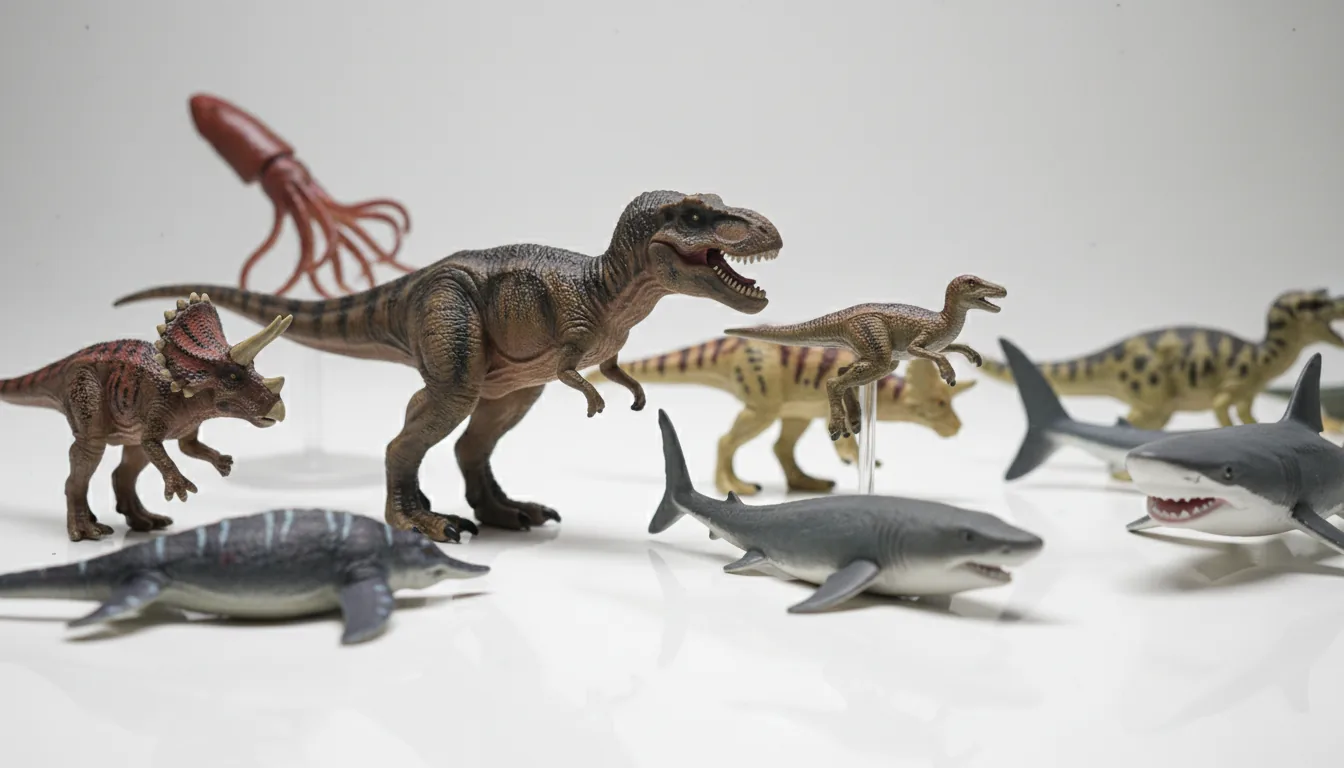
The dinosaur series within Capsule Q Museum is the most renowned. Each figure represents a specific known dinosaur species in a scientifically current pose, reflecting the paleontological understanding at the time of production. Series from the early 2000s have been superseded by scientific revisions (feathered dinosaur discoveries, stance corrections), making early Capsule Q Museum dinosaur figures historical artifacts of paleontological history as well as collector objects.
Marine life series, ancient mammal series, and insect series within Capsule Q Museum have also generated devoted collector communities, particularly among natural history enthusiasts, educators, and museum professionals who find them useful as teaching tools and display pieces at a price point accessible to institutional purchasing.
Dinotales
Dinotales was Kaiyodo's watershed product for international recognition — a series of 40+ dinosaur capsule figures produced in the early 2000s in collaboration with food manufacturer Furuta (distributed inside candy packages in Japan). The Dinotales figures are widely considered the most accurate, most detailed capsule-format dinosaur figures ever produced. Series 1–6 cover the major dinosaur taxa with remarkable completeness, and the figures include rare and obscure species alongside the famous ones — reflecting genuine curatorial decision-making rather than commercial selection criteria.
Dinotales figures became an international phenomenon, particularly in the natural history collector community outside Japan, where their combination of scientific accuracy and accessibility at low price points made them unique. Complete Dinotales series in good condition are now valuable collector items, with complete sets selling for $100–$400 depending on the specific series and condition.
Aquatales
The marine biology counterpart to Dinotales. Aquatales figures focus on ocean organisms — fish, cephalopods, marine mammals, deep-sea creatures — with the same commitment to zoological accuracy that defines the Dinotales line. Less internationally well-known than Dinotales but equally revered within the natural history collector community. Deep-sea series featuring anglerfish, giant squid, and abyssal fish are particularly sought-after for their documentation of organisms rarely depicted in commercial figure form.
Choco Egg Animal Figures
Kaiyodo's Choco Egg line — produced in collaboration with Furuta, distributed inside chocolate egg candy products similar to Kinder's format — represents the most commercially accessible entry point into Kaiyodo quality. The animal figures included in Choco Eggs are genuinely excellent miniature natural history models despite their low effective per-unit cost. Series covering Japanese wildlife, global mammals, birds, and reptiles have been produced across multiple decades. The Japanese wildlife series — featuring raccoon dogs (tanuki), Japanese serows, brown bears, and other endemic species — is particularly valued internationally as documentation of Japanese fauna in quality figure form.
Pricing and Value
Kaiyodo capsule figures at original retail are priced at ¥500–¥800 for standard releases and ¥700–¥1,200 for premium series — slightly above the Bandai standard but still firmly within mass-market capsule toy pricing. The quality premium over Bandai at comparable price points is significant and widely acknowledged by collectors who have purchased from both brands.
On the secondary market, Kaiyodo figures from popular and discontinued series appreciate significantly. Dinotales complete sets: $100–$400. Early Aquatales series: $50–$200. Capsule Q Museum dinosaur series from pre-2010 productions: $80–$300. The natural history series commands stronger appreciation than anime character series because the former appeals to a global collector base without cultural geographic restriction, while anime character licensing restricts appeal to franchise fans.
Licensing: Natural History and Museum Partnerships
Kaiyodo's relationship with museums and scientific institutions is one of its most distinctive competitive advantages. Formal partnerships with institutions like the National Museum of Nature and Science in Tokyo, the Osaka Museum of Natural History, and international natural history museums in the US and Europe give Kaiyodo access to the scientific authority that validates their accuracy claims.
These partnerships work bi-directionally: Kaiyodo produces figures that museums sell in their gift shops (providing revenue for the institution), while the institutions provide specimen access, scientific consultation, and reputational endorsement for Kaiyodo's accuracy. The relationship is genuinely symbiotic and has lasted decades in many cases.
For collectors, the museum partnership context matters because it means Kaiyodo natural history figures are as close to scientifically validated physical models as the capsule toy format allows. Educators using Kaiyodo figures as classroom teaching tools or diorama building are working with representations that have passed scientific review — a claim no other capsule toy manufacturer can make.
Where to Buy Kaiyodo
- AmiAmi: Stocks a wide range of current and recent Kaiyodo releases at Japanese MSRP plus international shipping. Pre-order system allows planning purchases months in advance.
- HobbyLink Japan: Comprehensive backlist inventory makes HLJ especially valuable for hunting discontinued Kaiyodo series. The search and filtering tools make series-specific searching efficient.
- Mandarake: Japan's premier used and vintage collectible retailer. Mandarake's online store and physical shops in Tokyo (Akihabara, Shibuya), Osaka, and Nagoya carry extensive vintage Kaiyodo inventory including Dinotales, Aquatales, and early Choco Egg series.
- Yahoo Japan Auctions (via proxy): The largest online marketplace for Japanese collectibles. Using a proxy service like Zenmarket or Buyee provides access to thousands of Kaiyodo listings at various price points, including individual figures from discontinued series at often-reasonable prices.
- eBay: International Kaiyodo availability on eBay has improved significantly as the global natural history collector community has grown. Prices are typically 1.5–3x Japanese market pricing, but the convenience of direct purchase without proxy service may justify the premium.
Investment Value of Older Kaiyodo Series
Kaiyodo's collector value proposition is fundamentally different from Pop Mart or Bandai WCF. Rather than trending-driven demand spikes driven by cultural moments or celebrity endorsements, Kaiyodo values are supported by enduring collector communities whose interest is rooted in permanent institutional factors — love of natural history, appreciation of sculptural craft, and the irreproducible accuracy of specific figures.
This means Kaiyodo values appreciate more slowly and more predictably than licensed character figures. They are less susceptible to speculative demand bubbles and less likely to collapse when a cultural trend moves on. A Dinotales Series 3 complete set bought in 2005 for ¥4,000 is worth $150–$250 today and will likely be worth $200–$350 in ten years. The growth curve is not dramatic but it is reliable.
For collectors interested in the intersection of collecting hobby and investment, Kaiyodo natural history figures represent a lower-volatility asset class within the capsule toy market. They are worth owning both for the pleasure of having excellent objects and for their stable long-term value trajectory.
Kaiyodo Product Lines Reference Table
| Product Line | Subject | Format | Retail Price | Collector Value | Best For |
|---|---|---|---|---|---|
| Revoltech | Anime / Mecha | Retail box | ¥2,000–¥5,000 | $30–$200+ | Poseable figure fans |
| Capsule Q Museum (Dino) | Paleontology | Capsule | ¥500–¥800 | $80–$300 (sets) | Natural history collectors |
| Capsule Q Museum (Marine) | Marine biology | Capsule | ¥500–¥800 | $50–$200 (sets) | Marine life enthusiasts |
| Dinotales 1–6 | Dinosaurs | Candy premium | ¥200 (w/candy) | $100–$400 (sets) | Completist collectors |
| Aquatales | Ocean life | Capsule | ¥500 | $50–$200 (sets) | Marine biology fans |
| Choco Egg Animals | Wildlife | Candy premium | ¥150–¥300 | $30–$150 (sets) | Entry level collectors |
| Capsule Q Insects | Entomology | Capsule | ¥500–¥800 | $40–$150 (sets) | Insect enthusiasts |
| Kaiyodo Figure Kompleks | Anime characters | Retail/event | ¥2,000–¥8,000 | $30–$400+ | Premium anime collectors |
Getting Started with Kaiyodo Collecting
For collectors new to Kaiyodo, the natural entry point depends entirely on your existing interests. If you have a background in natural history, science education, or museum collections, start with the Capsule Q Museum or Dinotales lines — these represent the company's most academically rigorous work and will resonate most strongly with that background.
If you are approaching Kaiyodo from an anime figure collecting background, the Figure Kompleks and various one-off character figure releases provide familiar subject matter at Kaiyodo's premium quality level. The Evangelion figures in particular — produced across multiple eras of the company's history — represent some of the finest Eva figures produced at any price point.
If budget is a primary constraint, the Choco Egg animal series provides an accessible entry point with genuine Kaiyodo quality at low effective per-figure cost. Building a complete Japanese wildlife or global mammals series from Choco Eggs is an achievable, satisfying first collection goal that introduces Kaiyodo's quality standards without requiring significant investment.
Above all, approach Kaiyodo collecting with patience and a willingness to do research. Unlike Pop Mart, where new series are heavily marketed and easy to discover, Kaiyodo's releases are often quiet, specialist-community events. The discovery pleasure of finding a Kaiyodo series that perfectly fits your interests is worth the additional research effort it requires.