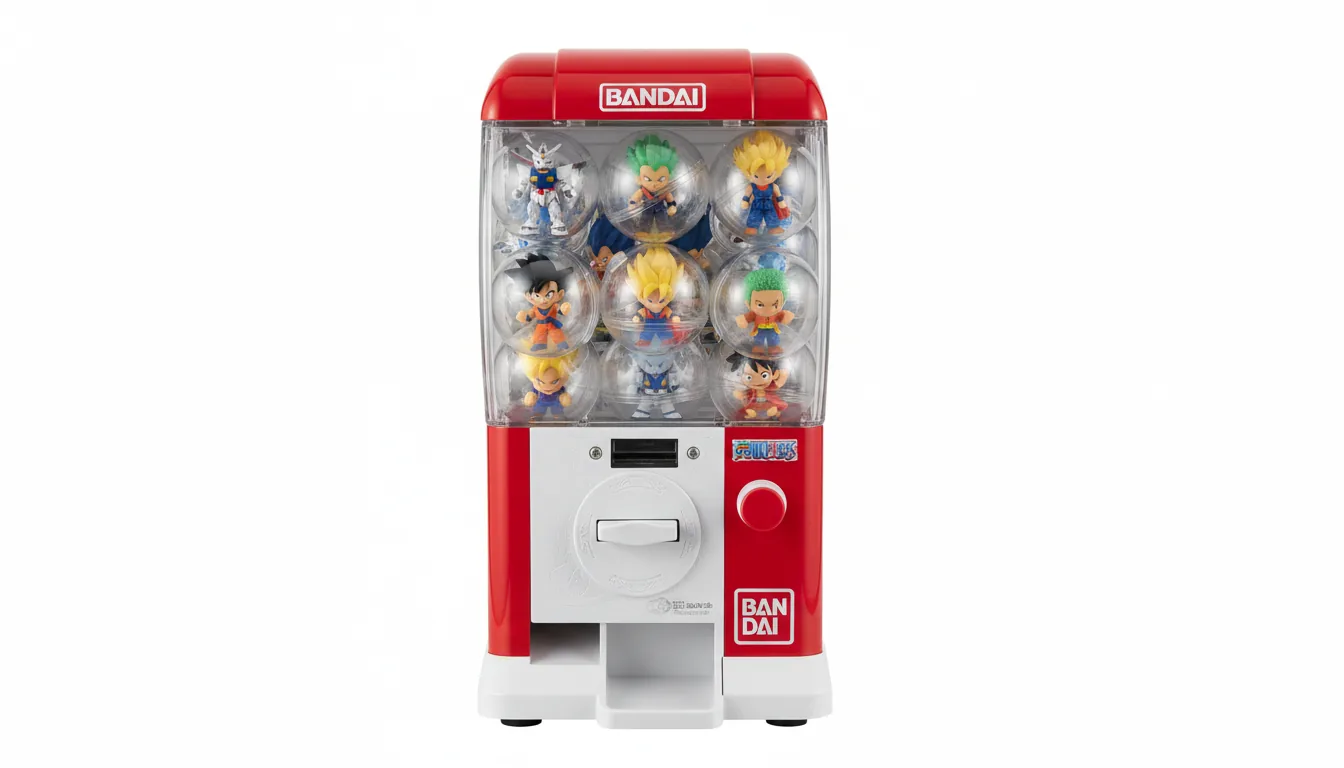
Bandai's Gashapon History
Bandai's relationship with capsule toys began in 1977, when the company introduced its first capsule vending machines to Japanese retail. The timing was significant: Japan's postwar economic miracle had created a generation of children with disposable income and parents willing to spend on novelty. The coin-operated capsule machine — insert a coin, turn the handle, receive a surprise — was perfectly calibrated for this market moment.
What distinguishes Bandai from every other company in the capsule toy space is the ownership of the name itself. "Gashapon" is a registered trademark of Bandai — the onomatopoeic word derived from the sounds of the machine operation (gasha = the handle turning, pon = the capsule dropping). While the term is widely used generically across the industry, its legal ownership by Bandai gives the company a brand authority in the space that competitors cannot match. When collectors say "gashapon," they are, technically, saying "Bandai."
The company expanded its capsule toy operation dramatically through the 1980s and 1990s as Japan's anime and tokusatsu television programming created massive licensed character demand. Bandai already held the toy licenses for Dragon Ball, Kamen Rider, Super Sentai (Power Rangers in the West), Gundam, and dozens of other major properties. Translating these licenses into capsule figure format was a natural and enormously profitable extension of the core licensing business.
Bandai's capsule toy division operated for decades under the Bandai umbrella before being reorganized. The dedicated Gashapon business unit manages retail placement of the distinctive yellow and red capsule machines — over 12,000 units operating in Japan alone as of 2026 — while coordinating the product development pipeline that releases hundreds of new series per year.
Bandai's Licensing Empire
No capsule toy manufacturer on earth holds a licensing portfolio comparable to Bandai's. The company's access to Japan's most valuable entertainment IP is structural and enduring — many of the licenses are not merely contracted but internally originated, as Bandai is both a toy company and a media company with ownership or co-ownership stakes in multiple major properties.
- Dragon Ball: Arguably the most globally recognized manga/anime franchise. Bandai holds the comprehensive toy license. Dragon Ball gashapon figures — particularly older series featuring Cell, Frieza, and the original Goku designs — are among the most actively collected vintage capsule toys.
- One Piece: Ongoing with no end in sight, One Piece maintains one of the most consistently productive gashapon pipelines in the industry. Each story arc generates new character designs and new figure series.
- Demon Slayer (Kimetsu no Yaiba): The breakout success of the early 2020s, Demon Slayer gashapon figures drove enormous demand during the series' peak cultural relevance and continue to sell strongly.
- Naruto / Boruto: Multi-generational franchise with deep catalog depth. Early Naruto gashapon figures from the early 2000s are genuine vintage pieces for adult collectors who grew up with the series.
- Gundam: Bandai literally owns Gundam, as the franchise is a Bandai creation. Gundam capsule figures benefit from the franchise's extraordinary fan loyalty and the collector culture of scale modelers who frequently crossover into capsule figure collecting.
- Kamen Rider and Super Sentai: Japanese tokusatsu (live-action special effects) franchises with 50+ year histories. Their capsule figure series are particularly popular with older Japanese collectors, creating a stable demand base for these licenses.
Major Product Lines Explained
Standard Gashapon
The original format. Plastic capsule, vending machine distribution, ¥200–¥500 price point. The foundation of the entire Bandai capsule business.
World Collectable Figures
WCF — premium non-capsule collector figures sold in blind boxes. Higher detail, slightly larger scale (7–10cm), ¥800–¥1,200 per box. The premium tier of Bandai's figure lineup.
Styling Figures
Mid-tier poseable figures with interchangeable parts. Popular with display-oriented collectors who want some customization without full model kit complexity.
Capsule Q Museum
Co-developed with Kaiyodo for natural history, architecture, and cultural institution themes. Museum-quality accuracy in capsule format.
SD Gundam Capsule
Super-deformed (SD) Gundam figures in capsule format — chibi proportions applied to mechs. Popular entry point for Gundam figure collecting.
Converge Series
Structured multi-part figures that can be combined with other Converge pieces. Appeals to the builder/customizer segment of the collector market.
World Collectable Figures (WCF) Deep Dive
WCF deserves special attention as the premium branch of Bandai's capsule figure business. Launched in the late 2000s, WCF established a new quality standard for blind-box anime figures: 7–10cm scale, fully painted with consistent detail, sold in blind packaging at a price point between standard gashapon and full retail figures.
The One Piece WCF line is the longest-running and most expansive, with volumes covering almost every major character and story arc in the franchise. Complete WCF sets from early volumes — particularly the East Blue arc characters and the Alabasta saga — are among the most sought-after collector items in the Bandai catalog, with complete sets in good condition selling for $100–$300 on secondary markets.
Rarity System
Bandai's capsule and blind box products use a distribution-based rarity system that determines how many of each figure appear in a standard case or machine fill. Understanding this system is essential for setting collecting expectations and secondary market evaluation.
Common Figures
Common figures appear at approximately equal rates across a standard machine fill or case. In a case of 12 boxes, commons typically appear 1–2 times each. These are the figures you can reasonably expect to find in normal retail purchasing and are priced accordingly on the secondary market — typically at or slightly below retail.
Rare Figures
Rare figures are seeded at lower rates — typically 1 per case or 1 per every 2 cases. These might represent popular or especially detailed characters in the series. Rare figures typically trade at 2–4x retail on secondary markets. In capsule machine context, rare figures are identified by being among the harder pulls when working through a single machine.
Super Rare / Secret Figures
Bandai's premium product lines (particularly WCF) include super rare or secret variants with much lower distribution rates — sometimes as low as 1 per every 5–10 cases. These figures are typically special colorways (metallic, transparent, exclusive color variants), exclusive characters, or combination pieces. Super rares from popular WCF series can trade at 5–20x retail.
Pricing Across Regions
Bandai gashapon pricing varies significantly across regions due to different retail contexts, import costs, and market positioning decisions.
- Japan (domestic): Standard capsule figures: ¥200–¥600 ($1.35–$4.00 USD). This is the most accessible price point globally and represents the core mass market the product line is designed for.
- Japan retail import (via proxy/forwarder): Add $1–$3 per figure in shipping and service fees, bringing effective cost to $3–$8 per figure for international buyers purchasing domestically-priced product.
- US authorized retail: Bandai America releases selected series domestically at $4–$8 per capsule-equivalent figure, reflecting import and distribution costs. Not all Japanese series receive US releases.
- US secondary market: Loose figures from desirable series: $5–$30 for commons and rares. Super rares and vintage pieces: $20–$200+.
- Import retailers (AmiAmi, HLJ): Japanese retail pricing plus international shipping — typically $2–$6 per figure in normalized shipping cost for orders of 10+ pieces.
Best Bandai Series for New Collectors
Entering the Bandai gashapon world is made easier by focusing on series with active communities, good secondary market supply, and genuine artistic merit. Here are the top ten starter series with reasoning:
- Dragon Ball WCF Vol. 1–5: Classic character designs, widely available at reasonable secondary market prices, and serve as introduction to the premium WCF format.
- One Piece WCF East Blue Arc: Iconic character designs from the series' most-loved story period. Excellent starting set for One Piece fans.
- Demon Slayer WCF Vol. 1: Contemporary appeal, excellent character selection, still relatively accessible at secondary market prices.
- Gundam Universe capsule figures: Entry-level Gundam in capsule format. Perfect for mech-curious collectors not ready to commit to Gunpla.
- Kimetsu no Yaiba Nichirin Sword Stand figures: Unique accessory-focused capsule series featuring detailed sword replicas from the series. Popular display pieces.
- Dragon Ball Ichiban Kuji lottery figures: Premium format with high production values. Entry point to Bandai's lottery figure ecosystem.
- Naruto Shippuden WCF: Large character roster, multiple volumes, great for Naruto fans building series-specific collections.
- Capsule Q Museum natural history series: Different aesthetic from anime figures — natural history models excellent for non-anime collectors or educational display contexts.
- Kamen Rider legacy capsule figures: Access to 50+ years of tokusatsu character history. Excellent gateway for vintage collector sensibility.
- My Hero Academia WCF: Contemporary franchise with active fan community and ongoing series production ensuring supply continuity.
Bandai Gashapon World Stores
Bandai operates dedicated Gashapon retail concept stores in Japan that function as tourist destinations for collectors visiting the country. These stores offer the widest selection of current and recent series in a single location, exclusive event-only releases, and the experience of operating authentic gashapon machines in themed environments.
The flagship Gashapon World store in Akihabara, Tokyo, is the largest, covering multiple floors and organized by franchise/license category, making it easy to navigate to specific properties. The Ikebukuro location (within Sunshine City) caters to the significant female collector demographic that the area's otaku culture has historically served. The Yokohama location at World Porters mall is more accessible for tourists based in the greater Tokyo area without Akihabara-level transit convenience.
Exclusive vs Standard Releases
Understanding which Bandai releases are exclusive and which are standard is critical for collecting strategy, particularly for international collectors who cannot easily access Japan-specific retail channels.
Standard releases are widely distributed through the gashapon machine network across Japan, exported through authorized importers, and available through HobbyLink Japan, AmiAmi, and similar retailers. Most Bandai collectors outside Japan access the majority of their collection through these channels.
Event exclusives are figures produced specifically for events like Wonder Festival, Tokyo Toy Show, Anime Japan, and character-specific conventions. These are sold only at the event booth, in extremely limited quantities, and almost never enter standard retail. Event exclusives command immediate secondary market premiums of 5–20x retail and can be highly challenging to authenticate given the lack of standard packaging.
Lottery figures (Ichiban Kuji): Bandai's Ichiban Kuji lottery system distributes premium figures through a convenience store and specialty retailer lottery format. Players pay a flat fee to pull a prize — ranging from a top-tier figure worth $80+ to small accessory items. The system generates enormous revenue and produces some of Bandai's most premium-quality figures, but participation is limited in practice to Japan-based buyers or those using proxy services.
Where to Buy Bandai Internationally
- AmiAmi (amiami.com): Japan's most collector-trusted online figure retailer. Regularly pre-sells new Bandai series at Japanese MSRP plus international shipping. Excellent packaging standards and reliable fulfillment.
- HobbyLink Japan (hlj.com): Long-established English-language Japanese hobby retailer with comprehensive Bandai catalog access. Good for both current and backlist inventory.
- Amazon Japan (amazon.co.jp): Can ship internationally but requires Japanese-language navigation. Broadest real-time inventory view. Use for price comparison and to identify whether a product is available before ordering through another channel.
- Bandai Namco's official shop: Bandai operates its own e-commerce in Japan. Some products are available internationally through regional subsidiaries.
- Otaku Mode: English-language Japanese merchandise retailer with curated Bandai selection and English customer support.
Bandai vs Other Manufacturers: Quality Comparison
In the capsule toy market, Bandai occupies a specific quality niche: excellent paint consistency and design accuracy at accessible price points, with production efficiencies that allow mass-market pricing without significantly compromising output quality. Where Bandai excels is in licensed character accuracy — when you buy a Dragon Ball Z Cell figure, it looks exactly like Cell. The design translation from source material to 3D figure is precise and clearly guided by thorough reference material.
Where Bandai is outperformed is in sculpting artistry and material premium. Kaiyodo's capsule figures, particularly their natural history series, achieve a level of sculptural detail and realism that Bandai does not attempt at comparable price points. Bandai's approach is optimized for character-accurate production at scale rather than artistic excellence per figure.
For collectors, this means that Bandai is the right choice when: licensed character accuracy is the priority, budget accessibility matters, and collection breadth (many different series across different licenses) is the goal. Kaiyodo or INSTINCTOY-level product is more appropriate when sculptural quality and material premium are the primary drivers.
Bandai Series Reference Table
| Series Name | License | Year | Figures | Price Range | Collector Rating |
|---|---|---|---|---|---|
| Dragon Ball WCF Vol.1 | Dragon Ball | 2010 | 8+2 rare | ¥500 / $5–$40 | ★★★★★ |
| One Piece WCF East Blue | One Piece | 2011 | 8+2 rare | ¥500 / $5–$30 | ★★★★★ |
| Demon Slayer WCF Vol.1 | KnY | 2021 | 8+1 SR | ¥500 / $6–$25 | ★★★★☆ |
| Naruto Shippuden WCF | Naruto | 2015 | 8+2 rare | ¥500 / $5–$20 | ★★★★☆ |
| Gundam Universe Capsule | Gundam | 2020 | 5+1 rare | ¥400 / $4–$15 | ★★★★☆ |
| Kimetsu Nichirin Swords | KnY | 2021 | 6 standard | ¥400 / $4–$12 | ★★★☆☆ |
| Capsule Q Museum Dinosaurs | Natural History | 2018 | 6+1 rare | ¥500 / $5–$30 | ★★★★★ |
| MHA WCF Vol.1 | My Hero Academia | 2018 | 8+1 SR | ¥500 / $5–$20 | ★★★★☆ |
| Kamen Rider Legacy | Kamen Rider | Various | 6+1 rare | ¥300 / $3–$20 | ★★★★☆ |
| Dragon Ball Ichiban Kuji | Dragon Ball | Ongoing | Lottery system | ¥1,500 / $15+ | ★★★★★ |
Building a Complete Bandai Collection
The sheer scale of Bandai's catalog makes "complete Bandai collection" a concept more aspirational than achievable. The practical collecting strategy for most enthusiasts is to define a personal canon — selecting the franchises that matter most to you personally and pursuing depth within those licenses rather than breadth across all of Bandai's output.
Depth-focused collecting generates more satisfying outcomes. Owning all 20+ volumes of One Piece WCF creates a coherent display and demonstrates genuine commitment to the source material. Owning 3 figures from 50 different series creates neither a satisfying display nor particular collector credibility.
Japan trips remain the gold standard for Bandai gashapon collecting — the domestic machine experience, the ability to find figures at ¥200–¥400 that would cost $15+ via import, and access to event-exclusive pieces not available through any other channel makes a Japan visit transformative for serious capsule toy collectors. If such a trip is possible, planning your capsule toy collecting strategy around Akihabara, Harajuku's toy shops, and Gashapon World stores will produce results that international purchasing cannot replicate.